The Underground Frequency
Totalitarian regimes mistakenly assume that cordoning off the physical world can contain the human spirit that dwells upon it. In the gray decades of the Cold War, the Soviet regime could ration bread, censor newspapers, and build concrete barriers, but it couldn’t crush the need to dance. That rhythm triggered a visceral mutiny on the airwaves while politicians traded threats of total annihilation.
While politicians traded threats of total annihilation, a visceral mutiny was happening on the airwaves. Behind the Iron Curtain, trapped youth craved a cultural revolution above all else. They wanted the sweat of the blues, the erratic freedom of jazz, and the raw, dangerous electricity of rock and roll. Music became their refuge. In a place where thinking differently could land you in a labor camp, simply dropping a needle onto a forbidden groove was a radical assertion of liberty.
Shortwave Sorcery
Before someone could buy a bootleg record, they had to catch the ghost in the machine. That meant tuning in to the forbidden frequencies of Western radio: Radio Free Europe, Radio Liberty, and the Voice of America, which beamed Western music and uncensored news into the countries of the Soviet Bloc.
Radio Free Europe, founded in 1950 and initially funded covertly by the CIA, operated as a surrogate home service for countries behind the Iron Curtain. It provided locally relevant news, analysis, cultural programming, and the music that state-controlled media suppressed. Unlike Voice of America, which presented a strictly American perspective, Radio Free Europe focused on internal events within each target country, exposing regime failures, broadcasting dissident writings, and airing jazz and rock records. These transmissions reached millions and sustained morale by offering a vivid, alternative narrative to communist propaganda.
Soviet authorities deployed extensive jamming techniques against these transmissions. They operated networks of high-power “skywave” transmitters located deep in Soviet territory that broadcast continuous noise, buzzing, howling tones, or mechanical interference on the same frequencies to drown out signals over long distances. Urban areas featured dense grids of lower-power local jammers targeting individual receivers within cities. Operators varied jamming intensity, used “spoofing” with fake programming, or shifted frequencies dynamically to frustrate persistent listeners.
Jamming proved costly, at times exceeding the budget for domestic broadcasting, and remained imperfect. Dedicated enthusiasts countered with improved antennas, hunted clearer frequencies during lulls (often at night), or listened when jamming coverage weakened. These hard-won airwaves delivered both music and ideas that official media withheld.
Soviet teens spent their nights huddled over heavy, tube-lit shortwave radios, slowly turning the dials with the precision of safecracking thieves. They filtered through the state-sponsored noise to catch a fleeting bar of Willis Conover’s jazz show or a crackling, distant broadcast of early rock and roll. Hearing a blues guitar cut through the wall of Soviet jamming proved that another world existed, that individual expression was possible, and that the state was terrified of it.
The Zhdanov Doctrine and the Battle for Soviet Culture
In the late 1940s, Soviet authorities under Andrei Zhdanov established strict rules for culture and rolled out a doctrine designed to scrub Soviet society of any Western “rot.” The Zhdanov Doctrine required that art serve the state. Music needed to remain accessible, optimistic, and free of formalist experiments or Western influences.
Jazz, with its inherent reliance on individual improvisation, was branded a capitalist infection. The regime outlawed the sound and hunted down the instruments, issuing a ban on the saxophone in state orchestras in 1949. The instrument was blacklisted from official ensembles and treated like contraband. Conservatories circulated a warning that became a dark joke among underground players: “Today you play the saxophone, tomorrow you betray the Motherland.”
This suppression backfired spectacularly. By outlawing the instrument, the regime transformed the saxophone into an intoxicating weapon of rebellion. A saxophone solo ceased to be mere entertainment; it was an act of open defiance screaming through the state’s wall around culture.
The regime’s cultural firewall began to crack. A trickle of smuggled American rock and roll in the mid-1950s soon turned into an avalanche. Young Soviets huddled around shortwave radios, capturing raw boogie-woogie frequencies. By the early 1960s, The Beatles conquered the Soviet underground entirely. The band became a fierce obsession to an entire generation. To Soviet youth, their music suggested an untamed world completely separate from state-sanctioned collectivism.
Stilyagi Subculture: The First Style Rebels
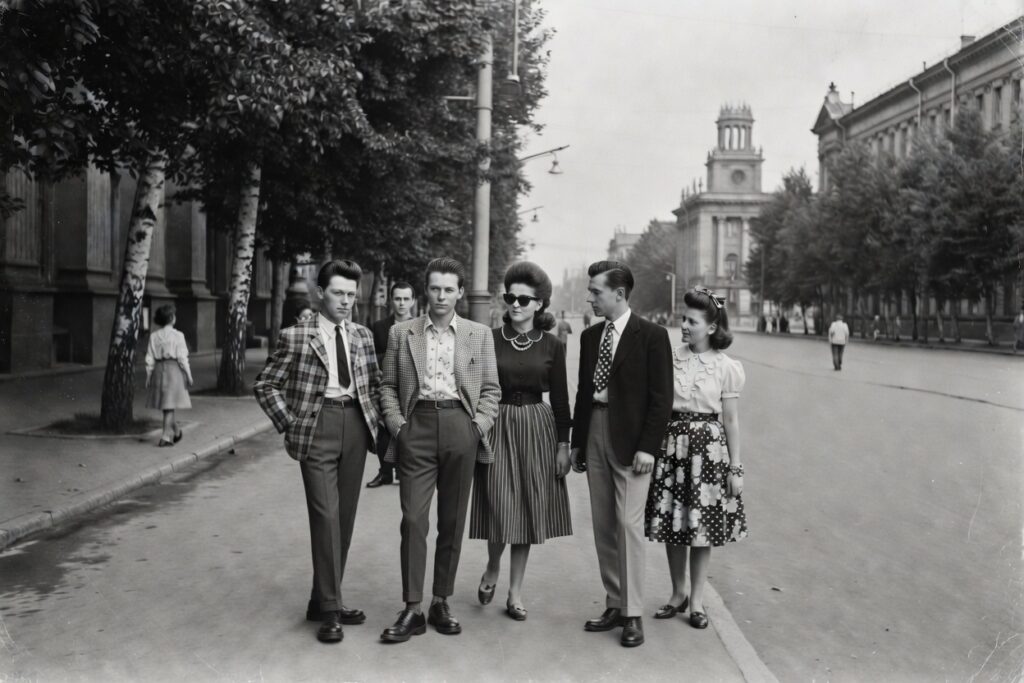
The frontline of this cultural mutiny belonged to the Stilyagi, the Style Hunters. While the state required conformity, these rebellious youth used clothing and movement to signal their defection from Soviet norms. They transformed Moscow’s Gorky Street into a vibrant runway they called ‘Broadway.’ They openly mocked the rigid, military posture expected of Soviet citizens by adopting a loose, syncopated stride that mimicked jazz rhythms. Their uniforms consisted of neon shirts, narrow trousers, thick-soled shoes, and towering pompadours. They gathered in secret to dance to early rockabilly and trade smuggled tracks.
As the 1950s closed, a more cerebral wave of rebellion emerged alongside these colorful dandies. Soviet authorities began targeting the Beatniki, an intellectual youth movement inspired by the American Beat Generation.
Where the Stilyagi used neon colors, the Beatniki were minimalists. They huddled in dim rooms wearing thick sweaters, dark glasses, and black turtlenecks. They listened to complex jazz, read smuggled poetry, and targeted the state with sharp, underground sarcasm.
The state retaliated against both groups with raw violence. Komsomol youth squads ambushed them in alleys. The state thugs destroyed the clothes of the Stilyagi with scissors and forcibly shaved their heads. They raided the rooms of the Beatniki, confiscating banned literature and labels.
This persecution only fueled the momentum. By living as if the state didn’t exist, these subcultures weaponized their own lifestyles. They proved that the totalitarian regime was an irrelevant nuisance, paving the way for the heavier rock rebellions of the decades ahead.
Bones, Skulls, and Rock and Roll: The Roentgenizdat Mutation
As the 1950s bled into the 1960s, the demand for this forbidden sonic vibe completely outpaced the supply of smuggled vinyl. Vinyl was heavy, rare, and if a border guard found a Little Richard record in someone’s suitcase, it was sure to be confiscated and that person might even do some jail time. The underground needed a workaround, and they found it in the trash heaps of Soviet hospitals.

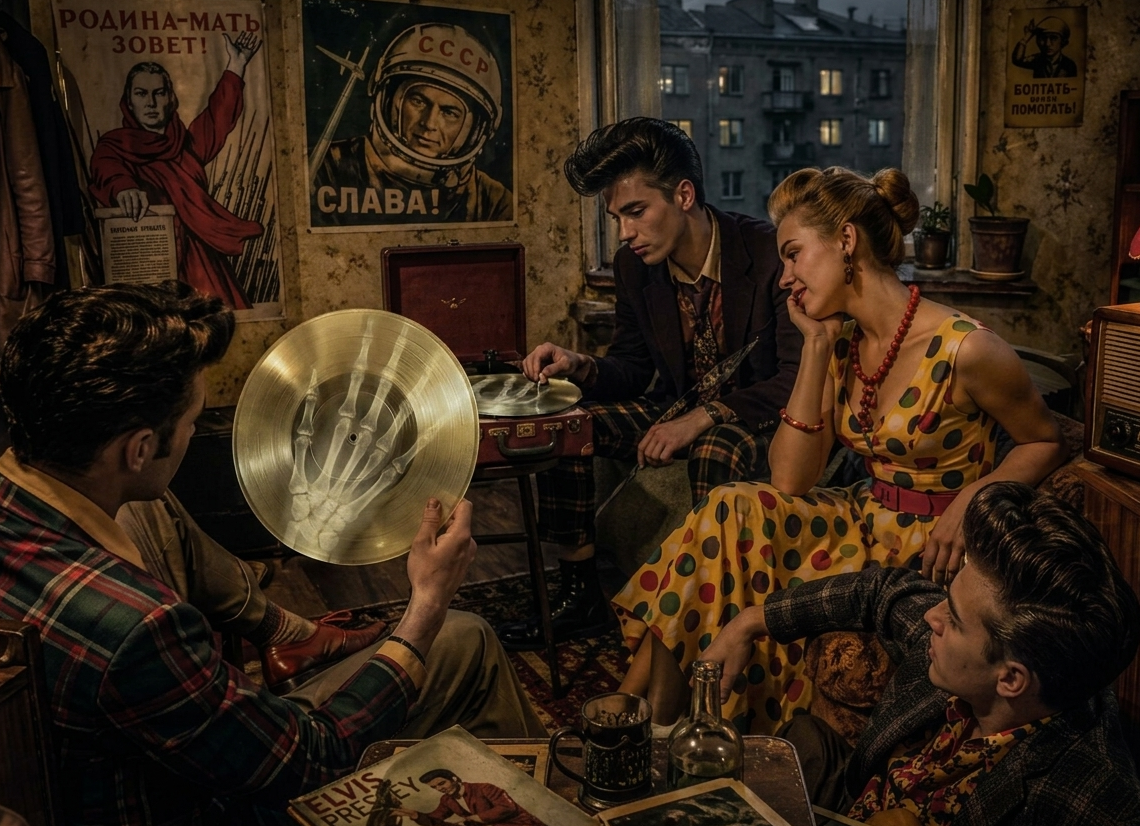
Soviet medical regulations required hospitals to discard flammable X-ray sheets after a few years. Counter-culture hustlers, known as fartsovshchiki, bought these sheets from radiology departments for pennies or traded them for black-market cigarettes. Using modified dictation machines or homemade lathes, they etched grooves into the soft plastic, cutting a center hole with a cigarette tip. They called it Roentgenizdat (X-ray publishing), or simply “Bone Music.”
Holding a Bone record up to the light was a surreal experience. One would look through the ribs of a stranger, a fractured femur, or a shattered skull, while listening to the crackling, ghostly audio of Bill Haley, Little Richard, or Muddy Waters.
The audio quality was terrible; it hissed like a frying pan and lost its fidelity after a dozen plays. But the imperfection didn’t matter; in fact, the hiss added to the myth. Listening to a blues track pressed onto the skeletal image of a Soviet citizen was a macabre irony: the state was trying to freeze human expression, but the literal bones of its people were screaming rock and roll.
The Magnetizdat Revolution: Decentralizing the Grid
By the mid-1960s, a new technology arrived that broke the state’s monopoly on sound forever: the magnetic reel-to-reel tape recorder.
A decentralized network emerged around taping, known as Magnetizdat. If a copy of a Beatles album or an underground Soviet protest singer came into a fan’s possession, it didn’t stay a single copy for long. A listener would invite a few friends over, hook two tape recorders together with homemade cables, and duplicate the reel. Those friends would go home and copy it for five more. This viral spread made it exponentially more difficult for the state to censor the music because distribution was being decentralized on the kitchen tables in millions of communal apartments. Songs spread across eleven time zones like wildfire, shifting human consciousness behind the Iron Curtain by teaching an isolated generation how to self-publish.
Up to this point, the single state-run record label, Melodiya, maintained an absolute monopoly over all official recording and distribution. Bureaucrats decided which compliant artists received pressings and meticulously shaped every release to align with rigid ideological standards. To bypass this bottleneck, Soviet rock bands began recording their own magnitoal’bomy (tape-albums) in makeshift home studios. Underground engineers like Andrei Tropillo created clandestine recording setups using scavenged factory equipment and modified consumer gear. This shadow pipeline created vast, informal libraries of raw, authentic music, allowing local artists to build massive national audiences beyond the oversight of the state.
Red Wave: The Pioneers of Soviet Underground Rock
Fed by this tape-deck network, vibrant underground rock scenes burst alive in cities like Leningrad and Moscow. Bands such as Kino, Akvarium, DDT, and Alisa established a sonic underground, playing in secret apartments or unlicensed, word-of-mouth clubs.
No discussion of this counter culture exists without Viktor Tsoi, the frontman of Kino. With his sharp, post-punk angularity, black clothes, and a baritone voice that sounded like it was pulled directly from the cold earth, Tsoi became the ultimate icon of late-Soviet youth. Rather than overtly singing about political uprisings, he fixed his sights on the raw claustrophobia of daily life: walking down empty streets, waiting for the train, and the sheer boredom of the state machine. By day, Tsoi worked as a coal shoveler in a Leningrad boiler room to avoid being arrested under Soviet “anti-parasite” laws. By night, he wrote anthems like “Peremen!” (Changes!), a driving, dark-wave track that became the unofficial soundtrack for a generation demanding a new reality.
Where Kino brought post-punk urgency, Akvarium (Aquarium), led by Boris Grebenshchikov, brought bohemian mysticism. Grebenshchikov blended Western folk-rock, Celtic melodies, and avant-garde jazz with dense, heavily coded Russian poetry. He managed to stay one step ahead of the censors by writing lyrics so metaphorical and surreal that Soviet bureaucrats couldn’t decipher exactly what he was singing about. Akvarium proved that counter-culture could subvert a monolithic system through sheer intellectual and spiritual independence.
DK: The Architects of Conceptual Sabotage
In 1980, a Moscow collective known simply as DK (ДК) systematically dismantled the aesthetic framework of Soviet sanity. Founded in 1980 by radical conceptualist and drummer Sergey Zharikov, DK existed as the ultimate underground experience in low-fi audio subversion. They rejected standard rock tropes entirely, forging a dirty art-punk sound that collided free jazz with distorted blues-rock and abrasive spoken-word theater.
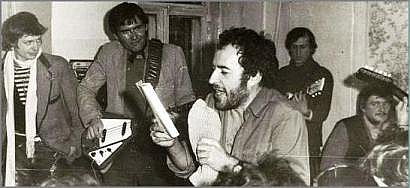
Using hacked tape recorders, DK pioneered a form of sonic collage, splicing their tracks with Soviet advertising slogans and the disembodied voices of Kremlin politicians. Their highly scandalous, deeply anti-Soviet satire targeted the core hypocrisy of the regime. Because they rarely performed live the state security apparatus found their decentralized influence impossible to pin down. DK effectively rewrote the rules of the underground, establishing a template of raw, confrontational independence that would ignite the rest of the Bloc’s punk explosion.
If Akvarium was the poetry and Kino was the pulse, Grazhdanskaya Oborona (Civil Defense, or simply GrOb) was the unfiltered radioactive waste of the Soviet punk movement. Led by the fiercely nihilistic Egor Letov, the band played dirty, lo-fi garage punk recorded on cheap consumer tape decks in Siberian apartments. Letov’s lyrics were a violent assault on both Soviet totalitarianism and the commercialism of the West.
The regime was terrified of Letov’s unhinged influence; the KGB forcibly committed him to a psychiatric hospital in a desperate attempt to break his spirit. They failed. He returned to recording immediately upon his release, cementing GrOb as the ultimate symbol of a musical movement that refused to be silenced.
The Leningrad Rock Club
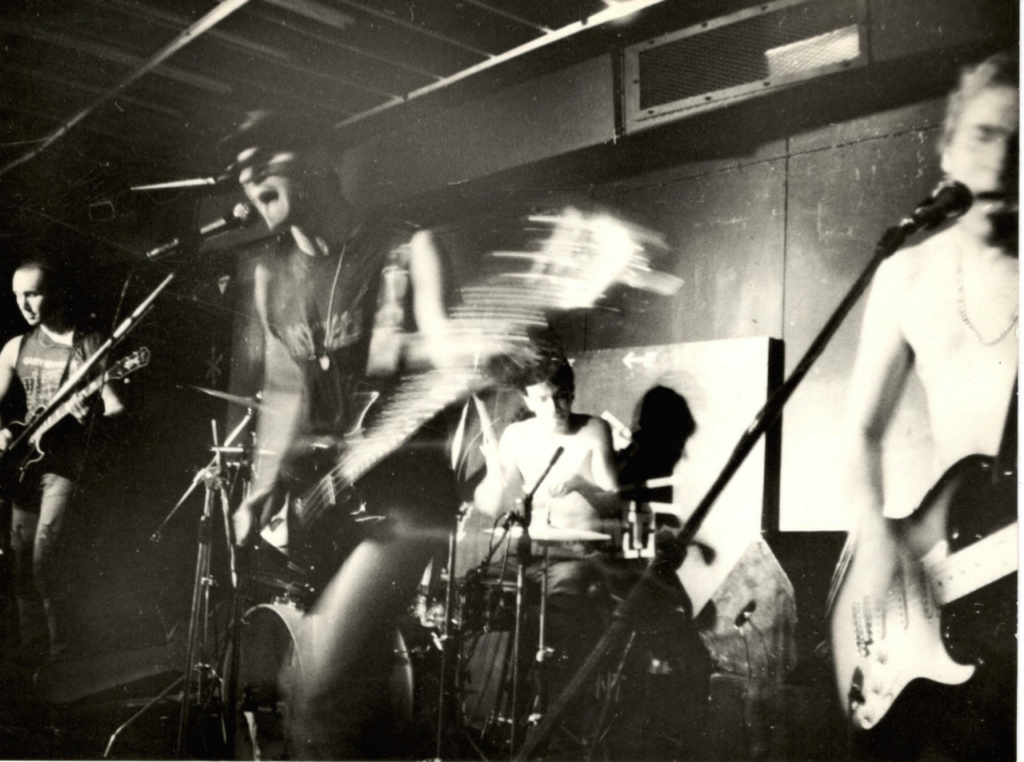
To contain this exploding, tape-fueled phenomenon, the state attempted a dangerous experiment in cultural pacification. On March 7, 1981, authorities founded the Leningrad Rock Club. Operating legally under the watchful eyes of the KGB and the Komsomol youth organization, the club was designed as a controlled pressure valve,
The compromise was explicit: bands like Kino and Akvarium received access to real stages, sound equipment, and authorized concert spaces, but they had to submit every lyric to a state review board for vetting. Secret police informants sat in the back of every show, taking notes on the crowd’s reactions. However, by providing a legal roof for the counter-culture, the regime allowed musicians to organize, refine their craft, and build a unified scene that would eventually overwhelm the censorship of the state.
The Bulgarian Sunrise: The Julaya Loophole
Nowhere was this musical transformation more profound than in Bulgaria, where Uriah Heep’s ten-minute 1971 epic “July Morning” became an annual catalyst for mass defiance. The track crossed into the country via smuggled vinyl and Yugoslav radio broadcasts, taking deep root in the consciousness of a youth starved for a connection to the global hippie movement. During the oppressive heights of the 1980s, young Bulgarians weaponized the song to create a brilliant, living tradition known as Julaya (The July Morning).
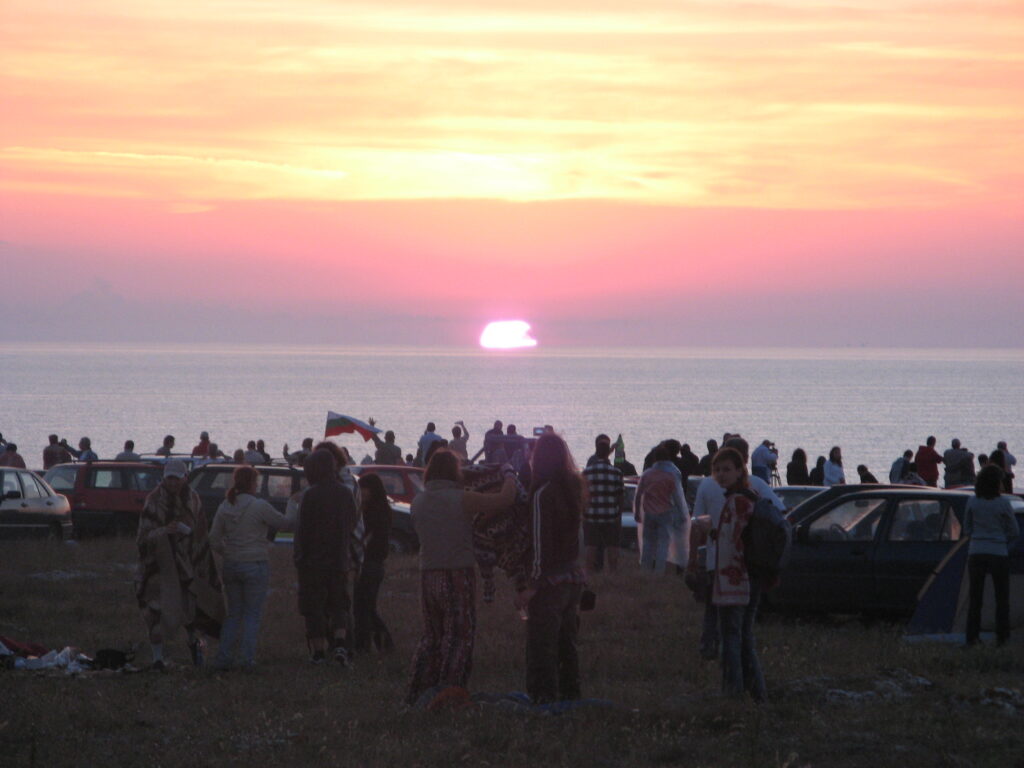
Every year on the night of June 30, thousands of teenagers and bohemian young adults came together on the rocky Black Sea coast. They gathered on the cliffs around bonfires, sharing drinks, passing acoustic guitars, and staying awake through the dark. As the sun finally cracked over the horizon on the morning of July 1, the entire crowd sang “July Morning” in unison. Because the Bulgarian communist regime ruthlessly crushed formal political rallies, Julaya served as a clever, untouchable loophole. The state police found it incredibly difficult to criminalize citizens for simply watching the sunrise. The gathering symbolized a yearning for a new beginning, a literal and spiritual turning away from the darkness of the regime. Decades later, the tradition has outlived the regime; thousands still flock to places like Kamen Bryag every summer to greet the dawn, celebrating a song that outlasted a government.
The Existential Shiver: “Child in Time”
Further north, across Poland, Czechoslovakia, and the Soviet Union, Deep Purple provided a completely different kind of existential battle cry with their 1970 epic “Child in Time.” If Uriah Heep was about the hope of the morning, Deep Purple was about surviving the night. Ian Gillan’s piercing, sirens-of-doom vocal screams and Ritchie Blackmore’s volatile, escalating guitar solo resonated deeply with a generation living under constant totalitarian surveillance and the omnipresent threat of Cold War madness.
The song’s lyrics, which dealt with the blurred lines between good and evil and the blindness of shooting at targets, operated as a direct, unflinching commentary on the absurdity of the Iron Curtain. Listening sessions in dark, cramped apartments became communal rituals. Young people sat in silence as the track built its massive crescendo, using the music as a collective emotional purge, a way to scream back at a system that demanded complete compliance.
Yugoslav New Wave: A Bridge of Influence
Yugoslavia’s relatively open socialist system and non-aligned status made it a vital cultural bridge for Eastern Bloc youth. The Yugoslav New Wave, known as Novi val, emerged in the late 1970s and early 1980s, drawing directly from British and American new wave, punk, ska, reggae, and power pop. Operating with far more creative freedom than artists in stricter Warsaw Pact countries, key acts like Azra delivered deeply poetic, socially conscious lyrics, while Idoli released the brilliant satirical track “Maljčiki,” which openly mocked the forced heroism of Soviet-style socialist realism. Bands like Električni Orgazam mutated from pure punk to psychedelic soundscapes, alongside pioneering experimental groups like Šarlo Akrobata and Pankrti, the first true Yugoslav punk outfit.
This sonic wave, including the ska-infused poetry of Haustor, Prljavo Kazalište, and Film, reached eager listeners through smuggled records, magnitizdat tapes, and radio spillover from Yugoslav stations. Their stylish aesthetics, ironic lyrics, and sharp critiques of socialist bureaucracy resonated strongly with a youth facing similar pressures. Yugoslav New Wave inspired boldness, originality, and cultural exchange across the Bloc.
Eastern Bloc Punk Scenes: Raw Rebellion
Punk arrived in the Eastern Bloc in the late 1970s and 1980s as a rawer, more confrontational form of resistance, emphasizing speed, aggression, and direct social critique at great personal risk. In Poland, punk found relatively more breathing room. The annual Jarocin Festival became a massive sanctuary for thousands of young people, where bands like Brygada Kryzys, KSU, and Dezerter delivered razor-sharp lyrics about alienation, militarism, and systemic hypocrisy. Though authorities tolerated the scene as a controlled outlet, they maintained regular harassment of musicians and fans.
In Czechoslovakia, punk faced far harsher repression. Beyond the experimental underground, groups like DG 307 and Psí Vojáci channeled raw anger and absurdity against the rigid “normalization” regime. Concerts were frequently raided by police, resulting in regular blacklisting and arrests. East Germany produced a vigorous underground punk movement despite the Stasi’s intense surveillance state. Bands like Feeling B, Die Skeptiker, and others in the East Berlin squatter scene mixed chaotic energy with anti-authoritarian messages, persisting even as the Stasi infiltrated their ranks, confiscated gear, and forced punks into mandatory military service. Meanwhile, Hungarian bands such as ETA, CPG (Coitus Punk Group), and Mos-oi embraced aggressive Oi! styles, facing immediate performance bans and police violence. In Romania and Bulgaria, severe dictatorial grip kept punk smaller and tightly shrouded in secrecy.
Eastern Bloc punk rejected polished aesthetics in favor of DIY chaos. It directly confronted conformity, militarism, and state control, transforming its very existence into a loud refusal of the system’s demand for obedience.
The Plastic People and Charter 77
In Czechoslovakia, the Plastic People of the Universe embodied uncompromising underground defiance. Formed in 1968 shortly after the Soviet-led invasion crushed the Prague Spring, the band drew inspiration from the Velvet Underground and Frank Zappa. They broke completely with state-approved aesthetics, embracing experimental, psychedelic sounds and actively rejecting socialist realism. Authorities revoked their professional license in 1970, confiscated their instruments, and banned public performances.
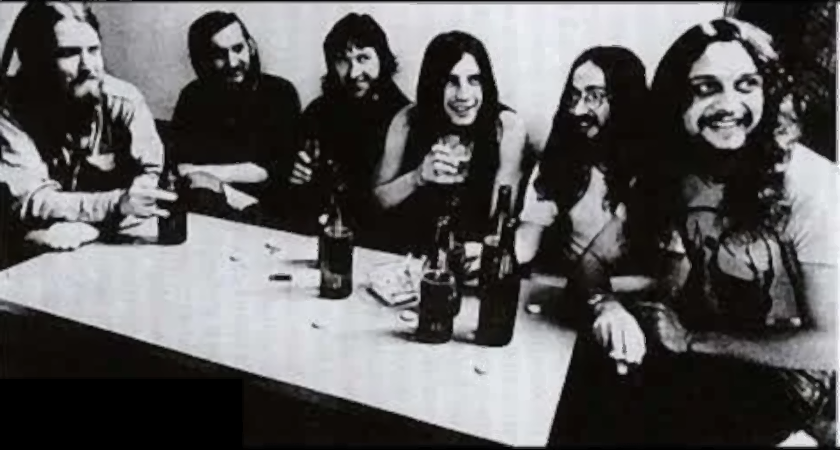
The group shifted to secret concerts disguised as private parties or academic lectures. Police routinely raided these events, subjected attendees to beatings and interrogations, and arrested members repeatedly. In 1976, following a major underground festival, authorities tried and imprisoned several members and associates for “organized disturbance of the peace,” issuing sentences ranging from eight to eighteen months.
The persecution of the Plastic People directly catalyzed the Charter 77 human rights movement. On January 1, 1977, a group of intellectuals and artists, including Václav Havel, issued the Charter 77 manifesto. The document welcomed Czechoslovakia’s ratification of the International Covenants on Civil and Political Rights and on Economic, Social and Cultural Rights, along with the Helsinki Final Act. It then sharply criticized the regime for restricting these obligations in practice, noting that basic human rights existed only on paper—including freedom of expression, protections against arbitrary interference in private life, and freedom from discrimination based on dissenting views.
The manifesto described Charter 77 as a loose, informal, and open association of people of various opinions, faiths, and professions. It operated without rules, permanent bodies, or formal membership, focusing its energy on conducting a constructive dialogue with the state by documenting violations, suggesting remedies, and defending human dignity. It began with 243 signatures and eventually grew to over 1,000.
Though framed as a civic and humanitarian initiative, Charter 77 faced intense repression. Signatories endured harassment, job loss, surveillance, and imprisonment. Even under state pressure, the document became a unifying force for dissidents, linked cultural resistance with broader demands for human rights, and laid the crucial groundwork for the 1989 Velvet Revolution. Across the Eastern Bloc, from Czech basements to Polish festivals like Jarocin, rock music served as a shared, visceral language of survival.
Post-1989 Reflections
Following the fall of the Berlin Wall and the dissolution of the Soviet Union, the musicians and fans who lived through this era stepped into entirely new realities. Viktor Tsoi and Kino became permanent cultural heroes across the former Soviet Union, celebrated through murals, monuments, and annual tributes.
Many underground figures transitioned into mainstream stardom or assumed influential roles in the new cultural landscape. The habits of independent thought and creative resistance, forged in apartment concerts and magnitizdat tapes, left a lasting mark on post-communist society. Rock and roll successfully shaped the values of openness and self-expression that defined a generation coming of age in freedom.
Don’t let the conversation stop here. We’re tearing down the walls and continuing the debate over on Blue Sky – @thebohemianstar.com. If you’re still lingering in the old spaces, you can also join our private inner circle over at The Bohemian Star Salon on Facebook to talk rock mythology, occult history, and alternative realities with the rest of the crew.
Bibliography
- Coates, Stephen. X-Ray Audio: The Strange History of Soviet Music on the Bone. London: Strange Attractor Press, 2015.
- Cushman, Thomas. Notes from Underground: Rock Music Counterculture in Russia. Albany: State University of New York Press, 1995.
- Egorov, Boris. “How the Soviet ‘Hipsters’ of the 1950s Fought for Their Right to Party.” Russia Beyond, October 14, 2021. rbth.com.
- Frumkin, Vladimir. “The Subversive Tape Recorder: How Magnitizdat Changed Soviet Conscience.” Journal of Popular Culture Studies 14, no. 2 (Fall 1989): 112–128.
- Fürst, Juliane. Stalin’s Last Generation: Soviet Post-War Youth and the Emergence of Mature Socialism. Oxford: Oxford University Press, 2010.
- Glazer, Jonathan. “Shortwave Sorcery: The BBC and Voice of America Behind the Iron Curtain.” Cold War Broadcast Studies Quarterly 8, no. 3 (Spring 2014): 45–61.
- Gorbachev, Mikhail. Perestroika: New Thinking for Our Country and the World. New York: Harper & Row, 1987.
- Meduza. “The Leningrad Rock Club Turns 40: Listen to the Legendary Russian Bands That Got Their Start at the Soviet Union’s First Legal Rock Venue.” Published March 8, 2021. meduza.io.
- Ramet, Sabrina Petra, ed. Rocking the State: Rock Music and Politics in Eastern Europe and Russia. Boulder: Westview Press, 1994.
- Ryback, Timothy W. Rock Around the Bloc: A History of Rock Music in Eastern Europe and the Soviet Union, 1954-1988. New York: Oxford University Press, 1990. [1]
- Stingray, Joanna. Red Wave: An American in the Soviet Music Underground. London: Manship Press, 2020.
- Troitsky, Artemy. Back in the USSR: The True Story of Rock in Russia. London: Faber and Faber, 1987.
- Tsipursky, Gleb. Socialist Fun: Youth Culture and Western Technology in the Soviet Union, 1945-1970. Pittsburgh: University of Pittsburgh Press, 2016.
- Volkov, Solomon. The Magical Chorus: A History of Russian Culture from Tolstoy to Solzhenitsyn. New York: Alfred A. Knopf, 2008.
- Yurchak, Alexei. Everything Was Forever, Until It Was No More: The Last Soviet Generation. Princeton: Princeton University Press, 2005.
- Zhdanov, Andrei. “Report on the Journals ‘Zvezda’ and ‘Leningrad’.” Soviet State Cultural Decree, Central Committee of the Communist Party of the Soviet Union, 1946. Soviet History Archive Collection.
Discover more from The Bohemian Star
Subscribe to get the latest posts sent to your email.