Where myth, magic, and cultural imagination collide. From Philip K. Dick’s Gnosticism to government occult experiments, esoteric philosophers, and symbolic languages, this section explores the strange undercurrents that continue to shape belief and art.
You’ve heard it: without God, morality collapses into chaos. But history tells a different story. Long before Christianity, ancient civilizations—from Mesopotamia’s codes to Egypt’s Ma’at and Greek philosophy—crafted ethical systems rooted in fairness, harm avoidance, and social survival. Across continents, humans converged on shared norms: don’t kill, don’t steal, don’t exploit. These weren’t divine revelations but emergent human solutions, refined by empathy, reason, and experience. Morality evolves—confronting outdated controls on sexuality, slavery, and power—proving it’s a living project, not a fixed decree. In a world of interpretation and consequence, the real question isn’t divine absence, but our shared responsibility to keep building better ways to live together.
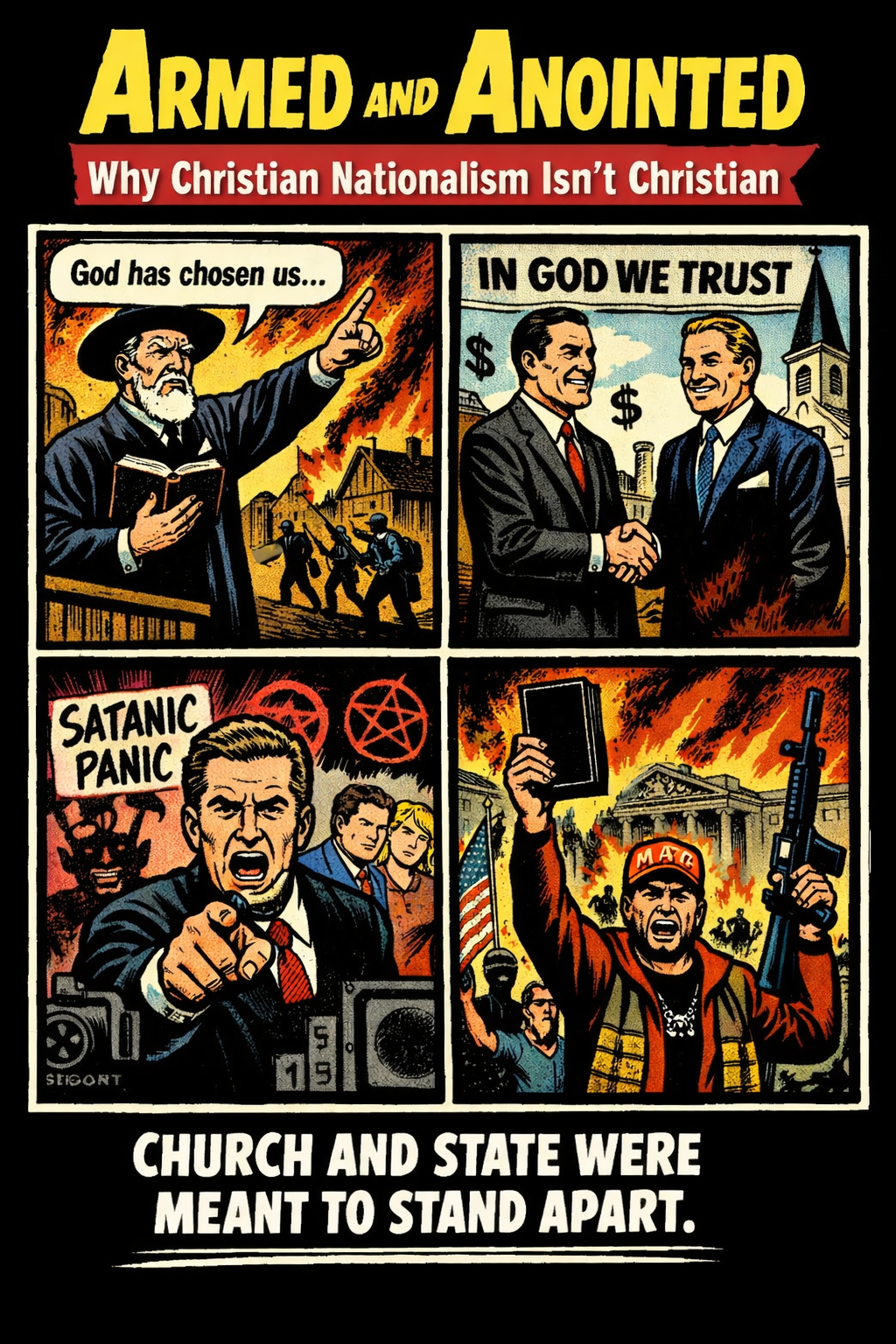
From Puritan theocracy to modern MAGA politics, Christian nationalism has evolved into a force that merges faith with power. What begins as belief becomes control that reshapes law, culture, and undermines democracy through the language of divine authority.
Canaanite gods and ancient divine kingship still shape modern theocratic creep in America. From Baal and Yahweh’s merger to the authoritarian roots of Christian nationalism, ancient structures of obedience and divine sovereignty are being turned into law and policy.
Reality may be less a thing than a description. From Plato’s cave to neuroscience and artificial intelligence, language, symbols, and the brain shape the world humans believe they see.
Contemporary media and entertainment have largely reduced the Kama Sutra to a catalog of elaborate sexual positions, but the classical text is concerned with the art of desire and the disciplines attending pleasure. It informs aesthetics, psychology, and the power to shape intimacy and culture. Far from a mere manual, it offers a disciplined vision of conscious pleasure that refines perception, deepens connection, and contributes to a balanced life.
Magic words like Abracadabra, Hocus Pocus, and Mumbo Jumbo sound playful today—but their histories are layered with ritual, translation, performance, and cultural transformation. Explore how their meaning has shifted through ritual, stagecraft, and cultural power.