
The conspiracy spreads from the corrupt boardrooms of global elites into the frantic, paranoid streets of a fracturing civilization.
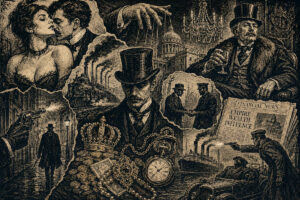
Episode 4 mapped Desdinova’s clinical, high-society infiltration using the predatory blueprint of “Career of Evil.” Episode 5 captures the immediate, chaotic blowback of that campaign. The timeline advances into the volatile opening decade of the twentieth century. In the wake of a coordinated wave of imperial assassinations, the world’s empires react with frantic desperation, deploying an unprecedented international dragnet. The narrative abandons the steady, deliberate machinations of corporate espionage, opting for the breathless pulse of the Tyranny and Mutation classic: “The Red and the Black.”
Within the Soft Doctrines of Imaginos mythos, this track represents the protagonist in perpetual motion. Desdinova himself navigates a tightening global net, intentionally transforming an elite cross-border manhunt into a weapon of absolute cosmic manipulation.
The Adrenaline Pulse of the Chase
The musical landscape of “The Red and the Black” serves as the auditory signature of a manhunt. Driven by a frantic, hyper-accelerated hard rock tempo, the track is built on a relentless, driving bassline and a searing rhythm guitar assault, punctuated by frantic, unpredictable drum fills. The sonic structure feels unstable, breathless, and fundamentally paranoid.
While the composition originally appeared under a looser, jangly garage-rock arrangement on the band’s 1972 debut titled “I’m on the Lamb but I Ain’t No Sheep,” this heavier iteration preserves a distinct, militaristic desperation. It musically portrays a high-stakes, cross-border escape, transforming a wild flight from justice into a volatile street-level reality. The music provides no place to rest, validating that the conspiracy has transitioned from silent boardroom manipulations into a deadly game of survival across a frozen frontier.
The Buffalo Connection: The Temple of Music
To understand why the shape-shifting agent of Les Invisibles is frantically crossing the northern border, one can look at the geopolitical catalyst that closed the summer of 1901. On September 6, 1901, United States President William McKinley was shot by an anarchist radical at the Pan-American Exposition in Buffalo, New York. In the framework of Pearlman’s mythology, Desdinova operates as the shadow architect overseeing the event. He was present on the exposition grounds to ensure that the conspiracy was properly executed, weaponizing a sudden vacuum to fracture American political stability and shake the global order.
The historical setting provides a striking, occult irony for a saga told through song. McKinley was shot inside a grand exposition concert hall named the Temple of Music, during a public musical reception. Desdinova uses this celebration of music to execute a political sacrifice. He transforms a human cultural center into a staging ground for global chaos.
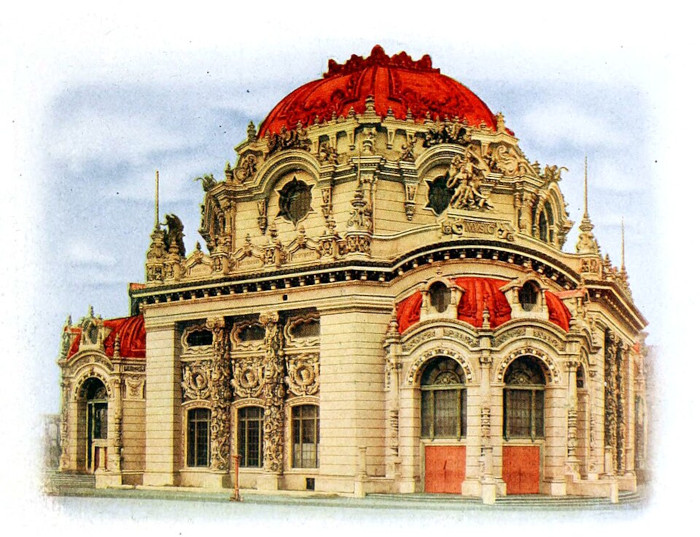
The geography of the hit dictates the geography of the escape. Buffalo sits on the Canadian border. Following the shooting, as a massive federal manhunt paralyzed western New York, Desdinova carried out his exit strategy. Fleeing into the coming northern winter, he crossed the frontier into Canada.
The rugged lyricism shifts from a transgressive rock trope into a depiction of a turn-of-the-century winter escape into the wilderness: “I got a whip in my hand, baby / And a girl or a husky / At leather’s end… Hornswoop me bungo pony on dogsled on ice.” The archaic phrase “Hornswoop me bungo pony” points to the moment that the traveler is forced to abandon a pack pony and rely on a dogsled to cross the winter ice. Using the frozen terrain to evade pursuit, Desdinova pushed deep into the British Dominion.
The Mythic Frontier vs. Human History
To the objective historian, the geography and chronology of this northern flight present immediate, irreconcilable paradoxes. The real-world assassination of President William McKinley occurred in September 1901. This is a season of late-summer warmth completely incompatible with a dogsled escape over frozen polar ice. Furthermore, the lyrics specifically mention the “Canadian Mounted” operating in Quebec. In the actual history of 1901, the force was still named the North-West Mounted Police, and their jurisdiction was strictly confined to the western territories. They possessed zero presence in the province of Quebec.
We must recognize these anomalies as a defining hallmark of Sandy Pearlman’s lyricism. Pearlman was writing a mythic poem rather than a linear history textbook. He was creating a thematic collage. By explicitly titling the composition “Immitted to the RCMP” and forcing these disparate elements together, he chose mythic resonance over historical accuracy. He synthesized the cinematic dread of a sub-zero Canadian manhunt with the cold, Saturnian themes of institutional containment to construct a narrative where Desdinova breaks through the boundaries of conventional human time. The frontier in “The Red and the Black” is a poetic abstraction. It is a frozen, lawless dead-zone designed to show that Les Invisibles operate on a cosmic timeline that leaves human calendars completely shattered in its wake.
The Frontier Trap: “Immitted to the RCMP”
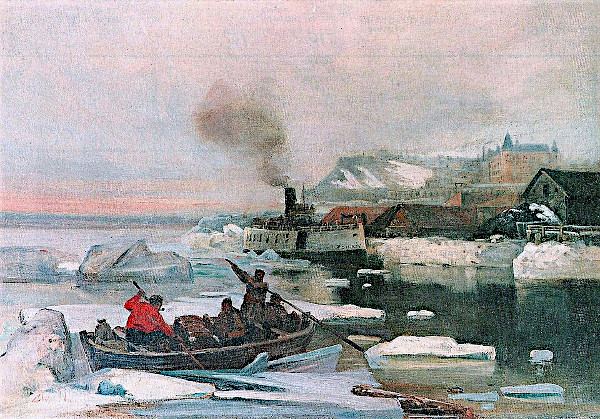
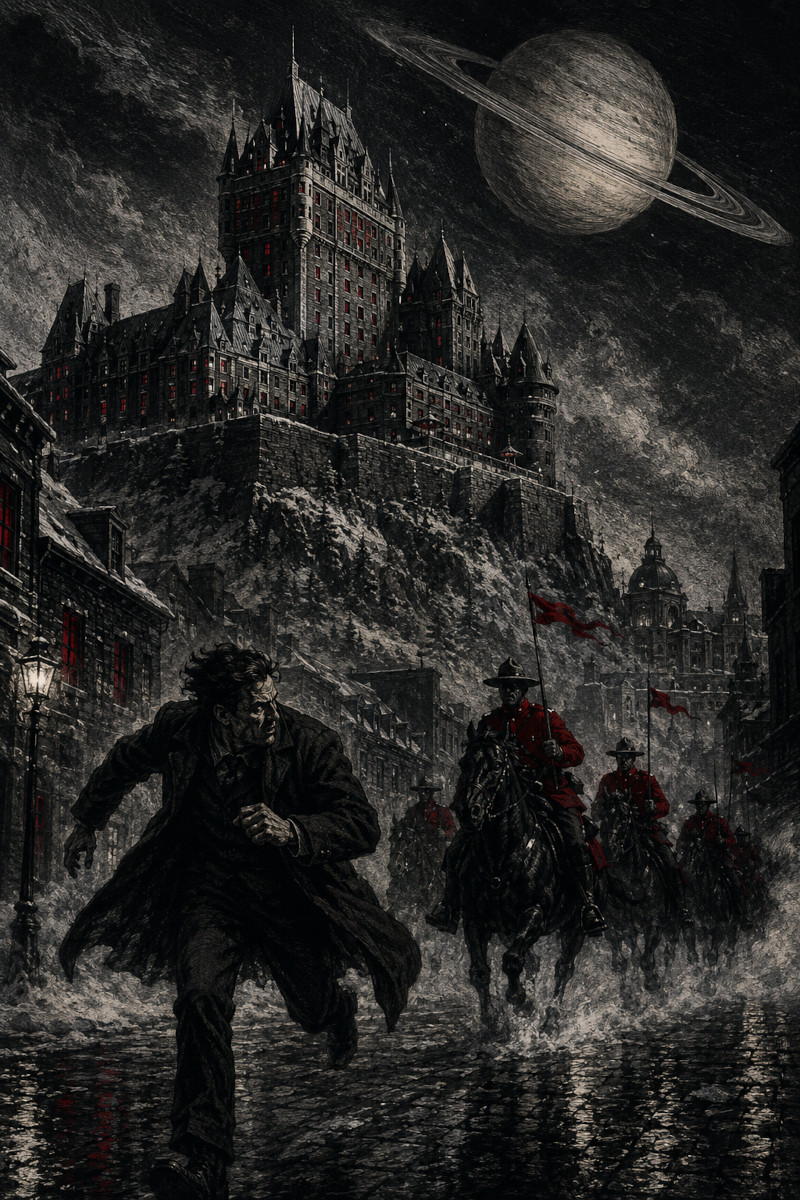
Pearlman’s lyrics explicitly name the specific police agency tasked with executing this dragnet: “Canadian mounted, baby / Police force at work / Red and black / It’s their color scheme / Get their man / In the end.”
The Royal Canadian Mounted Police represent the iron fist of the British Crown in North America. Renowned for their unyielding doctrine, that they always “get their man,” the Mounted Police represent the highest caliber of law enforcement. This historic context uncovers the true meaning behind the song’s original working title: “Immitted to the RCMP.”
To immit means to systematically inject or introduce an external element into a closed host system. Desdinova’s cross-border flight was part of a process of infiltration. He intentionally allowed himself to be tracked by the Crown’s elite authorities. By embedding his multi-dimensional influence directly into the nervous system of Canadian intelligence, he was compromising the highest echelons of colonial governance.
Following this injection, the lyric highlights the vast, corporate infrastructure of the Dominion: “Frontenac chateau baby / I cross the frontier at ten.” The Château Frontenac in Quebec City served as the ultimate visual anchor for this northern expansion. The grand, fortress-like hotel was constructed by the powerful Canadian Pacific Railway, and had been open for eight years by the time it entered the story in 1901.
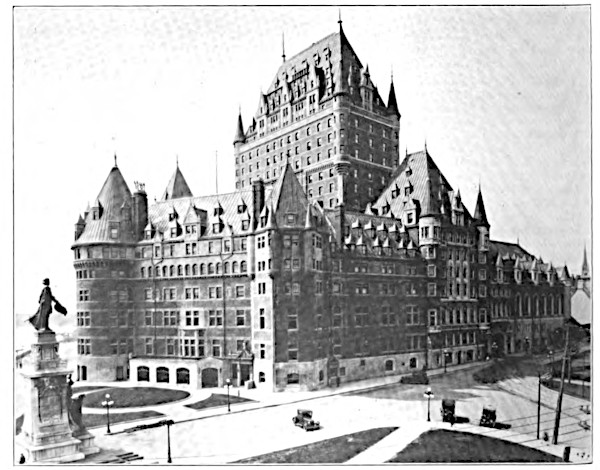
This corporate railway connection also exposes a historical loop. Exposition organizers originally considered Cayuga Island for the 1901 fair due to its proximity to Niagara Falls. However, the booming railroad syndicates forced the exposition into Buffalo, converting the city into a massive transit hub to maximize corporate passenger profit. The very same rail boom that hauled President McKinley to his doom inside the Temple of Music directly financed the company behind Desdinova’s ultimate refuge, the Château Frontenac. By referencing this landmark, Pearlman signals that the authorities are operating across a territory entirely unified by corporate transportation infrastructure.
The Magick & Malice of Saturn: Red and Black
By drilling into the real-world uniform of the Mounted Police, Pearlman adds a layer of alchemical and planetary magick beneath the scarlet tunics and dark breeches: “Red and black, it’s their color scheme.”
In Western esotericism, the pairing of red and black relates directly to the planetary current of Saturn. Saturn is the celestial ruler over boundaries, time, and limitations. In planetary magick, black is the foundational hue of the Saturnian current, representing the void and the cold reality of the cosmos. When paired with red, the symbolism shifts into a volatile alchemical transition. Black represents nigredo, the initial stage of putrefaction, decay, and the burning away of the old world order into ash. Red represents rubedo, the final alchemical stage of completion, the reddening that brings forth total transformation through blood and fire.
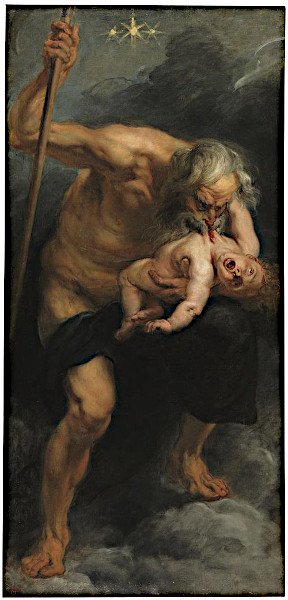
This devouring Saturnian matrix is visually immortalized in Peter Paul Rubens’ brutal 1636 masterpiece, Saturn. The painting depicts the ancient god of time tearing into the flesh of his own offspring, driven by a paranoid obsession to eliminate any threat to his sovereign authority. At the apex of the canvas, three cold, distant stars burn in a tight alignment, a stellar signature mirroring the fixed and consequent configuration of Sirius.
By framing the Canadian dragnet in these specific colors and themes, Pearlman signals that the authorities are not acting independently. Like the paranoid god devouring his own young, the fracturing world empires are unwitting components in a dark, transmutational ritual designed by Les Invisibles. The state is being driven to systematically consume its own civilian populations, binding human history to a rigid, pre-ordained matrix of global suffering.
The Foyot Spark
Desdinova’s flight to the Canadian frontier was only one front in a coordinated global maneuver. While he compromised the security apparatus of the British Dominion in North America, his shadow network was simultaneously squeezing the empires of Europe from within. Political assassinations decapitated states and shook the foundations of global governance, but the catalyst for the street-level dragnet actually began in the crowded, civilian spaces of the European anarchist underground. Within the context of Imaginos, this campaign of generalized panic was engineered by Desdinova, who moved through the shadows to stoke the flames of cell-based, insurrectionary violence. Rather than relying on overt alien technology, Desdinova weaponized the radical, volatile ideologies of human actors, guiding disparate anarchist factions to act as unconscious operators for Les Invisibles.
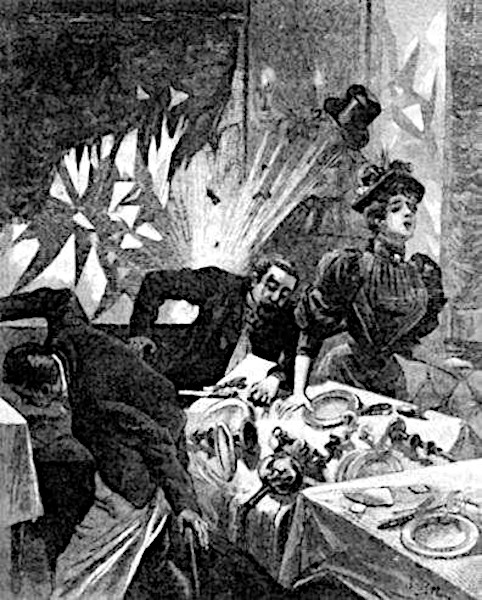
The apparent randomness of this terror served a purpose. A definitive manifestation unfolded during the French Ère des attentats (Age of Combat) on April 4, 1894, with the infamous Foyot restaurant bombing in Paris. A bomb concealed inside a floral pot on the restaurant’s windowsill exploded, tearing through the dining room and blinding the French satirical poet and anarchist polemicist Laurent Tailhade.
The event was wrapped in a savage historical irony: only months prior, Tailhade had publicly praised a catastrophic bombing at the Chamber of Deputies with the shocking decadent proclamation: “Qu’importent les victimes si le geste est beau?” (“What do the victims matter if the gesture is beautiful?”). Desdinova forced Tailhade to live out his own transgressive aesthetics, using the explosion to prove that the hidden network operates with indifference to human life. By steering these street-level operations across borders, Desdinova weaponized human malice, creating a pervasive culture of fear that forced world governments to overreact.
The 1904 Secret Police Grid
To ground this street-level conflict in real history, one can look at the immediate international reaction to this campaign of systemic terror. The early 1900s saw the birth of the modern global police state. Following the widespread chaos of these bombings and subsequent imperial deaths, world empires scrambled to defend their sovereign power, mobilizing a coordinated counter-offensive that culminated in historic International Anti-Anarchist Conferences in St. Petersburg and Rome.
These summits yielded a clandestine agreement known as the St. Petersburg Protocol, a secret treaty where ten nations authorized an unprecedented expansion of advanced secret police networks, most notably Tsarist Russia’s notorious Okhrana. Under Desdinova’s hidden influence, these security organs transitioned from localized detective work into a centralized, professionalized engine of global surveillance. The trajectory of this era would lead to biometric tracking, automated fingerprint databases, systematic border crackdowns, and a vast network of agents provocateurs managed by interior ministries.
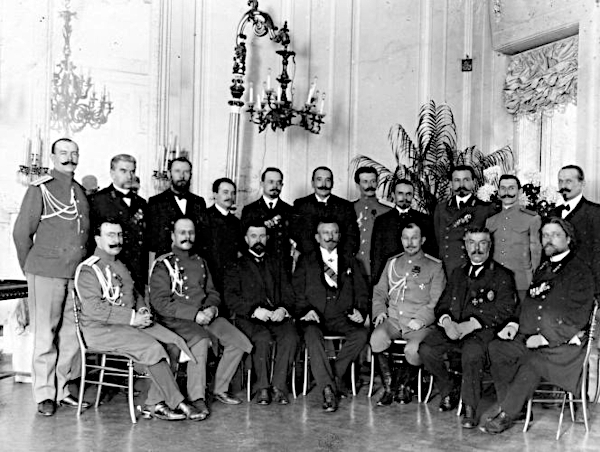
This draconian coordination became institutionalized. Historians recognize this specific anti-anarchist campaign as the foundation that ultimately gave rise to the International Criminal Police Commission in 1923, the organization known today as Interpol.
Conventional history books treat this authoritarian expansion as a rational, defensive measure to preserve imperial peace. However, the Imaginos framework exposes a terrifying paradox: the fugitive operators under Desdinova’s command deliberately provoked these totalitarian clampdowns. The hidden network required the global police state to grow. Desdinova needed humanity to build a permanent, borderless surveillance matrix to monitor the global flock. By forcing empires to weaponize their own paranoia, Desdinova successfully locked the civilian “sheep” into a rigid, irreversible Saturnian net, priming the global engine for the industrial slaughterhouses of World War I.
The Net Closes
The international dragnet is secure, borders have transformed into walls, and the state has weaponized its own paranoia. The fugitive has successfully guided the hunters into position.
Next week on The Bohemian Star – Act II: The Great Manipulation – Episode 6: The Border Fires (“ME 262”)
World War II erupts. Desdinova unleashes high-tech aviation weaponry built on extraterrestrial science, satisfying the alien gods’ desire for industrial slaughter.
Canadian mounted, baby
Police force at work
Red and black
It's their color scheme
Get their man
In the end
It's all right... it's all right
It's all right... it's all right
It's all right... ah yeah my honies know it's all right
It's all right... it's all right
It's all right... it's all right
It's all right... ah yeah baby knows it's all right
You'd kill, you'd maim... ah, c'mon kill 'em
You'd kill, you'd maim... look out
C'mon my husky
Frontenac chateau baby
I cross the frontier at ten
I got a whip in my hand, baby
And a girl or a husky
At leather's end
It's all right... it's all right
It's all right... it's all right
It's all right... ah yeah baby knows it's all right
It's all right... it's all right
It's all right... it's all right
It's all right... yeah baby yeah it's all right
You'd kill, you'd maim... ah, c'mon kill 'em now
You'd kill, you'd maim
Hornswoop me bungo pony on dogsled on ice
Make a dash for freedom baby
Don't skate on polar ice
It's too think to be sliced
By the light
Of long and white polar nights
It's all right... it's all right
It's all right... it's all right
It's all right... yeah baby knows it's all right
It's all right... it's all right
It's all right... it's all right
It's all right... yeah knows it's all right
You'd kill, you'd maim... ah, c'mon kill 'em now
You'd kill, you'd maim... maim 'em too
Ah, break it up
Don’t let the conversation stop here. Join us at Blue Sky – @thebohemianstar.com. If you’re still lingering in the old spaces, you can also join our private inner circle over at The Bohemian Star Salon on Facebook to share thoughts on music, culture and the weird side of history.
Discover more from The Bohemian Star
Subscribe to get the latest posts sent to your email.