
“Look here, brother, who you jivin’ with that Cosmik Debris?” Frank Zappa
From the fever-curing amulets of antiquity to the theatrical stages of the modern era, so-called “magic words” have punctuated ritual, medicine, performance, and folklore.
Abracadabra!… Hocus Pocus!!… Alakazam!!!… They sound playful to modern ears. Their histories are not.
Abracadabra: “Thoughts and Prayers“
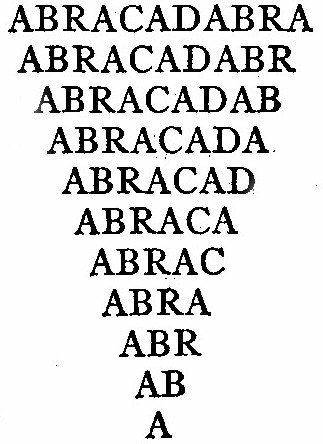
Abracadabra is one of the earliest widely attested of the familiar “magic words”. It first appears in the 2nd-century medical text Liber Medicinalis by the Roman physician Serenus Sammonicus. His prescription for recurrent fevers (likely malaria) was precise: write the word in a diminishing triangle on parchment and wear it as an amulet for nine days.
As the word contracted line by line, the illness was expected to diminish with it. This is a classic example of sympathetic magic, the belief that symbolic reduction could produce the physical reduction of a malady.
Beyond that 2nd-century ritual use, however, certainty ends.
The true linguistic origin of Abracadabra is unknown. Several theories have been proposed over the centuries:
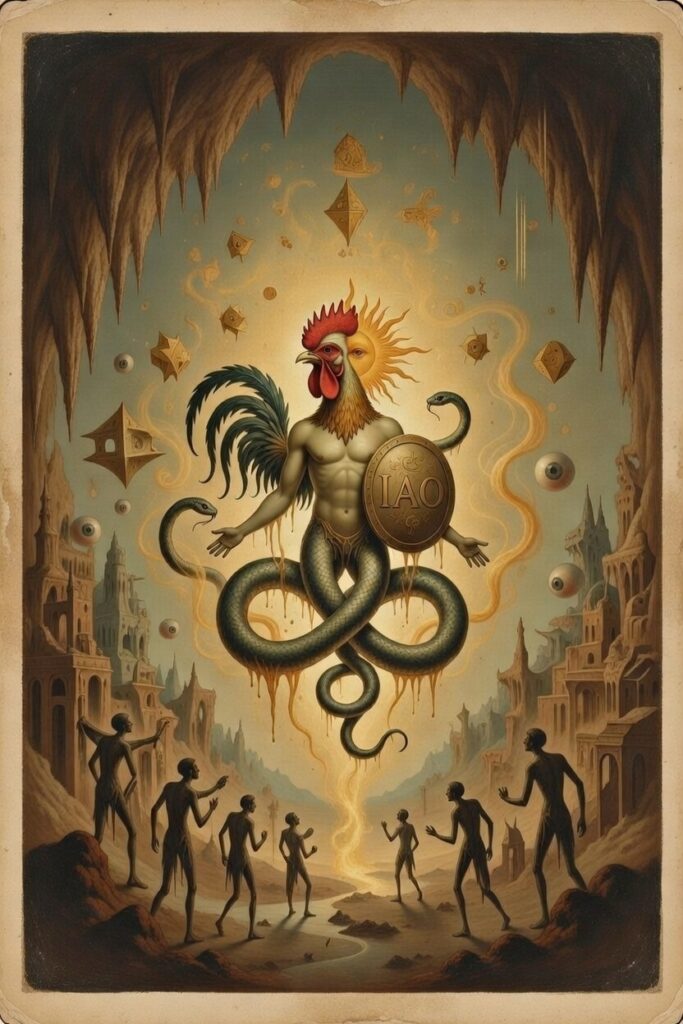
- Abraxas/Abrasax: A proposed link to Abraxas, a Gnostic figure whose name in Greek letters totals 365, symbolically tied to cosmic wholeness.
- Hebrew/Aramaic Acronym Theory: Some suggest it represents Ab, Ben, Ruach Hakodesh (Father, Son, Holy Spirit).
- Aramaic Charm Theory: The phrase Abhadda Kedhabhra has been glossed as “perish like the word,” aligning neatly with the shrinking-illness ritual.
- Phoenician/Hebrew Formula: Another proposal, Abreg ad Hâbra, is sometimes translated as “hurl your thunderbolt even unto death.”
- Avra Kahdabra: Rendered אברא כדברא (evra ke-davra), often translated as “I create as I speak.”
To be clear: we cannot definitively prove any of these proposed origins. The only firmly documented fact is its appearance in the 2nd century as a medical amulet. Beyond that all we have are various hypotheses layered upon resemblances. And yet we instinctively want words to mean something and for magic words to mean something magical. We want their sound to carry semantic weight and historic authority. Regardless of whether Abracadabra ever meant “I create as I speak” or “perish like the word,” many understand that speech itself can generate reality.
Hocus Pocus: …Squirrel!
By the 17th century, English conjurors used “Hocus Pocus” as a distracting patter during sleight-of-hand. The most widely accepted theory holds that it’s a corruption of the Latin phrase Hoc est corpus meum (“This is my body”), spoken during the Eucharist in the Catholic Mass.
In early modern England, Latin liturgy would have sounded mysterious to many lay listeners. Street performers capitalized on that sonic mystique. The phrase functioned as what Thomas Ady described in 1655 as a “a dark composure of words, to blinde the eyes of the beholders, to make his Trick pass the more currantly without discovery.” It was language designed to hold attention while hands did other work.
It was even adopted as a stage name by the 1620s performer William Vincent, sometimes called “The King of Hocus Pocus.”
Alakazam and Presto Chango: For the Exotically Inclined.
Alakazam appears to be a modern invention. It emerged in late-19th/early-20th-century American circus and vaudeville Some have proposed a connection to the Arabic al-qasam (“oath” or “invocation”), but no historical evidence backs this up. It was probably coined for its exotic ring, perhaps vaguely echoing Arabic or invented outright to mimic abracadabra.
Similarly, Presto Chango combines the Italian presto (“quickly”) with a rhyming adaptation of the English “change.” By the early 20th century, such phrases functioned less as invocations and more as theatrical cues signaling transformation.
Open Sesame: Ali Baba Edition
Open Sesame entered Western consciousness through the 18th-century French translation of Ali Baba and the Forty Thieves by Antoine Galland. The tale itself wasn’t part of the earliest Arabic manuscripts of One Thousand and One Nights, but was incorporated through Galland’s retellings.
The symbolism of sesame is often explained botanically: ripe sesame pods split open naturally, revealing their seeds. The phrase thus functions as a metaphor for sudden access to hidden treasure.
Alternatively, some suggest it’s a corruption of the Hebrew šem-šāmáyįm, meaning “name of heaven.”. Another theory connects it to the ritual use of sesame oil in ancient Babylonian practices.
Whether it’s a matter of folklore or literary embellishment, it demonstrates how translation can crystallize a phrase into global permanence.
Sim Sala Bim: Let’s Make Some Noise!
In the 20th century, Danish-American magician Dante (Harry August Jansen) popularized “Sim Sala Bim,” borrowed from nonsense syllables in a Danish children’s folk song (variants in “Højt på en gren en krage,” like “Simsaladim bamba saladu saladim”). He made it his signature, naming his hit touring show Sim-Sala-Bim and playfully claiming it meant “a thousand thanks” (more applause, bigger thanks). Its real power is in the way the rhythmic and exotic consonants command attention and conjure mystery.
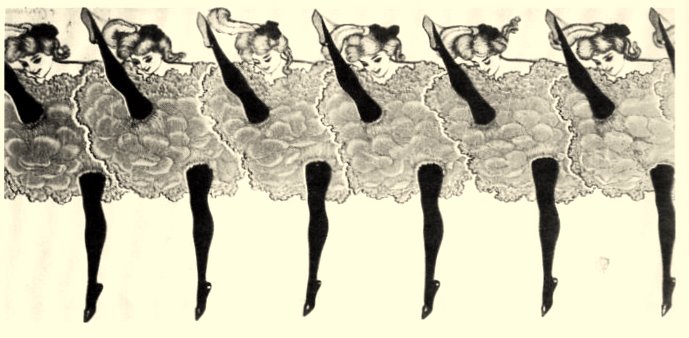
This taps into phonetic magic, where sound carries more power than meaning. Think vaudeville’s “Ta-ra-ra Boom-de-ay”: nonsensical lyrics, yet the explosive “boom” and accelerating rhythm evokes energy. …Or maybe it was the high-kicking cancan dancers?
In jazz, scat singing turned the voice into an instrument with emotive nonsense syllables. Louis Armstrong’s 1926 “Heebie Jeebies” popularized modern scat (improvised after dropping the lyrics, per legend), while Cab Calloway’s “hi-de-ho” choruses added rhythmic, humorous flair that echoed into later pop.
Early rock ‘n’ roll amplified it. Little Richard’s 1955 “Tutti Frutti” erupts with “A-wop-bop-a-loo-mop-a-lop-bam-boom!”—a tumbling onomatopoeic drum imitation that detonates raw glee and urgency far beyond a word’s meaning.
The Beatles built on this, turning vocables into cultural lightning. “Yeah, yeah, yeah” became a harmonious chant sparking teen frenzy: repetition as pure Dionysian ecstasy. “Cha-cha-boom!” opens their version of Bésame Mucho like a percussive kiss. And I Am the Walrus piles on surreal gibberish—“goo goo g’joob,” “—like a primordial, psychedelic incantation.
In all of these instances, syllables carry pure power rather than familiar meaning. From Dante’s patter to scat, Little Richard’s eruption, or a Beatle “yeah” shaking stadiums full of screaming girls, the power comes from rhythm, cadence, explosion, and repetition that makes the primal articulable.
Mumbo Jumbo: Make a Culture DISAPPEAR!
The title of this essay comes from perhaps the most revealing example.
Mumbo Jumbo derives from the Mandinka Maamajomboo, a masked ritual figure in West African societies. This figure played a role in dispute resolution and communal regulation. It was a vital cultural element in a functioning social system.
In 1738, English traveler Francis Moore described the figure in Travels into the Inland Parts of Africa. Filtered through colonial misunderstanding, stripped of cultural context, and reframed for European audiences, the term gradually shifted in English usage. By the 19th century, “mumbo jumbo” meant meaningless ritual or confused speech.
This transformation reflects a broader pattern in which unfamiliar religious or social practices are first exoticized, then trivialized, and finally dismissed. Cultural assimilation often works by reduction: what can’t be easily categorized is rendered irrational, primitive, or nonsense.
The demotion of Maamajomboo into “mumbo jumbo” is a small linguistic example of a much larger dynamic, one that has shaped the history of Western civilization. Traditions have been borrowed, rebranded, sanitized, and absorbed, while the people who carried them were marginalized or discredited.
What Are Words For?: Missing Persons Edition
Magic words have functioned as healing charms, sacred echoes, theatrical distractions, mistranslations, and misunderstood rituals. Some were thought to shape reality; others were crafted to sound as if they could.
Yet a deeper question persists: Does speech create reality? Judeo-Christian tradition frames creation through the Word (“In the beginning was the Word”). In the Apocalypse, the divine voice declares, “I am the Alpha and the Omega”—the first and last letters of the alphabet. Even secularly, words define social realities in the forms of verdicts, promises, and identities that alter behavior and perception and shape what we think of as the world.
The ancients treated speech as potent enough to heal fevers, consecrate bread, and regulate communities. Whether words and syllables themselves hold some innate power or a belief in them does, the effects are tangible. If someone believes that Abracadabra means “I create as I speak,” the etymology may be uncertain, but the idea behind it echoes across the ages: Reality, at least at the human level, is structured symbolically. It is fashioned of letters, numbers, definitions, agreements—patterns processed by a nervous system that converts symbols into lived effects. Words rearrange perception, behavior, and social order. As William S. Burroughs once said, “Writers are, in a way, very powerful indeed. They write the script for the reality film. Kerouac opened a million coffee bars and sold a million pairs of Levis to both sexes. Woodstock rises from his pages. Now if writers could get together into a real tight union, we’d have the world right by the words. We could write our own universes, and they would be as real as a coffee bar or a pair of Levis or a prom in the Jazz Age. Writers could take over the reality studio. So they must not be allowed to find out that they can make it happen. Kerouac understood long before I did. Life is a dream, he said.” — Remembering Jack Kerouac (1985), included in The Adding Machine : Selected Essays (1993), p. 180
Join the conversation in The Bohemian Star Salon, our private Facebook group for deep discussions, rare tracks, obscure lore, and unfiltered thoughts on music, culture, and the weird side of history.
Join The Bohemian Star Salon


