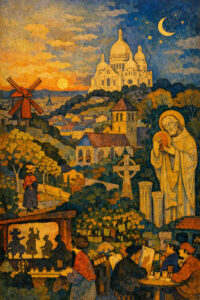

Introductory Note: This article revisits and expands L’Abbaye de Thélème: A Retrospective, a piece I first wrote in 2008. It explores fin-de-siècle Montmartre, with particular attention to the nightlife around Place Pigalle. A building once stood at 1 Place Pigalle whose history mirrors the restless evolution of the neighborhood itself. Originally conceived as a residence and working studio for artists, over time, it became something far more fluid.
It passed from atelier to spectacle: transformed into the themed restaurant l’Abbaye de Thélème (a knowing nod to François Rabelais). During the First World War it served as a meeting place for the French League for Women’s Rights. In the years that followed, it emerged as a vital hub for the Black American jazz community in Paris, before shifting again under the German Occupation into the nightclub Le Chapiteau. In its final incarnation, it became the exotic striptease venue Les Naturistes. Along the way, it bore several other names, each reflecting a different moment in the building’s life as well as the city around it.
Since first writing about it, I’ve learned more about the people and events that passed through its doors. That deeper research has allowed me to expand and color these stories, but it has also required correction. Some of the primary sources I relied on in 2008 contained errors that found their way into my earlier account. For example, both The New York Times and Theodore Dreiser misidentified the French chef and restaurateur Léopold Mourier as “M. Mouriez,” a mistake repeated in my original version and corrected here.
Alamantra
A Salty Devil
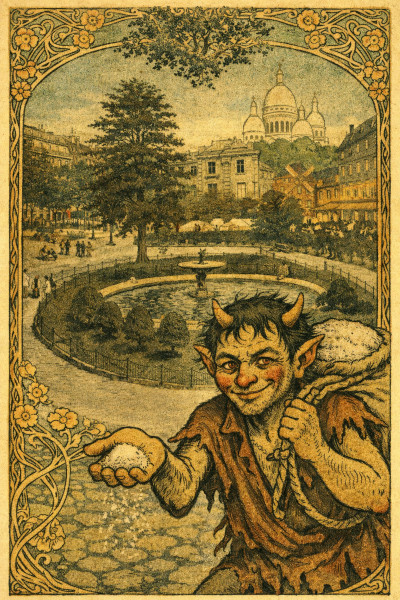
Place Pigalle, Paris: Long before cabaret lights came to define Montmartre’s nights, a small, mischievous devil named Pantagruel salted the tongues of those who drank themselves senseless, leaving them thirstier upon waking than when they collapsed. He appears in the 15th-century mystery plays of Simon Gréban, not yet a giant but already a problem.
A century later, François Rabelais took the name and transformed it into something colossal. Pantagruel became a giant of boundless appetite for wine, knowledge, laughter, and every form of excess. In Rabelais’s world, the answer to every question was the same: “Trinc!” Drink!
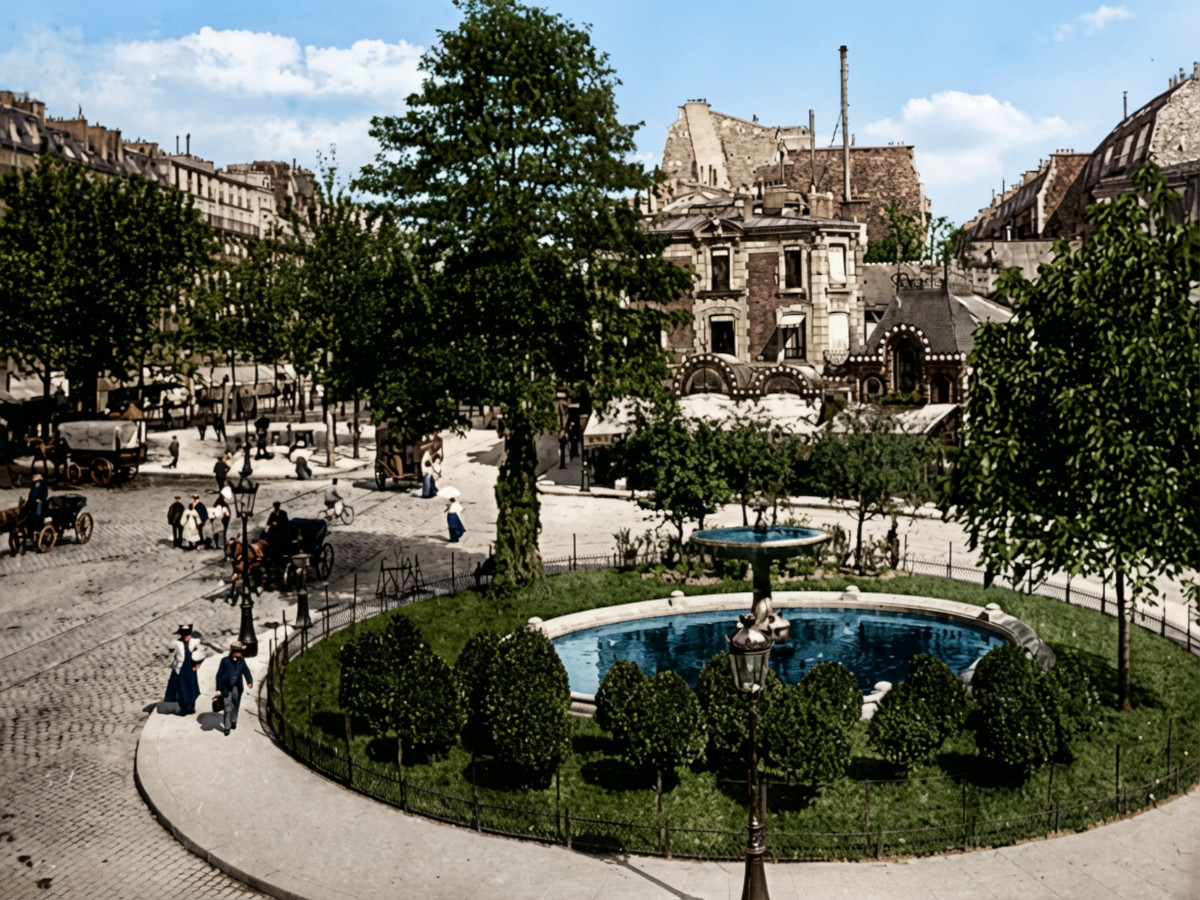
In 1862–63, architect Gabriel Davioud built the fountain that still stands in Place Pigalle, near the site of the old village well and the former Barrière de Montmartre octroi rotunda. Locals quickly adopted it as they had the well before: swapping gossip, rinsing carts, washing dogs, and gathering as a natural social hub. Even after an iron grille enclosed the basin in 1868, the fountain remained the beating heart of neighborhood life. Every Monday, artists’ models gathered there to wait for work. Painters like Renoir, Toulouse-Lautrec, and Van Gogh selected their muses here, beginning a journey that would eventually send their names echoing far beyond the Butte.
Before the Cafés: Workshop and Fault Line
Even as the village still clung to the edge of Paris, Place Pigalle was already stirring with artists, studios, and the first murmurs of something new. Cheap rents and inexpensive wine from the vineyards on the slopes above drew painters to the area. By the 1840s, Théodore Rousseau and Jules Dupré were working in studios at No. 11, where village life and artistic ambition quietly overlapped.
In 1871, during the Paris Commune, Place Pigalle became one of the flashpoints of insurrection. Contemporary accounts called it the “cradle” of the revolt. Troops sent to restore order faltered when their officers ordered them to fire on the crowd—including women and children. The soldiers ignored commands or met them with return volleys. They mingled with civilians; some retreated into nearby wine shops to drink with the very people they been sent to suppress. Nearby, insurgents seized Generals Claude Lecomte and Clément Thomas. Thomas, whom the quartier long hated for his brutal role in the June 1848 uprising, faced arrest at Place Pigalle itself before insurgents took him away and executed him.
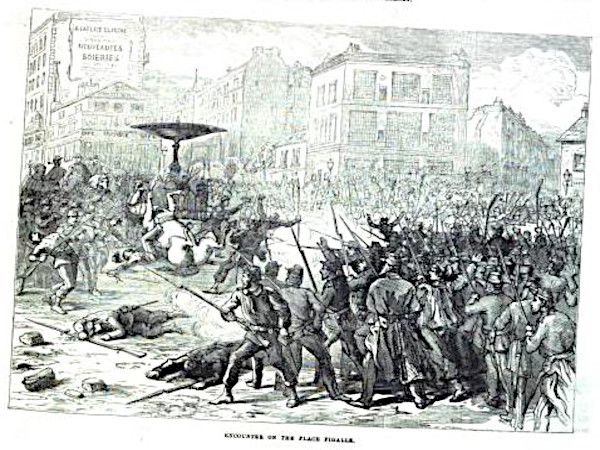
An engraving published that same year in The Illustrated London News captures the square on 18 March: buildings still uneven and half-rural, the street crowded with soldiers and citizens pressed together in uneasy proximity. There is no hint yet of the cabarets that would later define the area. Instead, the image shows authority and the crowd suddenly thrown together, the old village calm overtaken by open defiance, the fragile line between order and insurrection breaking apart before the artist’s eyes.
After the Commune: The Cafés
Place Pigalle burned like a phoenix: from armed rebellion and artistic ferment to riotous cabaret nights, before descending into the neon haze of “Pig Alley,” where vice and excess ruled the nights.
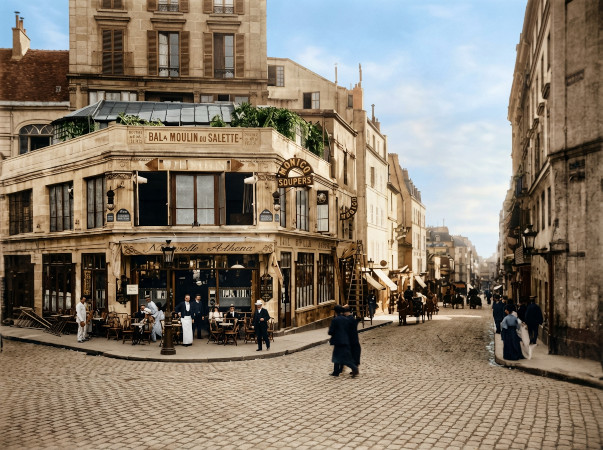
In the years following the Paris Commune, the square’s cafés became the beating heart of the new artistic Montmartre. Originally known as the Café de la Nouvelle Athènes at 9 Place Pigalle, the venue quickly established itself as the favorite haunt of the Impressionists. The Irish writer and critic George Moore called it “the academy where I received my education.” In the late 1870s, on any given evening one might find Manet, Cézanne, Gauguin, or Degas deep in conversation, swapping ideas, or arguing passionately over art and current events. Erik Satie played the piano there regularly.
Just across the square at No. 7 stood its slightly older, more eccentric counterpart: the Café Pigalle, soon universally known as Le Rat Mort (The Dead Rat).
“…the painter Marchal, Leon Goupil, Victor Davau, and Olivier Metra, dropping in one afternoon to take their aperient, found the establishment in a state of great excitement, — an enormous dead rat had just been discovered in the beer-pump. ‘C’est ici le café du Rat mort’ exclaimed Marchal; Goupil painted the unfortunate animal on the ceiling, and Davau, later, executed four oblong panels which still decorate the walls.” Paris from the Earliest Period to the Present Day, p. 157 (1899)
Born in the late 1830s as a simple local café, it had already become one of the earliest gathering spots where village life overlapped with the incoming wave of painters and bohemians. Artists came to hire models near the fountain, while a mixed crowd of painters, writers, and eccentrics found a tolerant, lively space to linger.
In the second half of the nineteenth century, no fewer than forty clubs sprang up across Montmartre. Many lasted only a few years before closing, but several embraced a distinctly Rabelaisian spirit. The most famous was Le Chat Noir, which opened its doors in 1881.
“There have been numerous imitations of the Chat Noir, but M. Salis has been the most successful, if not the first, of the organisers of literary and artistic taverns, where the ancient and the modern, the rococo and the commonplace are harmoniously blended. The Chat Noir is, of course, a huge joke, and the gay landlord, who poses as a kind of Rabelais, whom he partially resembles in features, is the first to laugh at the literary enthusiasts and gayos from the provinces who believe in the authenticity of his antique accessoires, and who are firmly convinced that they are drinking out of glasses or gazing at bric-à-brac which belonged to Villon, Voiture, the Curé of Meudon, or Cardinal de Richelieu.” The Bookmart P.132 (1890)
“Here Alfred de Musset, Alphonse Daudet, and the freres de Goncourt assembled to write verses and eat their dinners, including wine, for 20 sous. Here Guy de Maupassant came nightly, brooding alone, at a table apart from the others. Paul Verlaine wrote verses here, seated at a marble table, with ink and a bottle of wine before him, and a quill pen in his hand.” New York Times March 23, 1897 (Obituary of Rodolphe Salis)
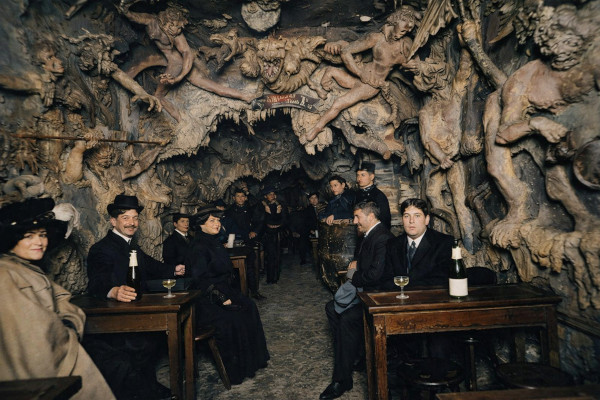
Many clubs followed the example of Le Chat Noir, adopting elaborate themes. At the Cabaret du Ciel (Heaven), waiters dressed as angels — complete with wings and golden wigs — served the “ambrosia of the gods.” The girls, however, drew the crowds with their risqué show. Scantily clad in little more than halos and gauze, they danced suggestively while mock sermons, bawdy hymns, and scenes of saints cavorting with devils unfolded around them. The result was a heady blend of mock piety and playful sacrilege; heaven found in the wicked cabaret.
“On the second floor of this house is another hall, which is called Heaven. It is a vast grotto, in which hang stalactites of a golden colour. Here Saint Peter is represented by a robust mulatto, armed with a long key, with which he opens the door for the elect, and a sergeant de ville — as an angel — guardian of the peace, closes, the procession, which enters this vast grotto, where figures of angels are suspended in space. Gorgeous transformations now take place in a mysterious manner, so as to favour the illusion that it is no longer this sad earth of ours, but a region ethereal and serene where all the angels are represented by women.” Pleasure Guide to Paris P.91 (1903)
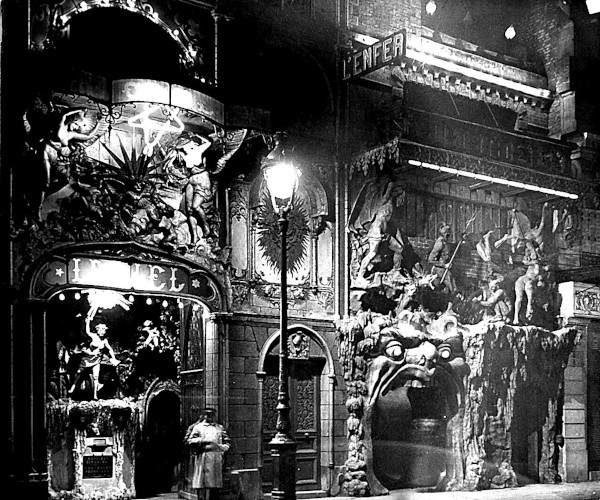
Eventually, one group made way for the next as staff cleared the room.The departing crowd would then spill next door into the Cabaret de l’Enfer (Hell), where waiters dressed as demons entertained patrons with diabolical illusions, fiery spectacles, and mock séances of black magic in Satan’s den.
“Near us was suspended a caldron over a fire, and hopping within it were half a dozen devil musicians, male and female, playing a selection from “Faust” on stringed instruments, while red imps stood by, prodding with red-hot irons those who lagged in their performance.
Crevices in the walls of this room ran with streams of molten gold and silver, and here and there were caverns lit up by smoldering fires from which thick smoke issued, and vapors emitting the odors of a volcano. Flames would suddenly burst from clefts in the rocks, and thunder rolled through the caverns.
Red imps were everywhere, darting about noiselessly, some carrying beverages for the thirsty lost souls, others stirring the fires or turning somersaults.”
Bohemain Paris of Today P.279-280 (1899)
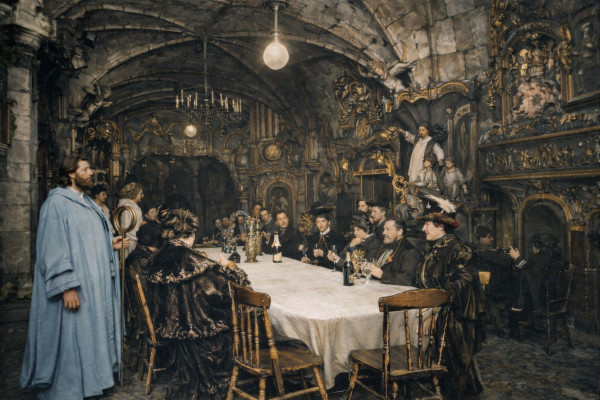
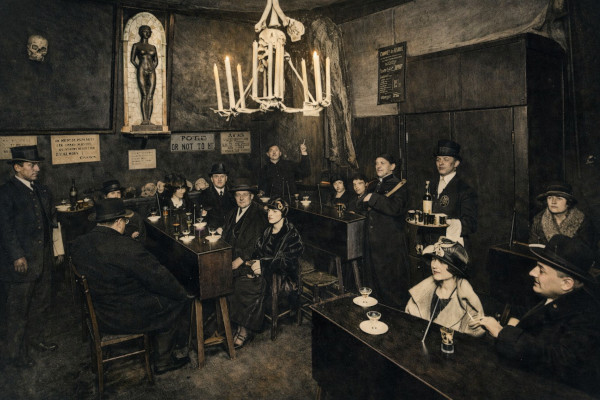
At the Café du Néant (Café of Nothingness), customers entered a dimly lit chamber where wax tapers hung from a chandelier made of human skulls and arms. Waiters dressed as undertakers ushered them to coffin-shaped tables, where they sat surrounded by images of death, carnage, and assassination. After drinking “les microbes de la mort,” guests were led down the “Hall of Incineration” to witness a macabre illusion: a chosen participant appeared to decompose into a skeleton right before their eyes.
“Enter mortals of this sinful world, enter into the mists and shadows of eternity. Select your biers to the right, to the left; fit yourselves comfortably to them and repose in the solemnity and tranquility of death ; and may god have mercy on your souls!” Bohemian Paris of Today p.265 (1899)
Women moved through the Montmartre cabarets selling flowers to patrons. Some laced their bouquets with cocaine, often purchased by affluent European rakes. These lured unsuspecting American and British tourists into a web of manipulation and exploitation. Amid absinthe, champagne, music, and dance, one entered the otherworldly mysteries of the Bohemians. It was in this mingling of commerce and desire that Place Pigalle found its edge.
“To astonish you, to give you a sensation, to quicken into some sort of action your jaded nocturnal nerves, is the object of all these places.” New York Times May 14, 1911.
“All the way down from the quaint little shops and crooked, cobble-stoned streets of the rustic upper region above the Moulin de la Galette to the blazing purlieus of the Place de Clichy and the Place Pigalle, there is always something on hand at midnight to amaze the neophyte. You may indulge or not, as inclination dictates, but you are pretty apt to be astonished, when you look at your watch, to see how long you have lingered.” Around the Clock in Europe by Charles Fish Howell P.343 (1912)
“No more excuse for inebriety exists in Montmartre than in an insane asylum. The place is crazy enough without the aid of an excess of alcohol. It is a distorted, iridescent world, seen through the bottom of a goblet; a dusty, dirty dream, full of colour, noise, and confusion, peopled with caricatures, and smelling stale as a plush dress on which a goblet of champagne has been upset. And there you sit and sit until the blue dawn begins to percolate through roofs of glass, and things and people fade and melt in the mixed lights.” Paris a la Carte By Julian Street P.77 (1912)
Hydropathes
In October 1878, a group of artists, writers, poets, and students known as the Hydropathes began gathering regularly in the Latin Quarter under the leadership of Émile Goudeau. They met in cafés for improvisational evenings of poetry, song, and performance. The atmosphere of spontaneity proved irresistible, and the group grew rapidly, sometimes requiring venue changes to accommodate the crowds.
Their journal, L’Hydropathe, launched with its first issue on 22 January 1879. After roughly two years the original Hydropathes club dissolved in June 1880 amid internal conflicts and other difficulties.
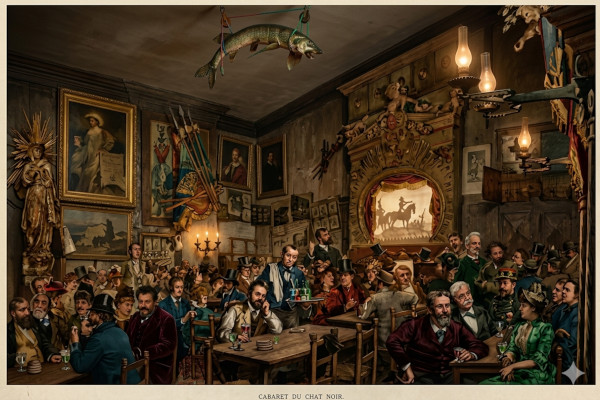
In late 1881, many former Hydropathes, including Goudeau, along with members of a short-lived successor group (the Hirsutes), began performing at the newly opened cabaret Le Chat Noir in Montmartre. Rodolphe Salis had opened the venue on 18 November 1881, and the arrival of these talented bohemians from the Latin Quarter proved transformative. Salis gained an instant artistic audience and authentic bohemian cachet, while the cabaret rapidly expanded its programs of poetry, song, and performance—turning it into both a lively performance venue and a living gallery for illustrators and painters.
The alliance helped make Le Chat Noir a phenomenon. Within about four years, by 1885, its popularity forced Salis to relocate to a larger building at 12 Rue Victor-Massé.
Le Chat Noir
“Poets, artists, singers, humorists, gathered within its precincts. Salis provided a small stage on which authors performed their own pieces with the assistance of silhouettes fashioned of zinc and designed by Caran d’Ache, Willette, Pille, and others. Some of these shadow-plays and playlets, ‘ L’Epopee,’ ‘ La Tentation de Saint Antoine,’ ‘ Sainte Genevieve,’ ‘ La Marche a l’Etoile,’ and notably ‘ L’Enfant Prodigue,’ became famous. All kinds of subjects were treated. The genre macabre found its place at the Chat Noir, and religious mysticism, Rabelaisian gauloiserie, and the Napoleonic legend were also laid under contribution.
Further, songs were sung, verses read or recited, and lightning cartoons improvised by one or another of the many men who in divers ways contributed to increase the establishment’s notoriety.” Paris and Her People p.182 (1919)
Salis was a master of spectacle, famously parading his own mock funeral through the streets to promote his establishment. When he relocated in 1885, he staged another grand procession. However, as his clientele grew wealthier, Salis’s greed followed; he hiked prices and exploited the very artists who built his success, offering them neither pay nor credit. This exploitation eventually sparked a revolt, immortalized in Adolphe Willette’s stained-glass window depicting the worship of the golden calf.
“The Chat Noir had begun as a gathering place for poor poets, but as middle-class Parisians came slumming in this artists’ haven, Salis expanded his venue’s commercial potential by catering to these new patrons and raising their drink prices. Setting the tone for Montmartre, other cabaret owners soon followed Chat Noir’s lead. To many observers this kind of crass commercialism betrayed the neighborhood’s reputation for placing a higher value on artistic expression. As a result, many believed that an ethos of “art for sale” was replacing a supposedly more traditional notion of “art for art’s sake.” The change prompted Montmartre resident and artist Willette, for one, to produce a stained-glass window depicting the worship of a golden calf in Paris to illustrate his distaste for the way that art, like that of Salis’s Chat Noir, pandered to the marketplace.” Making Jazz French P.36
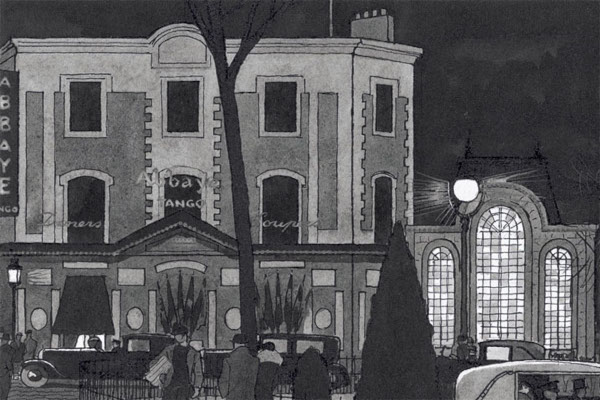
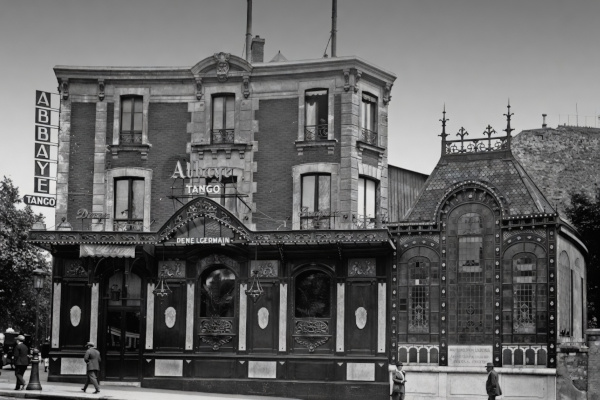
l’Abbaye de Theleme
Narcisse-Virgile Diaz de la Peña
Narcisse Virgile Díaz de la Peña commissioned the building at the corner of Place Pigalle and Boulevard de Clichy in 1857 as his residence and workshop. A gifted rebel, Díaz ended his early career decorating porcelain abruptly when his employer fired him for insubordination, his ambitions already straining against the limits of decorative craft.
In 1836, Díaz retreated to the Forest of Fontainebleau, where he met Théodore Rousseau. Though he was the elder, Díaz attached himself to the younger painter with reverence and restless energy, determined to master Rousseau’s approach to landscape. He quickly became one of the most vital spirits of the Barbizon circle: genial, impulsive, and shrewd when necessary. Where others labored in doubt, Díaz brought noise, warmth, and, when needed, money. He painted as he lived, producing sensuous, sun-drenched scenes of nymphs and mythological figures that proved far more popular with the public than the sober, rugged works of his companions.
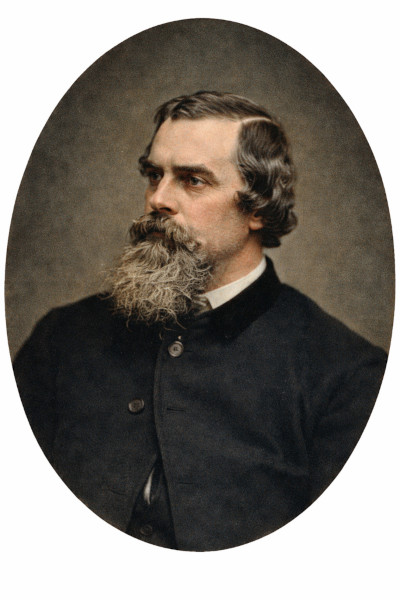
By the time he established himself at No. 1 Place Pigalle, Díaz had both the means and the temperament to create something more than a residence. He filled the building with tapestries, costumes, curiosities, and an ever-changing assortment of artistic props, renting rooms and studio space to other painters. What emerged was a shifting interior world that was part studio, part salon, and part staging ground for invention.
Over time, the building became a quiet creative hub. Artists such as Eugène Fromentin, Johan Barthold Jongkind, and Louis Béroud passed through its rooms. In the mid-1860s, a young Claude Monet, not yet the giant of Impressionism, also worked there, already moving toward the style that would define him. For a brief moment, the address held a rare overlap of generations: Díaz, rooted in the Barbizon tradition; Fromentin, balancing painting and literature; and Monet, on the cusp of the movement that would soon transform modern art. The past, its interpreter, and its future briefly shared the same roof.
In 1870, Díaz left Paris for the coast, purchasing a villa at Étretat where he spent his final years. Yet the building he had shaped did not fall silent. During the Paris Commune in 1871, fighting damaged the house at Place Pigalle and much of the surrounding district, serving as a stark reminder that the same streets that nurtured artistic life could swiftly turn violent.Even so, artists continued to live and work there for years afterward, sustaining its creative energy at least until 1882.
Jules Roques
In 1886, Jules Roques purchased the building and transformed it into l’Abbaye de Thélème, named after Rabelais’s fictional abbey whose single rule was “Do what thou wilt.” The name proved remarkably fitting. Roques was himself an eccentric and an iconoclast, and the cabaret quickly became an extension of his larger-than-life personality.
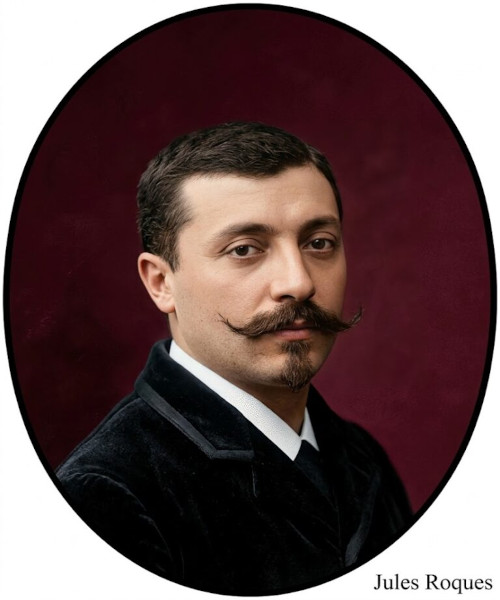
In 1889, Roques ran for local office as a socialist candidate but finished third with 359 votes. In 1890, he organized and negotiated for the coal stokers’ union, successfully securing a 10% pay increase during their strike. He was also a driving force behind the grand balls and fêtes that defined fin-de-siècle Paris. In 1887, he organized the “Bal de femmes,” followed shortly by the first “Bal des Quat’z’Arts,” which he helped sponsor. The latter became a long-running tradition that continued, in various forms, until 1966.
Le Courrier Français
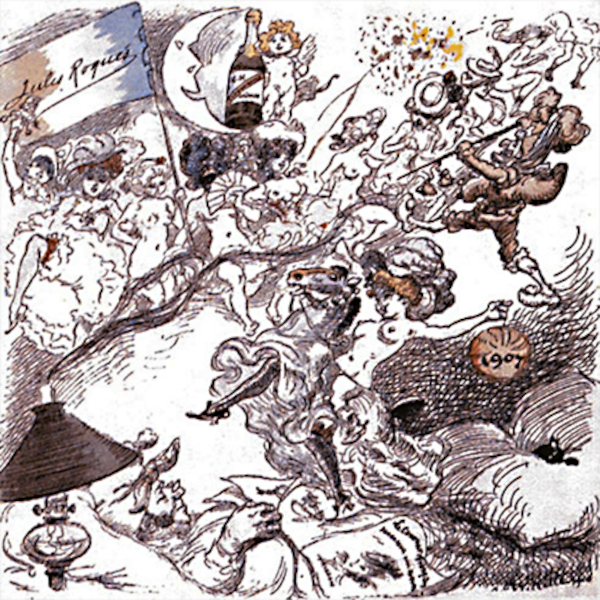
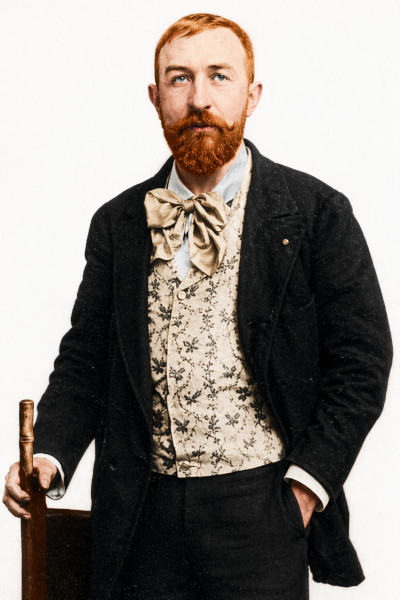
In 1884, Roques founded Le Courrier Français, a rival to Rodolphe Salis’s Le Chat Noir. The two publications drew from much the same pool of writers and artists. Adolphe Willette left Chat Noir to become a regular illustrator for Le Courrier, contributing for more than twenty-five years. Roques proved especially adept at securing sponsors; revenue from advertisements for Géraudel lozenges and Dubonnet quinine tonic wine helped sustain his ambitious publishing venture.
This financial independence gave his illustrators and contributors greater freedom to express radical Bohemian views. Le Courrier Français also served as a platform for Roques’s other socialist publications, including Le Cri de Paris and L’Égalité, the latter launched in 1889 with Michel Zévaco. Roques and his circle used the journal to champion liberty, denounce social inequality, and challenge censorship. It shocked respectable society by depicting nudes in contemporary settings rather than classical ideals, and by openly celebrating pleasure for its own sake. Within three years, by 1887, Le Courrier Français had become the most popular journal of its kind, distributed in nearly 1,000 cafés across Paris.
In 1888, Roques, his printer Lanier, and illustrator Louis Legrand received fines and two-month prison sentences for publishing Legrand’s drawing “Prostitution.The image showed a naked woman seated on a bed, embraced by a dark, shadowy figure, presumably Death. Legrand had intended it as a moral commentary on the horrors of prostitution. Although the three men won an initial acquittal, the government appealed. On retrial, the court handed down a guilty verdict.
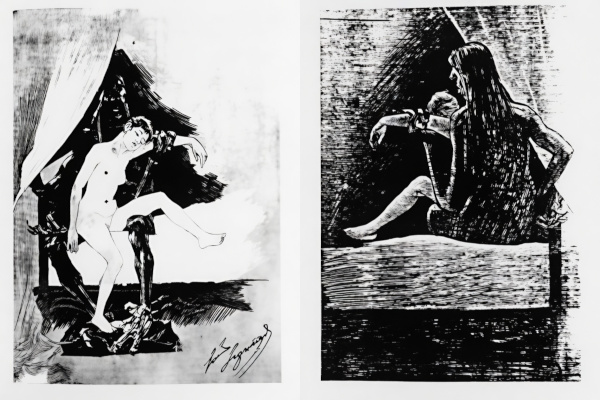
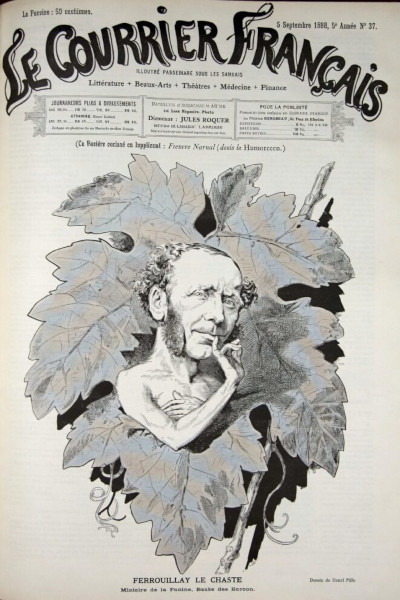
The verdict ignited outrage in the press and artistic circles. Many suspected that personal and political prejudices fueled Justice-Minister Ferrouillat’s decision.In retaliation, Le Courrier Français published another Legrand drawing that mocked the decision, this time showing the same woman from behind. Jean-Louis Forain joined the satirical assault.
One issue, dated 12 August 1888, featured a caricature titled “The Temptation of Saint Ferrouillat,” in which the bound Justice-Minister inspected a chorus line of derrières. Another, from 9 September 1888, portrayed him as “Ferrouillat the Chaste, Minister of Justice and Keeper of the Seals.” The campaign of ridicule continued for months until February 1889, when Ferrouillat finally resigned.
l’Abbaye Opens Its Doors
On 22 May 1886, l’Abbaye de Thélème opened with a lavish banquet worthy of Rabelais’s Gargantua. The guest list read like a roll call of Parisian bohemia: Émile Zola, Aurélien Scholl, Émile Goudeau, Adolphe Willette, Henri Rivière, and many of the regulars from Le Chat Noir.
“Le Courrier Français devoted an entire issue to Rabelais and to the new restaurant. ‘Today France has returned to the Gauls,’ proclaimed Mermeix with gargantuan hyperbole. At least the champions of liberty and laughter had ‘returned’ noisily to an anti-Catholic and pre-Catholic past, finding there historic roots for their cause.” P.37 Pleasures of the Belle Époque by Charles Rearick
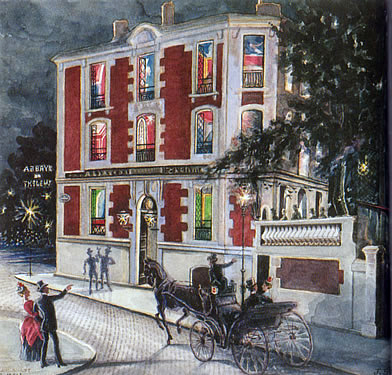
Like many establishments in the area, l’Abbaye de Thélème adopted a distinctive motif. Waitstaff dressed as monks and nuns, and the décor paid playful homage to Rabelais, with menu items named after prominent Montmartre artists and sculptors. Between 1895 and 1902, architect Jean Édouard oversaw renovations that enhanced the building’s character, much as he had done for several other Parisian taverns.
Like its neighbor Le Rat Mort, the Abbaye earned a reputation for good food at reasonable prices in a lively late-night setting. It became a place where patrons watched one another and paraded their latest fashions. By 1900, patrons arriving around one or two in the morning could enjoy a full meal for about three and a half francs while listening to the spirited music of gypsy tziganists.
“From 7 to 10 p.m. this place is one in which the visitor may dine quietly in the handsome saloon, or, if he desires, in the well-arranged and comfortable private dining-rooms. But at midnight a change takes place; it is no longer quiet — it then begins to justify its name. Frequenters of the Moulin de la Galette, the small theatres and houses of the Butte, after closing, come here in large numbers for further refreshments and a change of amusement. So great is the crowd that the small refreshment tables become speedily engaged, many persons having to wait their turn for a seat, during which time they stand in groups along the glazed terrace, and so soon as a seat is vacated it is at once taken by one of those in waiting. Women congregate here in great numbers from all parts of Paris, some of them being very doubtful characters; therefore it behooves the English visitor to be on his guard as to his purse and person.” Pleasure Guide to Paris (1903)
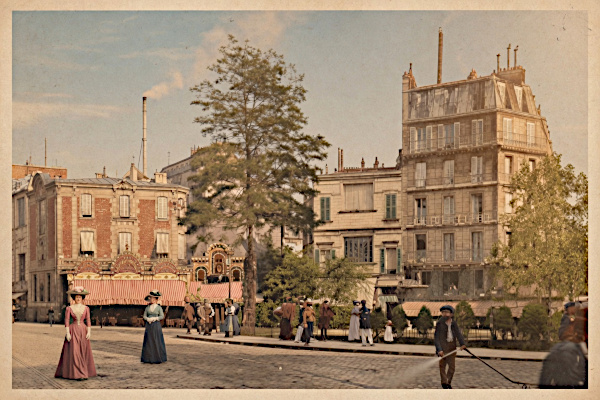
“Almost opposite (of Café Bruyant) are the restaurants of the ‘Abbaye’ and ‘Dead Rat.’ No one approaches them much before two; then they are packed. Both have tzigane (gypsy) bands and both provide supper – Montmartre ladies dart to and fro. But the gaiety of the “Abbaye” is not the gaiety of the Taverne Lorraine, for its clientele is neither young nor frank nor fresh. There is noise enough ; and when the tziganists play spirited airs, when a table is cleared away for a lady to dance, when a glass is smashed, when a chair is overturned, when a voice rises, when a quarrel ensues, when the manager comes up, there is excitement enough too. The flower woman enters, and her basket is the freshest thing in the place. It empties quickly, and she is glad to go. Restless young fellows, prematurely old, wander about with a scowl for their friends and an affectionate smile for all those whom they have never met and do not know. A monstrous waiter beams on them, however, and is sometimes persuaded to dance with them and to tell of how he was christened in champagne one night ‘le gros glouglou.” Often Armand plays with Edouard’s hat, and Edouard with Armand’s – both laugh insanely if one falls off and stooping to raise it, fall too. The “Glouglou” comes to the rescue, and Armand clasps his neck while Edouard pulls his legs, and “Glouglou” totters, and a circle forms to see whether “Glouglou” can resist, and how Armand and Edouard will find their feet. Occasionally, a Montmartre lady quarrels with her friend. The chasseur is called and seizes her. She struggles and is carried out.” Paris of the Parisians (1900)
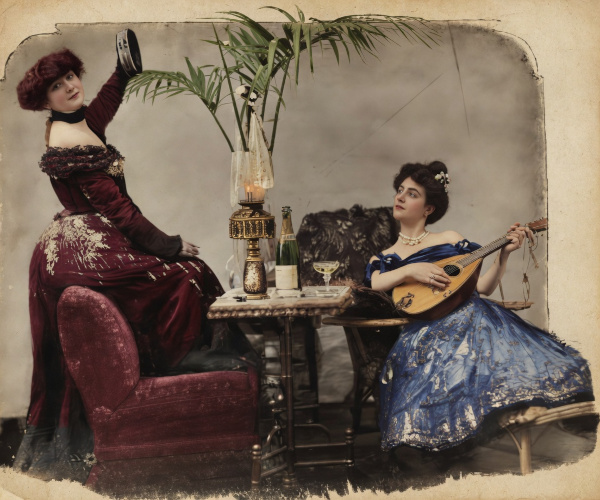
The 1900 World’s Fair turned Paris into the dazzling center of the universe. Millions of visitors, including waves of newly wealthy Latin American elites—Brazilian plantation heirs and Argentine cattle barons—flocked to the city. They sent their sons to “complete their education” in the ways of the world, bringing with them the sensual rhythms of the maxixe, an Afro-Brazilian dance and precursor to both the samba and the carioca. The maxixe had first appeared in Paris around 1889–1890 and remained fashionable in Europe long after its popularity waned in the United States due to racial restrictions. Through the influence of these Latin American visitors, the dance became central to Pigalle’s cosmopolitan nightlife. As early as 1908, l’Abbaye de Thélème featured the triumphant Paris debut of the acclaimed maxixeiros Geraldo Magalhães and his partner Nina Teixeira.
“In the Maxixe could be found the arts of Carmencita, of Otero, and of the old Egyptians. The costume might be of the ultra-modernity of Paris patterned on a mold of Spain; but the motion was that of the primeval female using beauty for beauty’s first purpose. Seduction rarely went more lithely to music.”
Percival Pollard, Their Day in Court (1909)
Montmartre and Place Pigalle became the perfect playground for this cosmopolitan mix of Old World sophistication and New World exuberance.
Amid the bohemian energy of Montmartre, l’Abbaye de Thélème maintained a distinctly sophisticated and aristocratic character. It became a favored rendezvous for a select clientele who made the ascent to the heights of the Butte. Paintings and works of art by master artists filled the dining rooms, while the spirit of Rabelais invited guests to indulge in the same joyful philosophy that once animated Gargantua’s feasts.The Abbey had embraced modernity without losing its core identity: a place dedicated to fine fare and merry company. Adjacent to the dining rooms lay a winter garden, where guests could enjoy dinner or supper at remarkably affordable prices, while surrounded by flowers and tropical trees. For many tourists, it ranked among the most refined and memorable experiences of their stay in Paris.
In 1901, founder Jules Roques turned over day-to-day management to Mme Zimmer, who formally incorporated the business as a limited-liability company. Roques presumably retained ownership of the building itself until his death in 1909.
Then came Léopold Mourier and Albert Volterra. Around 1906 the historic venue passed into the hands of this formidable new partnership. Mourier (1862–1923), already one of Paris’s most successful restaurateurs, had risen from humble beginnings in the Drôme. He had created the famous Lobster Thermidor at the Hôtel Foyot and by then owned the Café de Paris, the Pavillon d’Armenonville, and the Pré Catelan, establishments that defined Belle Époque dining. Albert Volterra, the eldest of the celebrated Volterra brothers (Léon ran the Casino de Paris; Elio managed the Princesse), brought the showman’s flair. Mourier supplied the capital and the kitchen; Volterra (“Albert”) handled nightly operations with his famously generous and affable style, often surprising guests with lavish gifts of flowers or champagne. For a time, the establishment bore the affectionate name Abbaye Albert.
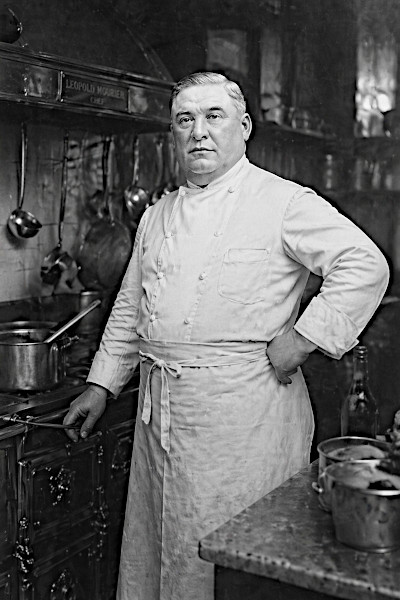
The new partnership quickly elevated l’Abbaye de Thélème into one of the most exclusive nighttime dining addresses in Paris. Its cuisine earned a sterling reputation among visiting gourmets, though some American tourists found the location a little off the beaten path. Transatlantic visitors soon became the dominant clientele, drawn by refined hedonism wrapped in lingering Rabelaisian charm.
Parisian nightlife venues loved to celebrate one another on stage. In the 1910 operetta La Fille de Willy at the Moulin Rouge, the final act was set inside the Abbaye Albert, vividly depicting its late-night diners, elegant gowns, songs, dances, and traditional gypsy musicians. Similarly, the 1913 revue La Revue Merveilleuse at the Olympia featured a lavish scene called “The Gay Nights of Paris” that paraded Montmartre’s famous establishments across the stage. The Abbaye Albert was presented as “the most select and fashionable of Montmartre’s establishments, renowned worldwide not only for the gaiety that reigns within its walls, but also for the famous and royal guests who frequented it.”
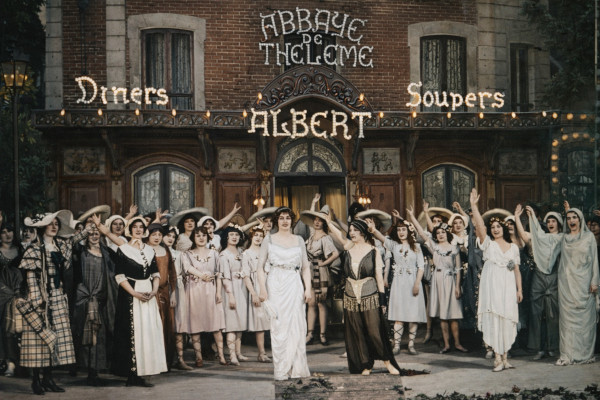
By the early 20th century, l’Abbaye de Thélème had become one of the most emblematic nighttime addresses in Paris. The once-daring bohemian haunt surrendered its edge to satisfy a new kind of visitor.
“Twenty years ago, if a respectable woman went into Maxim’s or the Abbay de Theleme, she was criticized, and was likely to lose caste. Nowadays these places are run differently. The management has realized that the greatest profit could be made out of respectable people who go to Paris to get shocked, and they have commercialized the semblance of vice. … Almost every place now caters especially to respectable folk, and the head waiter is always on the lookout to see that women vistors of this kind are treated with respect and anybody who offends is ushered out.” New York Times, Sept. 9, 1913, p.18
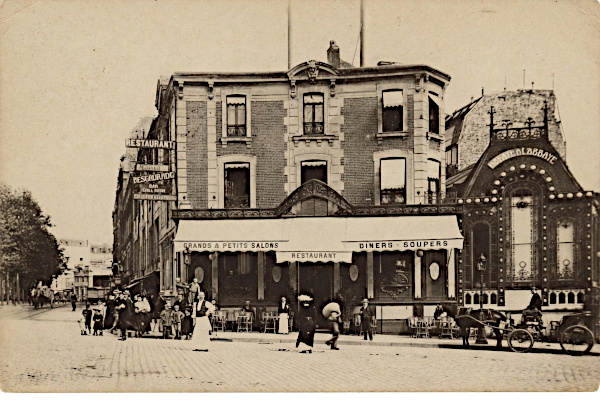
“The names change from year to year; but most folk know the Rat Mort, where you may dine amid peaceable appearing burgesses on the street floor, and later, on an upper floor, find all manner of mixed and fascinating dancing going on between the cataracts of champagne or tisane; most know the Abbaye, with its mirrors, its overdressed women, its paid dancers, and its supercilious servitors; and most have been to the Moulin Rouge either when it was sheerly a dance hall or when it was a music hall, or when, as lately, it is a cross between the two. There are numerous cabarets, all based upon the idea of Bruant, or of Café Noir of Rodolphe Salis.” Vagabond Journeys; The Human Comedy at Home and Abroad
H. L. Mencken, never one for sentiment, cast the Abbaye as a metaphor for the new tourism culture. He noted that some travelers brought home only a few “rosemary” memories of Paris: “a two-step danced with some painted bawd at the Abbaye” or “the night when you drank six quarts of champagne” at the Rat Mort.
The atmosphere was electric and cosmopolitan. Theodore Dreiser captured it vividly: “One really ought to say a great deal about the Abbaye Theleme, because it is the last word, the quintessence of midnight excitement and international savoir faire. The Russian and the Brazilian, the Frenchman, the American, the Englishman, the German, the Italian all meet here on common ground……By one o’clock, when the majority of the guests had arrived, this room fairly shimmered with white silks and satins, white arms and shoulders, roses in black hair and blue and lavender ribbons fastened about coiffures of light complexion. There were jewels in plenty – opals and amethysts and turquoises and rubies – and there was a perfect artillery of champagne corks. […] It was between three and four in the morning when we finally left; and I was very tired.” Traveler at Forty (1913)
Montmartre’s once-raw edge softened into a safe, thrilling spectacle, yet the Abbaye retained its reputation as the quintessence of midnight excitement and international sophistication It even appeared as a setting in several novels of the period.
The physical space was distinctive: guests entered through the main door into a lobby opening onto a principal room of roughly 3,600 square feet, irregularly pentagonal in shape. Tables lined the perimeter, leaving the center open for later dancing. The interior featured a lavender-white palette, rich velvet-green carpet, and six large prismed electric chandeliers casting a soft peach glow. The venue suffered from poor ventilation; Josephine Baker later recalled contracting bronchial pneumonia after dancing there.
World War I
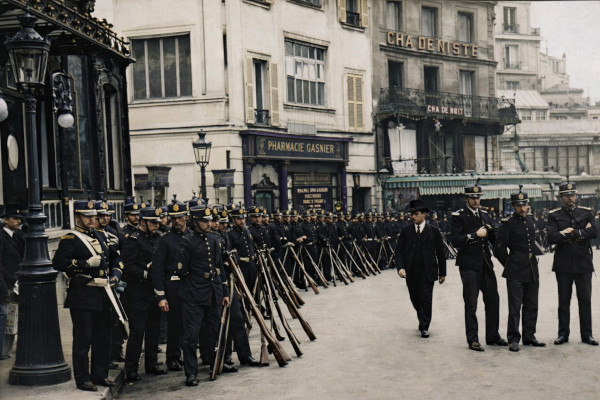
After the Great War broke out in 1914, most of the clubs in Place Pigalle closed their doors. Patrons and proprietors went to the front, and on the second day of mobilization the government ordered cafés to shut by 8:00 p.m. and restaurants by 9:30 p.m. Parisian nightlife effectively came to a halt. Café du Ciel and de l’Enfer closed. Le Rat Mort shut down. The Moulin Rouge began showing films instead of performances.
l’Abbaye de Thélème also stopped operating as a nightclub. War relief efforts occupied the former party salons.Just before Christmas 1915 (with similar events recurring in 1916 and later war years), the former abbey hosted a major charitable doll exhibition and sale. Neighborhood women used fabric donated by a women’s clothing shop forced to close due to the war to create thousands of beautifully dressed Parisian-style puppets, many in elegant civilian fashions or patriotic uniforms. One contemporary account noted that “all of juvenile Paris turned out to buy Christmas presents.”
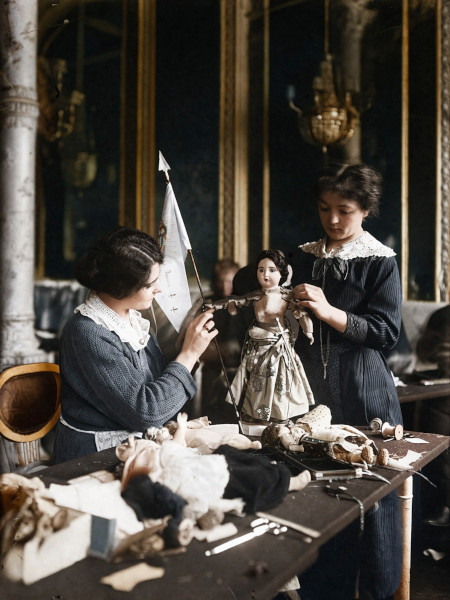
The French League for Women’s Rights (Ligue française pour le droit des femmes), directed by the lawyer and activist Maria Vérone, continued to use the space regularly throughout 1915 and 1916 as their meeting place and as one of their ouvroirs (relief workshops), where women sewed goods for charity and export and organized further sales and fundraisers.
In the same halls where artists, writers, and late-night diners had previously gathered, women now came together for practical work and mutual support. This quiet transformation stood in sharp contrast to labor unrest at Albert Volterra’s other operation. In late 1915, waiters at the Café d’Angleterre, run by Volterra and Jules Dumien, went on strike. They protested a daily charge of twenty sous, sixteen-hour workdays, and strict rules that included a ban on mustaches. Volterra’s insistence on maintaining authority over his employees, even as the cost of living rose sharply, drew public criticism in the press.
Post War Era
After the Allied victory in World War I, Paris emerged as one of the most cosmopolitan cities in the world. When the well-known bandleader and tango composer Manuel Pizarro arrived in the early 1920s, more than 4,500 Argentines called the city home. One of them, a young and wealthy Argentine consul named Vicente Madero, brought Pizarro to The Princess and introduced him to its owner, Elio Volterra. Pizarro persuaded Volterra to let him assemble a tango orchestra and host a tango night at the club.
The performers appeared in traditional gaucho costume, and the venture was an immediate success. Pizarro became a regular feature, and The Princess soon changed its name to El Garrón. Before long, Pizarro and his orchestra were performing for some of the most illustrious figures in Paris, including Rudolph Valentino, Josephine Baker, and Maurice Chevalier.
In 1918, Albert Volterra reopened l’Abbaye de Thélème as a nightclub, announcing that its wine cellar had remained undisturbed since the outbreak of war in 1914. The club quickly regained its former stature as a late-night destination, and its reputation continued to grow. In the spring of 1920, however, the government, seeking to conserve coal during a miners’ strike, ordered cafés and restaurants to close by 10:00 PM. L’Abbaye, along with Le Rat Mort and other Montmartre establishments, responded with a strike of their own, refusing to open at all until authorities agreed to extend operating hours to at least 11:00 PM.
Throughout the 1920s and beyond, l’Abbaye became a major center of the Parisian jazz scene and one of the best-known cabarets in the world. In 1924, a fourteen-year-old Django Reinhardt would often linger outside, catching whatever he could of Billy Arnold’s American Novelty Jazz Band.
Jean Cocteau and composer Darius Milhaud discovered Arnold’s group during a visit to England in 1920. Cocteau later told avant-garde musician, composer, and promoter Jean Wiener about them, and Wiener arranged for their appearance in France at the Ackerbau Hall. According to Cocteau, their performance on December 6, 1921, marked the first concert appearance of an American jazz band in France.
By 1926, after finishing her performances at the Folies Bergère, Josephine Baker would come to l’Abbaye and dance into the early hours of the morning. In 1930, following her extensive world tour, she returned and frequently performed with the Plantation Orchestra. Lew Leslie originally organized the orchestra in 1921 to support Florence Mills in New York’s Plantation Room as part of his Blackbirds Revue. It later toured Europe under the direction of Will Vodery.
After Mills’s death in 1927, the orchestra came under the leadership of trombonist Herb Flemming, who also performed with Baker. Flemming later recalled that “…the Abbaye was one of ‘these establishments [that] gave visitors the impression that they had suddenly stepped into Harlem.’” In Paris, Black Americans, accustomed to the degradations of Jim Crow, found a comparatively tolerant society in which they could build new lives.
Other notable musicians who appeared at l’Abbaye included violinist Stéphane Grappelli, renowned for his collaborations with Django Reinhardt, and trombonist Léo Arnaud (also known as Léo Vauchant), remembered for his composition “Bugler’s Dream” (1958), later used as the theme for the Olympic Games and for ABC’s Wide World of Sports.
In later years, Vauchant recalled that Edward, the Prince of Wales, was a frequent visitor who would occasionally sit in on the drums. He also remembered seeing Arthur Rubinstein, “always alone, with a bottle of champagne and peanut…”
In Rubinstein: A Life, authors Harvey Sachs and Donald Manildi recount an episode following the Quat’z Arts Ball, when Arthur Rubinstein and Jascha Heifetz arrived at l’Abbaye and performed for hours:
“He (Arthur Rubinstein) was especially happy to plunge head-long into Parisian night life, and Chotzinoff recalled having seen him “in a Paris restaurant…[on] the night of the famous Quatre Arts [Quat’z Arts] ball. On that night … all the accumulated restraints of civilization may be discarded, the celebrants permitting themselves freedoms normally prohibited or frowned on. Rubinstein (accompanied by Jascha Heifetz [Chotzinoff’s brother-in-law]) wore a bizarre armless, full-length garment, underneath which one caught glimpses of his white skin. Persons equally unrobed or disrobed wandered in, seemingly unconscious of their strange appearance. Unorthodox behavior by the students and their guests at the ball was hinted at in the next morning’s papers.” Rubinstein described the event as an orgy: men and women who didn’t know each other copulated on the floor and false rapes were enacted. Heifetz, he said, could not believe his eyes and feared a police raid, which did not take place. According to Chotzinof, “in the early hours of the morning, Rubenstein and Heifetz stopped on their way home at a night spot in Montmartre, took over the chores of the establishment’s violinist and pianist and played for hours, to the patrons’ delight.” This took place at the Abbaye de Theleme restaurant in the Place Pigalle; the principal members of the audience were Domingo Merry del Val, brother of a cardinal and the Chilean ambassador to Britain, and the two prostitutes who were his table companions.” p.158
Before the Curtain Falls
In September 1934, the address at 1 Place Pigalle was already preparing another reinvention. Raoul Favier, fresh from the success of Le Fiacre, announced a new cabaret, with décor intended to draw as much attention as the performers. At its center was René Goupil, better known to Paris as O’dett, returning not just as headliner but as artistic director. The formula was familiar: a strong personality, a defined atmosphere, and a room built to hold both.
O’dett already excelled as a performer who moved between parody and burlesque with precision. On stage, in the role of a sharp-tongued chatelaine, he worked in drag without softening the satire. Offstage, he shaped the room itself. Over the next few years, the venue shifted names as readily as he shifted roles.
It opened as La Noce, staged as a tavern. It was loud, social, and built for proximity. By the end of 1935, it had become Le Trône, with a slightly more formal revue structure. It was during this period that Élyane Célis made her debut there, before moving on to wider recognition.
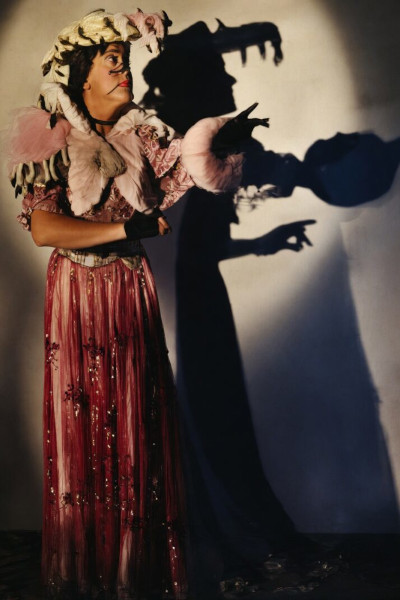
By 1938, it settled, briefly, into Chez O’dett. The name fit. This was now his room in tone as much as in management. Édith Piaf passed through during a difficult stretch, rebuilding after the murder of her manager, Louis Leplée in April 1936. Bruno Coquatrix handled artistic direction, years before he would take over the Olympia. The space was not large, but it was active and connected to the circulation of performers and material that defined Montmartre at the time.
As the decade closed, O’dett’s act sharpened. By 1940, he was performing a routine that mocked Adolf Hitler directly, presenting him as unstable and absurd. It was the kind of material that depended on timing, how far it could go, and how long it could last. When the German invasion began, O’dett didn’t wait to find out. He left for Monaco and remained there until after the war.
Le Coup de Patte
By early 1940 the venue had changed hands once more. Augustin Martini, a chansonnier and satirist, took control and reopened it as Le Coup de Patte, named after a title he had already used for a satirical weekly in the early 1930s.
Born in Corsica in 1882, Martini had long moved fluidly between cabaret stages and print. A sharp, performative satire characterized his work. He favored direct address and political wit, striking a tone better suited for the footlights than the page. At 1 Place Pigalle, this theatrical energy found a home.
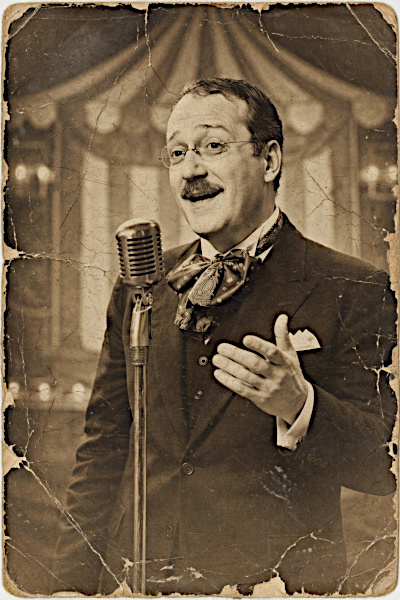
Rather than break with Montmartre tradition, Martini reconfigured the space around a single concept: the room itself as a performance device. He installed an overhead “circus tent”—a canvas canopy gathered to create an architectural illusion. Reproductions of Le Chat Noir and Le Divan Japonais lined the walls, evoking icons of cabaret history.The effect was one of deliberate framing: in an unstable present, the venue wrapped itself in the legible forms of the past.
A February 1940 account in Gringoire captured the result: an “itinerant” cabaret atmosphere built of circus imagery, poster art, and controlled theatrical displacement. The space became a hybrid environment where chanson, parody, and spoken commentary functioned as a single, coherent performance system.
Performers took the stage with theatrical flair. Oléo burst from a cage-like enclosure to present the ensemble: pianist Georges Matis, Pierre-Jean Vaillard, Victor Voilier, and Géo Charley.. Framed as a deliberate troupe, they moved seamlessly between musical numbers and staged character pieces. The humor remained precise and topical, skirting—but never openly breaching—the limits of the permissible.
Martini’s own segment, billed as a “tour d’horizon,” formed the political core of the evening. He moved through current events without naming them, relying on substitution, implication, and coded references (political figures reduced to “X” and “Y”). He engaged with censorship itself through the traditional theatrical personification of “Anastasie,” the censor. Meaning traveled through what the audience recognized rather than the words the performers uttered aloud.
This approach drew on Martini’s own generation and on his direct experience of the First World War, where he suffered severe wounds.The war entered his material as rhythm, phrasing, satire and the recollection of his memories.
By early 1940 the second war was already underway. Poland had fallen; fighting had spread across Europe. The enemy had not yet crossed the border, but wartime conditions already reshaped Parisian life. That proximity appeared directly in the repertoire. In April 1940 the venue staged a revue titled Blague-out, a pun on blackout regulations, turning the vocabulary of war into performance while the events were still unfolding.
The rest of the program moved fluidly across registers: chanson, sketch comedy, and lightly staged theatrical parody, including a version of Lysistrata. Soldiers sat among the civilians in the audience. Laughter rose. The show continued.
Under the Big Top
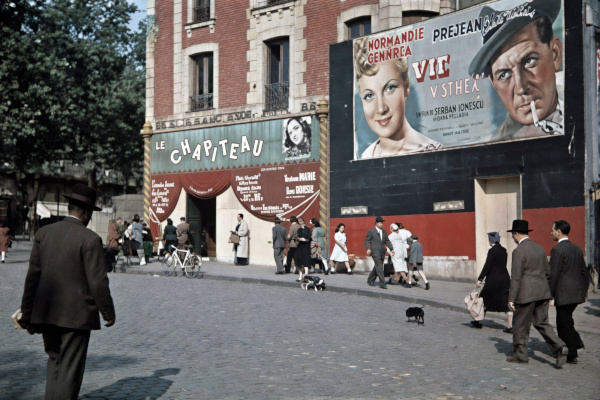
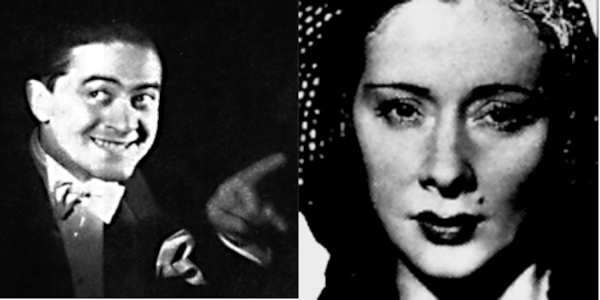
By spring 1940 the room was operating as Le Chapiteau. Marcelle Bordas retained and expanded the circus motif after taking over as both host and central performer. Bordas had already performed at the venue during O’dett’s tenure, and the two maintained a close friendship.
An August 1941 account in Les Ondes shows how completely the transformation had taken hold. The former Abbaye, previously known in succession as Chez O’dett and Le Coup de Patte, had been remade into a stylized circus interior. A miniature big top hung overhead, its pink-and-white canvas stretched into place by decorative rigging. Below it lay a polished wood ring instead of sand, and upholstered chairs had replaced benches. The space suggested the circus without imitating it.
Belle Époque posters announcing attractions such as the Théâtrophone, Guignol, and shadow plays lined the walls. A painted window opened onto an imagined fairground scene of clean, brightly colored caravans arranged like stage props.
The program followed the same hybrid pattern. Music moved between contemporary jazz and older popular songs. Performances blended music hall and parody. Menchassy, a popular eccentric comedian known for his animal parodies, appeared both as himself and inside his famous comic camel costume — an expressive dromedary that could emote, sulk, descend into the audience, sip clients’ champagne, and devour hats. Irène de Tréhert’s dancers provided disciplined, precise interludes that offset the surrounding humor. Bordas herself anchored the evening, her voice low and forceful yet delivered with restraint.
What emerged was the narrowing of expression that came with The Occupation. The tone remained measured and careful. Suggestion replaced direct statement. The room continued to function by carefully controlling its edges.
The earlier period under O’dett lingered in the background. His open mockery of Adolf Hitler had already marked the address, and that reputation did not disappear with the change in management. Even under Bordas, the venue drew criticism in pro-German publications.
At the same time, the audience shifted in ways that are harder to reconcile. Despite restrictions on music, particularly jazz, and the broader pressures on performers, Pigalle nightlife did not collapse. Le Chapiteau was one of the venues where that adjustment was visible. It attracted a mixed clientele, including those aligned with the occupying forces.
The Building Had Two Cellars.
Above, Le Chapiteau carried on: light, measured, a deliberately staged circus of canvas and nostalgia in which everything was visible and nothing entirely literal. Below lay cellars, storage rooms, service corridors, and the mundane machinery of a venue that had already passed through several names and several lives.
In occupied Paris, conversations often drifted from tables to stairwells. Information traveled the same streets as music. Whether anything more organized ever took shape in the cellars of 1 Place Pigalle remains unknowable. Still, the architecture itself encouraged the idea: a house of entertainment with more than one level, more than one audience. Above, the show went on. Below, the imagination was harder to police.
In a legal notice published in Les Annonces parisiennes on April 2, 1944 (registered from a private deed dated April 1), owner Raoul Favier granted a one-month free management lease for the cabaret-restaurant at 1 Place Pigalle to Henry de la Palmira. The contract was careful. De la Palmira took full personal responsibility for all orders, purchases, and supplies, shielding Favier’s company from any claims. And one detail stood out: “the wine cellar located on the second basement level remains the personal property of Mr. Raoul Favier.” In Pigalle, that meant a single wall in a basement could be the only thing separating a respectable cabaret from the vast, long-forbidden gypsum quarries honeycombing the ground beneath Montmartre.
Club owners in the district had quietly broken through into those old quarries for years. A hidden passage meant alcohol (and other goods) could move into Paris without taxes or official checkpoints. In the dark, porous stone under the streets, it was possible to slip unseen from one cellar to the next—perhaps straight from l’Abbaye into a neighboring establishment while patrols and watchful doormen remained oblivious above ground.
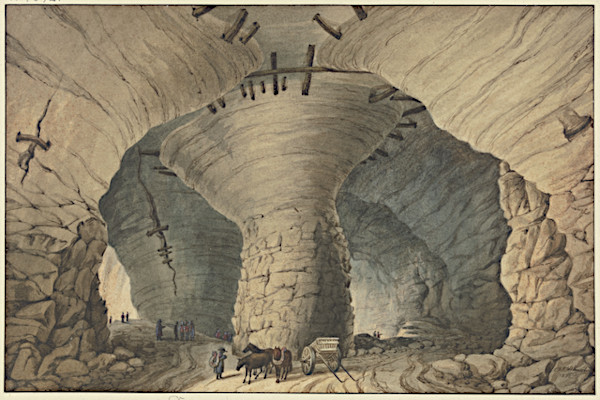
The Germans rarely ventured deep into those tunnels. The constant danger of fontis—sudden sinkholes that had plagued the area for centuries—made the underground a risky place for occupiers.
The quarries themselves had a longer history of quiet rebellion. During the Occupation, and especially as Paris rose up in August 1944, parts of this subterranean network served the Resistance: hiding weapons and equipment, sheltering operatives and fugitives, moving messages or small groups between safe points, and occasionally hosting clandestine printing operations. While the most documented command post lay farther south, under Place Denfert-Rochereau, the same logic applied here. If fighters could use the tunnels beneath Montmartre to move undetected against the Germans during the Liberation, it suggests these passages had already been quietly useful for some time—whether for contraband, survival, or something more coordinated.
Whether Favier’s second basement held only racks of fine wine or served as a discreet gateway into the district’s clandestine network remains speculation.
Upstairs, the performance played out in the lights. Below, through the white stone, something far less visible continued to move.
After the war, Marcelle Bordas stayed in Montmartre. She continued to live in the same district where she had performed throughout the Occupation, a detail that carried its own weight. In a city where some German sympathizers faced reckoning and others simply disappeared from programs and memory, she remained welcome.
Au Quolibet / Théâtre du Quolibet
From December 1947 to April 1948 the venue operated as Au Quolibet, soon billed as Théâtre du Quolibet. Augustin Martini, returned to the stage, offering chanson, sketches, and light satire that deliberately echoed the Montmartre cabaret tradition the Abbaye de Thélème had once helped define.
In May 1948, the name changed again back to Chapiteau / Théâtre du Chapiteau. These brief revivals tried to recapture something of the quartier’s earlier glamour: the circus-tent whimsy, the witty songs, and the shared cultural memory of Le Chat Noir and pre-war nights. Yet the surrounding streets moved in a different direction. Since the 1920s and 1930s, elements of the Corsican milieu consolidated influence over Pigalle and Montmartre.
Carbone and Spirito operated extensively in Paris. They set up an upmarket brothel in Montmartre and seized the operation that Charles Codebo once managed. They used those profits to open houses across France and hired women from Europe and South America to work there. Their connections reached high: the Prefect of Police, Jean Chiappe, counted Carbone as a friend. New clans replaced these collaborationist bosses after the war. Many of these new groups held ties to the French Underground and quickly claimed the available territory.
American and British troops, still present in numbers in the immediate postwar years, sought the livelier, more direct pleasures the area increasingly supplied. The district had earned the nickname “Pig Alley” from Allied soldiers, a blunt reference to its overt, raunchy sexual nightlife of hostess bars, striptease, and solicitation. Bringing back Martini as a nostalgia act couldn’t compete with the emerging scene. Traditional chanson evenings began to feel like relics.
By 30 November 1949 the venue had reopened as Les Naturistes, a name that announced its full embrace of the nude revues and more direct attractions that would soon dominate postwar Pigalle.
Les Naturistes
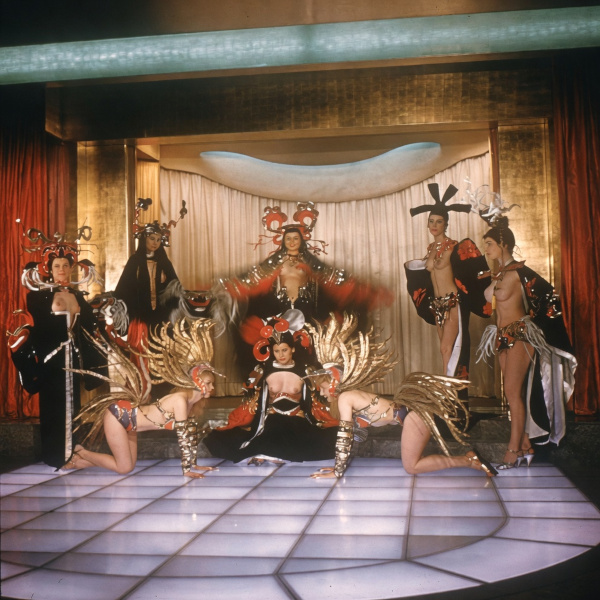
The new name left no doubt about the direction. The cabaret advertised for “very attractive models with impeccable figures” and mounted revues such as “Montmartre à Nu” and “Kingdom of the Nude,” complete with the Ballet des Naturistes. Souvenir programs and porcelain ashtrays sold the spectacle; one 1950s program featured numbers like “Pour Séduire Les Hommes” and “Dances Sauvages.”
The address that had once offered coded wartime satire and postwar nostalgic chanson now delivered displays of the flesh. In November 1950, Julia Child and her husband paused outside to look at the photos: a line of girls seen from behind, skirts lifted to reveal bare buttocks, while a multilingual tout pitched the show in five languages. Compared with the shabbier clip joints nearby, Les Naturistes retained a touch more polish; a 1960 travel guide still found it “not too unamusing” amid the tired B-girls and vicious touts.
Place Pigalle had become cinematic shorthand for the city’s nocturnal underworld, a modern echo of the old Ciel and Enfer clubs, heaven and hell in the same frame. Jean-Pierre Melville’s Bob le Flambeur (1956) captured the atmosphere best, turning the square into a character of aging gamblers and night-time commerce.
Behind the neon and tourist trade, the long shadow of organized crime continued to shape the district. Pigalle remained a place where entertainment, extortion, and opportunism overlapped.
By the early 1970s, the building had outlived its many lives. The wrecking ball claimed the building in 1972 or ’73. An address that began as a utopian experiment in artistic freedom welcomed the revelers of the world through its doors, survived war and occupation, and weathered the spasms of nostalgia and revival. Finally, workers stripped the structure to its bare flesh, and the house quietly disappeared.
What remains is the little Davioud fountain in the center of Place Pigalle, the same modest basin that once watched artists’ models gather on Monday mornings and later witnessed the neon rise and fall of “Pig Alley.” Today, an apartment building with shops stands on the site where l’Abbaye de Thélème lived so many lives. Place Pigalle endures, remade again, as it has been before.
Don’t let the conversation stop here. Join us at Blue Sky – @thebohemianstar.com. If you’re still lingering in the old spaces, you can also join our private inner circle over at The Bohemian Star Salon on Facebook to share thoughts on music, culture and the weird side of history.
Sources and Citations:
Primary Archival Sources (Gallica / Bibliothèque nationale de France)These contemporary newspapers, journals, and announcements provide direct evidence for the building’s history at 1 Place Pigalle.
- Announcement for the opening of l’Abbaye de Thélème. Paris-Montmartre: organe du XVIIIe arrondissement, June 6, 1886.
https://gallica.bnf.fr/ark:/12148/bpt6k7219438s/f2.item.r=%221%20place%20pigalle%22.zoom - Reference connected to the 1900 Paris World Exposition. Le Monde illustré, 1900.
https://gallica.bnf.fr/ark:/12148/bpt6k5699556t/f386.image.r=l# - Zimmer assumes control of l’Abbaye. Cote de la Bourse et de la banque et le Messager de la Bourse réunis, September 12, 1901.
https://gallica.bnf.fr/ark:/12148/bpt6k1748333v/f3.image.r=%22Mme%20Zimmer%22Th%C3%A9l%C3%A8me?rk=42918;4 - Continued control by Zimmer / l’Abbaye de Thélème. January 1, 1904.
https://gallica.bnf.fr/ark:/12148/bd6t543151102/f484.image.r=%221%20place%20pigalle%22?rk=600861;2 - l’Abbaye referred to as l’Abbaye Albert. Le Fin de siècle: journal littéraire illustré, March 7, 1909.
https://gallica.bnf.fr/ark:/12148/bpt6k49287183/f3.image.r=%22Abbaye%20Albert%22Mourier?rk=42918;4 - Business relationship between Mourier and Volterra. Le Droit: journal des tribunaux, May 23, 1909, p. 478.
https://gallica.bnf.fr/ark:/12148/bpt6k2958019h/f4.image.r=%22Abbaye%20Albert%22Volterra?rk=171674;4 - Operetta at Moulin Rouge referencing Abbaye Albert. Gil Blas, November 16, 1910, p. 3.
https://gallica.bnf.fr/ark:/12148/bpt6k75347626/f3.image.r=%22Abbaye%20Albert%22Mourier?rk=193134;0 - Building for sale at 1 Place Pigalle. November 26, 1910.
https://gallica.bnf.fr/ark:/12148/bpt6k4550473n/f3.item.r=%221%20place%20pigalle%22.zoom# - Albert as “the former head of the Rat Mort.” La Gazette de la Capitale, December 19, 1912, pp. 22–23.
https://gallica.bnf.fr/ark:/12148/bpt6k2360232d/f23.image.r=%22Abbaye%20Albert%22Mourier?rk=21459;2 - “La Revue Merveilleuse” at the Olympia, with reference to Abbaye Albert (including illustration). Comoedia Illustre, April 5, 1913, pp. 826–827.
https://gallica.bnf.fr/ark:/12148/bpt6k9704246f/f258.item.r=%22Abbaye%20Albert%22Volterra - Transfer of ownership by Mourier to Reboul (firm becomes “Volterra et Cie”). July 22, 1914.
https://gallica.bnf.fr/ark:/12148/bpt6k5162989c/f5.image.r=%221%20place%20pigalle%22?rk=1759665;2 - Waiter’s strike discussion. Le Bonnet rouge, November 28, 1915.
https://gallica.bnf.fr/ark:/12148/bpt6k4739924m/f1.image.r=Albert%20Volterra# - l’Abbaye de Thélème used for French League for Women’s Rights sale (Poilu Day / holiday gifts). L’Homme enchaîné, December 25, 1915.
https://gallica.bnf.fr/ark:/12148/bpt6k75904348/f2.item.r=%221%20place%20pigalle%22.zoom - Puppet/doll expo at l’Abbaye. December 28, 1915.
https://gallica.bnf.fr/ark:/12148/bpt6k75514547/f2.item.r=%221%20place%20pigalle%22.zoom - Continued Women’s Rights League sale. January 1, 1916.
https://gallica.bnf.fr/ark:/12148/bpt6k7599832m/f2.item.r=%221%20place%20pigalle%22.zoom - French Association for Women’s Rights event reminder. April 21, 1916.
https://gallica.bnf.fr/ark:/12148/bpt6k4740069k/f2.item.r=%221%20place%20pigalle%22.zoom - Serbian Day sale at l’Abbaye. June 24, 1916.
https://gallica.bnf.fr/ark:/12148/bpt6k598612b/f2.image.r=%221%20place%20pigalle%22?rk=3154522;0 - l’Abbaye de Thélème and Women’s Rights League sale (toys, woolens, etc.). December 10, 1916.
https://gallica.bnf.fr/ark:/12148/bpt6k7572312d/f2.item.r=%221%20place%20pigalle%22.zoom - Ouvroir de l’Abbaye (League for Women’s Rights). February 16, 1918.
https://gallica.bnf.fr/ark:/12148/bpt6k68154878/f1.item.r=%221%20place%20pigalle%22.zoom# - Additional Women’s Rights sale. April 7, 1917.
https://gallica.bnf.fr/ark:/12148/bpt6k537215h/f3.image.r=%221%20place%20pigalle%22?rk=4184570;0 - Obituary / tribute to Léopold Mourier (mentioning Abbaye de Thélème). Excelsior, March 22, 1923, p. 2.
https://gallica.bnf.fr/ark:/12148/bpt6k46051538/f2.image.r=leopold%20mourier - Firm name change to Albert Volterra et Cie, “L’Abbaye de Thélème.” Archives commerciales de la France, April 28, 1923 (pub. June 9, 1923), p. 884.
https://gallica.bnf.fr/ark:/12148/bpt6k1256758h/f4.image.r=l - l’Abbaye de Thélème presents Billy Arnold. June 13, 1924.
https://gallica.bnf.fr/ark:/12148/bd6t55333g/f8.item.r=%221%20place%20pigalle%22.zoom - l’Abbaye de Thélème presents Billy Arnold’s Jazz Band. June 20, 1924.
https://gallica.bnf.fr/ark:/12148/bpt6k47714003/f4.item.r=%221%20place%20pigalle%22.zoom - Company details and financial report for L’Abbaye de Thélème (including capital, profits, and “Le Jardin de ma sœur”). Les Assemblées générales, January 1, 1926, p. 4 (and related 1924–1925 reports).
https://gallica.bnf.fr/ark:/12148/bpt6k3078998t/f22.item.r=%221%20place%20pigalle%22
Additional entry: https://gallica.bnf.fr/ark:/12148/bpt6k1754310w/f1.image.r=%221%20place%20pigalle%22?rk=278971;2 - Annuaire Desfossés entry for L’Abbaye de Thélème (company purpose, capital, directors). January 1, 1929.
https://gallica.bnf.fr/ark:/12148/bd6t54243734h/f420.image.r=%221%20place%20pigalle%22?rk=236052;4 - Revue of Le Fiacre / previous establishment of Raoul Favier and O’dett. Comoedia or related, January 13, 1934, p. 251.
https://gallica.bnf.fr/ark:/12148/bpt6k1258805b/f192.image.r=%22Raoul%20Favier%22?rk=793995;2 - Formation of Raoul Favier et Cie. July 11, 1934.
https://gallica.bnf.fr/ark:/12148/bpt6k12542140/f3.image.r=%22Raoul%20Favier%22pigalle?rk=85837;2 - Opening announcement for new venue with O’dett. September 17, 1934.
https://gallica.bnf.fr/ark:/12148/bpt6k794507w/f5.image.r=%22Raoul%20Favier%22pigalle?rk=64378;0 - La Noce / l’Abbaye de Thélème. May 31, 1935.
https://gallica.bnf.fr/ark:/12148/bpt6k6130762s/f61.image.r=%221%20place%20pigalle%22?rk=42918;4 - Le Trône. December 14, 1935.
https://gallica.bnf.fr/ark:/12148/bpt6k794957v/f9.item.r=%221%20place%20pigalle%22.zoom - Chez O’Dett. June 17, 1938.
https://gallica.bnf.fr/ark:/12148/bd6t51427216d/f6.item.r=%221%20place%20pigalle%22.zoom - Property auction notice (building formerly l’Abbaye de Thélème, now “Odette”). June 21, 1939 (and related June 22 & 29, 1939 notices).
https://gallica.bnf.fr/ark:/12148/bpt6k263975r/f6.image.r=%221%20place%20pigalle%22?rk=1738206;0
https://gallica.bnf.fr/ark:/12148/bd6t54189490t/f25.item.r=%221%20place%20pigalle%22.zoom - Blague-out revue at Le Coup-de-Patte (Georges Matis). 1940. Referenced in Wikipedia entry on Georges Matis.
- Le Coup de Patte (Martini). Gringoire, February 15, 1940, p. 10 (and May 12, 1940).
https://gallica.bnf.fr/ark:/12148/bpt6k47474160/f10.image.r=l#
https://gallica.bnf.fr/ark:/12148/bd6t542407031/f13.image.r=%221%20place%20pigalle%22?rk=2982847;2 - Management lease for cabaret-restaurant at 1 Place Pigalle (Raoul Favier to Henry de la Palmira). Les Annonces parisiennes, April 2, 1944, p. 585.
https://gallica.bnf.fr/ark:/12148/bd6t52146352b/f21.image.r=%22Raoul%20Favier%22?rk=42918;4 - La Fête Foraine (with Jacques Pills, etc.). September 18, 1945 (and December 29, 1945).
https://gallica.bnf.fr/ark:/12148/bpt6k68211930/f2.item.r=%221%20place%20pigalle%22.zoom#
https://gallica.bnf.fr/ark:/12148/bd6t5116919m/f2.image.r=%221%20place%20pigalle%22?rk=3927058;0 - Company transformation (Abbaye de Thélème from SàRL to general partnership). February 13, 1946.
https://gallica.bnf.fr/ark:/12148/bd6t5400187h/f17.item.r=%221%20place%20pigalle%22.zoom - Au Quolibet (Martini). December 10, 1947.
https://gallica.bnf.fr/ark:/12148/bd6t51435678j/f18.image.r=%221%20place%20pigalle%22?rk=4399163;2 - Théâtre du Chapiteau. February 23, 1949 and March 27, 1949.
https://gallica.bnf.fr/ark:/12148/bd6t51435738c/f14.image.r=%221%20place%20pigalle%22?rk=3326196;4
https://gallica.bnf.fr/ark:/12148/bd6t51435747b/f14.image.r=%221%20place%20pigalle%22?rk=3583708;4 - Formation of Société Immobilière et de Gérance de l’Abbaye de Thélème. Archives commerciales de la France, November 22, 1949, p. 3090.
https://gallica.bnf.fr/ark:/12148/bpt6k95332222/f8.item.r=l - Les Naturistes. November 30, 1949; December 14, 1949; and March 15, 1950 (France-soir, p. 6).
https://gallica.bnf.fr/ark:/12148/bd6t51435778w/f65.image.r=%221%20place%20pigalle%22?rk=3090144;0
https://gallica.bnf.fr/ark:/12148/bd6t51435780z/f66.image.r=%221%20place%20pigalle%22?rk=2017177;2
https://gallica.bnf.fr/ark:/12148/bd6t5121799m/f6.image.r=%221%20place%20pigalle%22?rk=2017177;2
Secondary Sources and BooksThese provide broader historical, cultural, and biographical context for Montmartre, bohemian Paris, jazz in Paris, Rabelaisian themes, and related topics.
- Baedeker, Karl. Paris and Environs with Routes from London to Paris: Handbook for Travellers. Baedeker, 1900.
- Bellier de la Chavignerie, Émile, and Louis Auvray. Dictionnaire général des artistes de l’école française. 1885.
- Berlanstein, Lenard R. Big Business and Industrial Conflict in Nineteenth-Century France: A Social History of the Parisian Gas Company. University of California Press, 1991.
- Day, George. Pleasure Guide to Paris. Nilsson, 1903.
- Dion, Mathilde. Biographies of French architects. Paris: Ifa / Archives d’architecture du XXe siècle, 1991.
- Emery, Elizabeth Nicole, and Laurie Postlewate, eds. Medieval Saints in Late Nineteenth Century French Culture: Eight Essays. McFarland, 2004.
- Gendron, Bernard. Between Montmartre and the Mudd Club: Popular Music and the Avant-garde. University of Chicago Press, 2002.
- Goldstein, Robert Justin. Censorship of political caricature in nineteenth-century France. Kent State University Press, 1989.
- Horn, Pierre L., ed. Handbook of French Popular Culture. Greenwood Publishing Group, 1991.
- Hurlbert, William Henry. A Record of Things Seen and Learned in the French Provinces During the ‘Centennial’ Year 1889. Longmans, Green and Co., 1890.
- Jackson, Jeffrey H. Making Jazz French: Music and Modern Life in Interwar Paris. Duke University Press, 2003.
- Lethève, Jacques. Daily Life of French Artists in the Nineteenth Century. Translated by H.E. Paddon. Praeger, 1972.
- Morrow, William Chambers, and Édouard Cucuel. Bohemian Paris of To-day. J. B. Lippincott Company, 1899.
- Mencken, H.L., George Jean Nathan, et al. Europe After 8:15. John Lane Company, 1914.
- Muther, Richard. The History of Modern Painting. Macmillan, 1896.
- Nevill, Ralph. Days and Nights in Montmartre and the Latin Quarter. H. Jenkins limited, 1927.
- Newnham-Davis, Lieut.-Col., and Algernon Bastard. The Gourmet’s Guide to Europe. Grant Richards, 1903.
- Plattard, Jean. The Life of Francois Rabelais. Cass, 1968.
- Pollard, Percival. Their Day in Court and Vagabond Journeys. The Neale Publishing Company, 1909/1911.
- Rearick, Charles. Pleasures of the Belle Époque: Entertainment & Festivity In Turn-Of-The-Century France. Yale University Press, 1985.
- Reynolds-Ball, Eustace Alfred. Paris in Its Splendour. D. Estes & company, 1900.
- Sachs, Harvey, and Donald Manildi. Rubinstein: A Life. Grove Press, 1995.
- Sanborn, Alvan Francis. Paris and the Social Revolution. 1905.
- Segel, Harold B. Turn of the Century Cabaret. 1987.
- Shack, William A. Harlem in Montmartre: A Paris Jazz Story Between the Great Wars. University of California Press, 2001.
- Smith, F. Berkley. The Real Latin Quarter. Funk and Wagnall’s, 1901.
- Street, Julian. Paris à la Carte. John Lane company, 1912.
- Strieter, Terry W. Nineteenth-century European Art: A Topical Dictionary. Greenwood Publishing Group, 1999.
- Walton, William. Paris from the Earliest Period to the Present Day. G. Barrie & Son, 1899.
- Williams, Ellen. The Impressionists’ Paris: Walking Tours of the Painters’ Studios, Homes, and the Sites They Painted. New York Review of Books, 1997.
- Zeldin, Theodore. France, 1848-1945. Clarendon Press, 1977.
Additional contextual references (frequently cited in related literature):
- Various New York Times articles (e.g., August 9, 1908; December 14, 1914; March 16, 1920; June 20, 1921).
- Rabelais, François. Gargantua (source of the “Abbaye de Thélème” name and philosophy: “Fay ce que vouldras” / “Do what thou wilt”).
- Contemporary guides: Parisian Illustrated Review (1897), English Illustrated Magazine (1903), The Era Magazine (1903).
Discover more from The Bohemian Star
Subscribe to get the latest posts sent to your email.