“Though the face of the Hierophant appears benignant and smiling, and the child himself seems glad with wanton innocence, it is hard to deny that in the expression of the initiator is something mysterious, even sinister. He seems to be enjoying a very secret joke at somebody’s expense.” The Book of Thoth –Aleister Crowley
In the shadowed halls of the Hermetic Order of the Golden Dawn, spiritual authority was a fortress of ritual and rank. Robed adepts, wielding wands and secret passwords, presided over a rigid hierarchy of grades, from Neophyte to Adeptus, each step guarded by the elusive “Secret Chiefs.” At the heart of their Equinox Ritual, performed twice yearly to renew the temple’s energies, the Hierophant sat in the East, embodying divine wisdom. This chief officer invoked “Khabs Am Pekht”—a phrase drawn from E. A. Wallis Budge’s translations of Egyptian texts, interpreted by Golden Dawn leader Samuel Liddell MacGregor Mathers as “light in extension”—to summon celestial light into the temple. Budge’s work defined “Khabs” as “star” and “Khu” as “spirit,” terms the Order used to signify divine radiance and the astral self, channeled through collective ceremonies. But in 1904, Aleister Crowley, a disillusioned initiate, unleashed a revolution with The Book of the Law (Liber AL vel Legis). This text was a weapon, aimed at shattering the Golden Dawn’s gatekeeping and proclaiming the sovereignty of the individual self.
The rebellion’s opening salvo comes in Nuit’s voice: “The Khabs is in the Khu, not the Khu in the Khabs. Worship then the Khabs, and behold my light shed over you” (AL I:8–9). This is a direct assault on the Golden Dawn’s paradigm. In the Order’s rituals, the Hierophant summoned the Khabs as an external divine light, received by the Khu through ceremonial purification. But Nuit, goddess of infinite space, inverts this: the Khabs is the inner spark of True Will, the divine core within each person, while the Khu is the conscious self that veils it. To “worship the Khabs” is to align with this inner truth through self-knowledge, and isn’t to be found through a Hierophant’s chants or lodge rituals. Nuit’s promise of “my light shed over you” bypasses grades and intermediaries, offering illumination to those who embrace their own star-like sovereignty. The temple is no longer a physical lodge—it is the Self.
This revolution was deeply personal. Crowley’s journey through the Golden Dawn began with awe but ended in disillusionment. His experience within had devolved into frustration & doubt. His once-revered teacher, Samuel Liddell MacGregor Mathers, claimed guidance from secret, invisible masters—“Secret Chiefs”—whose legitimacy Crowley began to question. The rituals were powerful, but those who administered them were often petty, political, or fraudulent. Crowley began to suspect that the structure itself might be hollow.¹ “I became more and more certain that Mathers had deceived me and himself—that the Secret Chiefs were but shadows of his own projection,” he wrote (The Confessions of Aleister Crowley, p. 339).
In 1901, seeking clarity, Crowley traveled to Asia to meet Allan Bennett, his former mentor, now Bhikkhu Ananda Metteyya, a Buddhist monk.
“I had thought over the question of the authority of Mathers with ever increasing discomfort. He had outraged every principle of probity and probability; but he was justified, provided that his primary postulate held good. I could think {220} of only one way of putting him to the test. It concerned an episode at which Allan Bennett was present. Allan, and he alone, could confirm the account which Mathers had given me. If he did so, Mathers was vindicated; if not, it was fatal to his claims. It seems absurd to travel eight thousand miles to ask one question — a childish question into the bargain! — but that was what I did.” (The Confessions of Aleister Crowley, p. 220-221)
Bennett’s authentic practice, free of pretense, likely confirmed Crowley’s suspicion: true attainment lay beyond the Golden Dawn’s hierarchies.
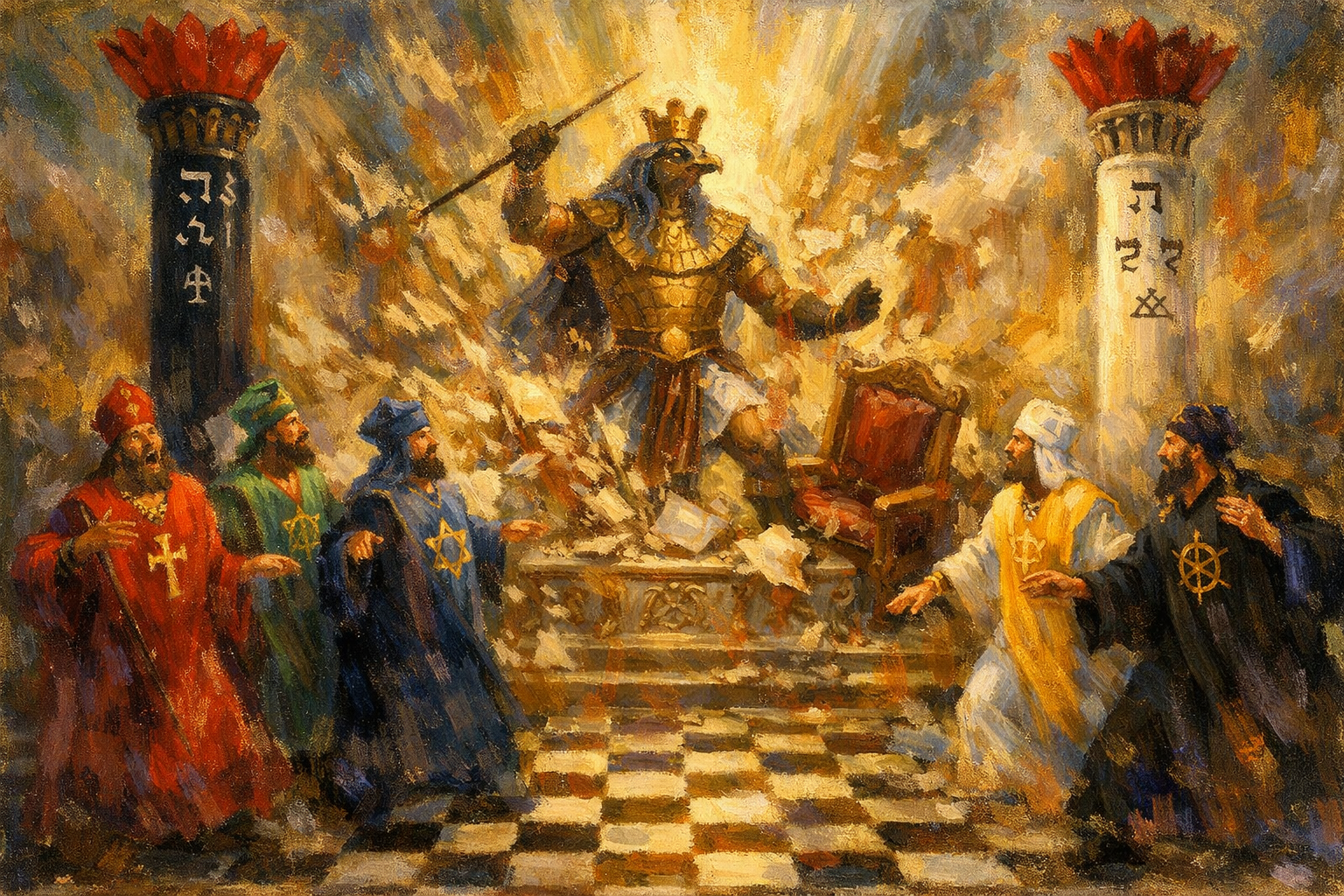
Liber AL escalates this rebellion with a seismic proclamation: “Abrogate are all rituals, all ordeals, all words and signs. Ra-Hoor-Khuit hath taken his seat in the East at the Equinox of the Gods” (AL I:49). The Hierophant’s seat, once held by a robed officer in the Golden Dawn’s Equinox Ritual, is seized by Ra-Hoor-Khuit, a solar, martial god of ecstatic will. The old gods—Osiris (Asar) as worshiper, Jesus (Isa) as sufferer—are set aside, their passive roles no longer central. Initiation now belongs to Hoor, the inner radiance of the aspirant. This is a coup, abolishing the Golden Dawn’s rituals, passwords, and hierarchical ascent. Yet Liber AL goes further: “The seat in the East is empty; let the Gods exalt me!” (AL III:34). Even Ra-Hoor-Khuit vacates the throne. No priest, no god, no external authority remains. The aspirant becomes the initiator, guided by their Inner Star.
Crowley came to this through disillusionment and betrayal. But what he discovered was not merely that the Golden Dawn had failed him. It was that no external system could substitute for the initiatory power of direct experience.
Thelema’s vision is radical: “Every man and every woman is a star” (AL I:3). The aspirant is not a petitioner but the center of their own universe, initiated by the flame of their Hidden God, not human priests. The Golden Dawn’s elemental trials—earth, water, air—are replaced by inner ordeals of fire, intellect, and gnosis, waged within the Self. The Khabs instruction anchors this shift, rejecting the Order’s complex ceremonies and secret masters. Illumination flows not through titles and grades but from knowing one’s True Will, a truth no lodge can bestow.
Thelema’s essence is total revolution. The Book of the Law is a weapon forged in Crowley’s disenchantment and sharpened by his rejection of the Golden Dawn’s hollow structures. It echoes the ancient Delphic maxim, “Know Thyself,” reimagining the Khabs as an emblem of self-knowledge. Liber AL burns the bridges of the old aeon, leaving the individual sovereign, unbound, and answerable only to their True Will. The seat in the East is empty because it was never needed.
¹ See The Confessions of Aleister Crowley (London: Arkana, 1989), particularly Chapters 37–39, where Crowley details his growing disillusionment with Mathers during the schism within the Golden Dawn. He writes: “I became more and more certain that Mathers had deceived me and himself—that the Secret Chiefs were but shadows of his own projection” (p. 339). In correspondence with Allan Bennett during this period (c. 1901), Crowley hints at a spiritual crisis and desire for validation beyond the confines of the Order, writing of his frustration with ‘men who wear the mask of initiation but fear the light behind it’ (Crowley to Bennett, unpublished letter fragment quoted in Lawrence Sutin, Do What Thou Wilt, p. 117). Crowley’s pilgrimage to meet Bennett in Ceylon seems to have been motivated by a search not only for Eastern wisdom, but for a living example of genuine attainment beyond the authority structures of Western ceremonialism.