
What does it mean to will? Thelema, raised from a Greek word into a doctrine, cannot remain a mere commentary on sacred texts and historical echoes, but must also describe the actual movements within our own being. The question of volition presses close: is Thelemic will a composed intention, formed in the mind and projected into the world, or can it also be the unmediated surge, the instinctive act that leaps before thought?
Consider someone who rushes into a burning building to save another. No time for deliberation, no weighing of consequence. The act erupts fully formed, without deliberation. Is this Thelema? Or is it only instinct? Is there any difference? Aleister Crowley defined Magick as “the Science and Art of causing Change to occur in conformity with Will.” That definition presumes an act shaped and directed. Yet life often moves in ways that defy deliberation. The body acts before the mind can speak, and the reasons come only afterward.
Here it is useful to distinguish Magick from Thelema. Thelema names the aim, the True Will or governing direction of a life, while Magick names the method, the art and science by which that aim is achieved. Thelema is the content of Will; Magick is an organized framework for its expression. The distinction is analytic rather than absolute, for in Crowley’s thought the two create a synergy: the practice of Magick refines the perception of Thelema, and a clearer sense of Will, in turn, informs Magickal practice.

Here instinct enters the discussion. Instincts are primal: hunger, thirst, fear, desire, the drive to propagate and to protect progeny. They are species-level inheritances, the bedrock of survival. Without them, no True Will could ever be realized, for the simple reason that without food, air, and shelter, life does not persist long enough for any higher purpose to unfold. True Will stands on instinct as a building rises from its foundation.
But instinct alone is not the whole of Thelema. To eat when hungry is natural, but Thelema arises when instinct is transfigured into vocation: when appetite becomes art, when thirst becomes science, when protection becomes purpose. A child cries out of hunger; a farmer cultivates the field from a deeper calling. Both acts depend on instinct, but only one reveals the deeper course of who we are. True Will arises from volition but is not reducible to raw impulse; it is the shaping of impulse by discernment, craft, and the self-directed aim of vocation.
Passion, by contrast, is not the same as instinct. It is the intensification of desire, capable of both elevation and distortion. That intensification can fuel art, devotion, and transformative risk or it can overheat, producing jealousy, excess, and moral confusion. Passion is therefore not excluded from Thelema but must be disciplined and transmuted, so that its energy serves the deeper current of vocation rather than the erratic impulse of ego.
Crowley’s own writings reflect this tension. In The Book of the Law (II:30–33), Hadit condemns the intrusion of “Because,” the reflective pause that halts Will. To ask why is already to weaken Power. In Liber LXV I:56, Crowley wrote that the wise man “counted his muscles, and pondered, and understood not, and was sad,” while the reaper “swept his swathe and rejoiced.” Crowley sides with the reaper: unhesitating action reveals joy, while calculation breeds paralysis. Yet deliberation doesn’t weaken Will. In practice, disciplined reflection can concentrate and direct it to its proper course. Crowley warns against hesitation born of procrastination, not against the clarity that arises from insight and calculated action.
True Will is not identical with every instinct or every impulse. It is the axis of being, the current that unites instinct and intention. It can appear as sudden and spontaneous: the soldier who holds the line against the instinct to flee, the rescuer who leaps into flame before thinking. It can appear as deliberate action: the artist who disciplines desire into creation, the mystic who trains appetite into contemplation. The measure is not whether the act is spontaneous or composed, but whether it unfolds from the deeper current of the self’s sense of vocation.
I. The Latency of Will
Between the surge of instinct and the deliberate act lies a third territory: latency. True Will is not always manifest; it can slumber, coiled within the organism, awaiting the precise configuration of circumstance that calls it forth. A seed contains the oak, but only under specific conditions of soil, light, and season does the tree emerge. So too with True Will. The adept may live decades in apparent ordinariness: eating, sleeping, laboring, while the deeper current gathers force beneath the surface. The moment of eruption, when it comes, may appear as instinct to the outward eye, yet it is the fruition of a latency that has been quietly organizing itself toward expression. Latency is not inaction; it is the invisible gestation of volition.
II. The Holy Guardian Angel as the Locus of True Will

Thelema names the deepest current of volition the True Will. Crowley, borrowing the Golden Dawn’s term, described its full realization as the Knowledge and Conversation of the Holy Guardian Angel. Though the phrase is inherited from an older magical vocabulary that imagined a literally separate spiritual being, in Crowley’s system it need not imply belief in external angels. It designates instead a structure of experience: the encounter with the organizing intelligence or integrative principle that is the Self beyond the sense of self. The “Angel” becomes a metaphor for the moment when inner necessity and outer circumstance reveal themselves as one seamless motion.
Crowley’s most explicit accounts appear in Liber Samekh and The Vision and the Voice. The operation, as he conceived it, is a stripping away of everything accidental to the essential Self: social conditioning, personal trauma, intellectual vanity, inherited moral habit. What remains is a point of lucidity through which volition acts without inner contradiction. The “dialogue” with the “Angel” can take many forms: symbolic, intuitive, or even literal. For some it appears as a moment of unmistakable inner clarity; for others, as an external event that speaks with uncanny precision to the situation at hand. Philip K. Dick described something strikingly similar in his encounters with what he called VALIS (Vast Active Living Intelligence System). In VALIS and his private Exegesis, he portrayed this divine/alien intelligence as penetrating the total occlusion of the Black Iron Prison. the illusory, oppressive reality that imprisons humanity unknowingly, through subtle, everyday channels that seem random or peripheral to everyone else. A fragment of television broadcast, a magazine page fallen open by chance, an overheard remark, or some discarded cultural detritus: these become precise, revelatory signals. To outsiders, mere noise; to the one addressed, perfect speech. No isolation or barrier can fully block the transmission—the Logos (disguised as marginal debris) infiltrates the prison’s own fabric, reaching even the most trapped minds via the incidental media that surround and sustain the illusion.

Seen this way, the Angel is not a supernatural intermediary but a mode of alignment. It marks the transition from acting with purpose to acting as purpose. It is the difference between a will that chooses and a will that simply is. The process is neither purely spontaneous nor purely deliberate. In early stages, deliberate work is necessary: ritual, discipline, psychological inquiry. These practices serve to clear noise from the signal. As integration deepens, spontaneity emerges naturally, not as impulsiveness but as immediacy. A sense begins to develop that one’s actions arise in harmony with circumstance rather than against it.
This model also clarifies the earlier triad of instinct, passion, and True Will. Instinct provides the biological foundation of action: the drives that sustain life and make any higher expression possible. Passion refines this energy, intensifying it toward creativity or connection; when unbalanced, it can distort both perception and action, but when disciplined, it becomes the vital engine of art, love, and discovery. True Will is the harmonization of these forces. It is the point where instinct and passion are not suppressed but integrated into a coherent pattern of living. The lifelong task is not perfection but permeability.
IIa. The Dweller on the Threshold
The path to the “Angel” is not linear but oscillatory. Every ascent into illumination throws a shadow of equal depth, and that shadow is the Dweller on the Threshold. In Crowley’s adaptation of nineteenth-century occult lore,the Dweller is the residue of everything still unintegrated, the valley that forms when consciousness peaks too sharply toward the light.
The image originates in Edward Bulwer-Lytton’s Zanoni (1842), where the “Guardian of the Threshold” personifies the initiate’s unresolved fears. The Theosophists reframed it as a principle of spiritual psychology, a spectral double that blocks entry into higher consciousness. Crowley inherited the image and renamed it Choronzon, the “Dweller in the Abyss,” described in “The Vision and the Voice.” It is not a demon in the medieval sense, but the ego’s last, desperate insistence on its own boundaries before dissolving into the impersonal current of True Will.

The Dweller embodies everything one’s sense of self refuses to integrate: fear, ambition, deceit, desire. It is the resistance generated when Will confronts the demand for transformation. Its weapon is imitation: it mimics insight, speaks with authority, and persuades the aspirant that the Work is done or that they’ve been chosen for a special mission. Those who mistake this reflection for illumination become self-enclosed: the reformer who confuses anger with righteousness, the mystic who sanctifies obsession, the artist who mistakes compulsion for inspiration.
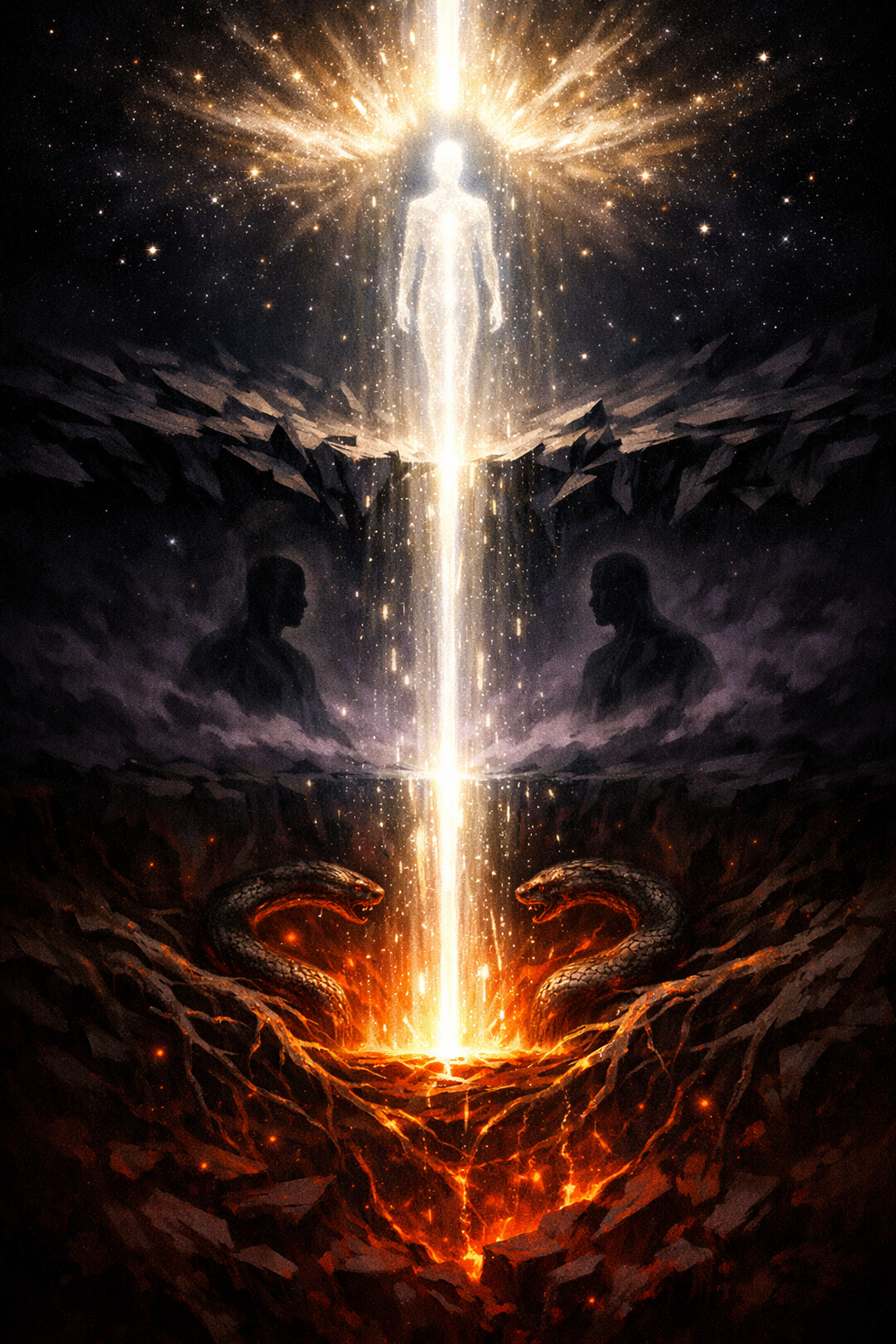
The Dweller and the Angel are not opposites but phases of one motion. The Angel is the coherent phase of Will, energy gathered into purpose and alignment. The Dweller is that same Will fragmented, resisting its own integration, terrified of extinction. Each implies the other: the Dweller’s chaos is the matrix of the Angel’s order; the Angel’s radiance casts the Dweller’s form. To meet one is already to invoke the other.
This polarity mirrors the relation between volition and inertia itself. True Will, in Thelema, is not mere choice but the dynamic through which consciousness integrates its own resistance. The Dweller is therefore not a tangent to volition but its test: the moment where desire confronts its own falsifications. To will truly is to move through that resistance without repressing or idolizing it, until the current is recognized as True Will.
IIb. The Dweller and the Shadow
Carl Jung’s Shadow is the nearest psychological analogue. The Shadow is the sum of traits the ego denies in itself: aggression, need, sexuality, projected outward or repressed inward as neurosis. Jung’s task is integration: to own the Shadow so it no longer sabotages conscious intention. Crowley’s task is transcendence: to pass through the Dweller so it no longer obscures the Angel.

The difference is teleological. Jung aims for psychic wholeness; Crowley aims for union with a trans-personal intelligence. For Jung, the integrated Shadow becomes creative potential: the artist’s rage, the lover’s jealousy, the leader’s drive. For Crowley, the Dweller integrated becomes transparent, allowing the Angel’s light to pass through without bending, delay, or coloration imposed by unintegrated egoic forces. Distortions that once misled perception, misread as inspiration, terror, or compulsion, fall away, leaving insight intact and consonant with True Will. The light is neither filtered nor amplified by the ego; it flows directly, revealing the current of volition as it truly is.
Yet both systems converge on one principle: the very energy that obstructs transformation is the same force that, once recognized, enables it.
IIc. The Dweller and the Id
Freud’s Id lies beneath both Shadow and Dweller: the reservoir of instinctual energy that drives hunger, sex, and aggression. It operates on the pleasure principle, indifferent to moral or social restraint. This is the raw current that volition must learn to channel. When repressed, the current reemerges in disguise as biological impulses dressed in spiritual or moral rhetoric, as when sexual desire resurfaces as a zeal for “purity.”
For Freud, the great danger to psychic stability is regression: the collapse of ego structure under the force of instinct, reducing the adult to infantile need. For Crowley, the danger to spiritual discernment is confusion: mistaking the Id for the Angel, using the language of divine inspiration to justify indulgence or cruelty. In both cases, Will becomes distorted when the instinctual current overwhelms or impersonates its guiding intelligence.
The Thelemic task is therefore not to silence instinct but to orient it and to recognize the Id as raw material for transformation. Properly routed, its energy becomes the motive force of the True Will, libido transmuted into creative and purposeful flow.
IId. The Dweller and the Real
Jacques Lacan, the French psychoanalyst who reshaped Freud through structuralist linguistics, understood subjectivity as something produced by language. His triad of the Imaginary, Symbolic, and Real frames the limits of what a person can know, speak, or integrate.
For Lacan, the Real is what cannot be absorbed into language. It is the raw fact of experience that escapes symbol or meaning. The Dweller is that encounter made personal: the moment the ego meets what it cannot explain or domesticate. The error is to mistake trauma for insight. To face it plainly, without pretense, is what opens the way to the Angel.
Both Lacan and Crowley describe transformation as a crossing of limits. For Lacan, it marks the point where speech fails. It is the boundary where the symbolic order collapses before what resists expression (Seminar XI). For Thelema, it is the point where Will discovers its own depth. The passage, in this view, is not an act of analytic interpretation, but of direct realization and immediate participation. True Will appears when the resistance falls away and purpose becomes lucid.
The Dweller, in all its guises: occult, psychological, instinctual, linguistic, is not an external adversary but the self’s own inertia at the edge of transformation. To will, in the Thelemic sense, is to transform resistance into motion. It is to pass from the divided will that wants to the True Will that acts ‘without lust of result.’
IIe. The Angel and Abulafia’s Ecstatic Union
Abraham Abulafia (13th-century Kabbalist) offers a pre-modern parallel to the Knowledge and Conversation. His prophetic Kabbalah aims at devekut, ecstatic union with the Active Intellect, through ḥokhmat ha-tzeruf (the permutation of Hebrew letters), controlled breathing, and specific bodily postures. The practitioner dissolves the ego in a torrent of divine names until the self becomes the Name pronouncing itself. The Angel, in this framework, is Abulafia’s Active Intellect individualized: not the universal Nous but the unique path of this soul’s return.

Abulafia’s method is combinatory; Crowley’s is evocatory. Abulafia rearranges the letters of Torah until the intellect combusts; Crowley invokes the Angel until the personality combusts. Both combustions leave a residue: for Abulafia, the prophetic voice; for Crowley, the True Will. The difference is symbolic rather than structural. Abulafia’s union dissolves the self into the infinite light of the Ein Sof; Crowley’s reveals it as a motion within the infinite expanse of Nuit.
Abulafia warns of spiritual madness, the intellect shattered by premature union. Crowley warns of the Black Brother, the ego clinging to the Abyss. Both dangers are the same: mistaking the method for the goal. The letters, the rituals, the visions are scaffolding. The Angel/Active Intellect is the underlying current the scaffolding was built to reveal.
IIf. Jouissance and Thelemic Ecstasy
Lacan’s jouissance is enjoyment that exceeds the pleasure principle: intense, excessive, sometimes painful, and always beyond ordinary comprehension. It is the orgasm that shatters the subject, the mystic’s rapture that dissolves the self, the addict’s fix that consumes the organism. In Thelema, jouissance appears at the precise moment the aperture opens beyond the ego’s capacity to contain the Angel’s current. The adept does not seek jouissance; it arrives when the circuit completes and the voltage spikes. Crowley captures this in the 18th Aethyr: “The intensity of the joy was such that I could not endure it; I cried out and fell.” Liber AL I:19 echoes the same reality in poetic terms: “the kisses of the stars rain hard on my body.” This is not ordinary pleasure (plaisir), but jouissance, the body convulsing under the full current.
Thelema distinguishes two registers of jouissance:
Phallic jouissance: The ego’s counterfeit rapture: orgasm, power, fame. It is the Dweller’s mimicry, the spike that contracts life into the silhouette of the subject.
Other jouissance: The rapture that expands the field until the subject dissolves. It is the Angel’s signature: the orgasm that is also a death, the death that is also a birth. The “kisses of the stars” are this Other jouissance, visible only when the aperture is wide enough to register the Angel’s current.
Lacan warns that jouissance is always stolen from the Other; Thelema insists it is returned. The adept does not hoard the spike; the spike is the return. The orgasmic convulsion in the 18th Aethyr, or the kisses of the stars in Liber AL, is not possession but dispossession. The danger is fixation at the phallic level: the adept who mistakes the spike for the Angel and builds a cult around the afterglow. The cure is continuity: to ride the spike into the next spike, until the spikes merge into a single, unbroken current.
In Thelema, this experience of jouissance is inseparable from True Will: the current flows unimpeded only when resistance falls away, revealing the trajectory of the self aligned with its own deepest purpose.
IIg. The Angel and Plotinus’ Henosis
Plotinus’ henosis (union with the One) is the Neoplatonic parallel to Knowledge and Conversation. The soul ascends through the levels of being—Body → Soul → Intellect → One—until it is no longer a part contemplating the One but the One contemplating itself through the soul. The Angel is Plotinus’ ‘One’ individualized: the unique aperture through which the One beholds this soul’s trajectory. Where Plotinus ascends by negation (stripping away multiplicity), Crowley ascends by evocation (summoning the individual into multiplicity). Both arrive at the same silence: the self that is fully realized beyond the sense of self.

Plotinus warns of spiritual vertigo, the soul mistaking the Intellect for the One and halting the ascent. Crowley warns of the Black Brothers, the ego mistaking the Abyss for the One and clinging to its own reflection. Both dangers are the same: arrested motion. The One/Angel is not a destination but a direction. The adept who “arrives” has already stalled. The test is continuity: does the union propel further acts, or does it collapse into stasis?
IIh. Nietzsche’s Wille zur Macht and the Thelemic Current
Friedrich Nietzsche’s Wille zur Macht (will to power) is the nearest secular analogue to Thelemic True Will, yet the resemblance is partial and the divergences instructive. Both concepts reject the slave-morality of resignation, locating value in the self’s overflow rather than external sanction. Yet Nietzsche’s horizon is immanent and biological, Crowley’s is transcendent and stellar. A comparative anatomy reveals the precise locus of each.
Nietzsche begins where instinct ends. The Wille zur Macht is not a specific desire (food, sex, dominion) but the meta-desire that all desires express: the drive to expand the force an organism can command. In Beyond Good and Evil §36 he writes: “The world seen from within…would be ‘will to power’ and nothing else.” Every act: digesting bread, composing a fugue, forgiving an enemy, is a modulation of this single continuum. Instinct is will to power at its most rudimentary; genius, at its most articulated.

Crowley would assent: instinct is raw power seeking form, but Nietzsche’s schema lacks a telos beyond expansion. The Übermensch embodies the will to power quantitatively: who commands the greatest circumference of force? Thelema introduces a qualitative criterion: does the act express the unique trajectory of this being? A tyrant may conquer continents and still violate True Will if conquest is not the song his Angel sings. Conversely, a recluse may remain in perfect conformity if contemplation is his being’s trajectory. Nietzsche measures by radius; Thelema, by resonance.
A second divergence is the role of consciousness. Nietzsche distrusts self-knowledge; the will to power operates most purely when it forgets itself in creation or destruction:“We are unknown to ourselves, we knowers…” (Genealogy of Morals, Preface). Crowley acknowledges that the hermetic axiom, “Know Thyself” is the hinge of the Great Work. The Angel is not reached by forgetting the self but by excavating it until only the self-that-is-fully-realized-beyond-the-sense-of-self remains. Nietzsche fears reflection as decadence; Crowley fears it only when premature, before the ego has been sufficiently abraded.
Their anthropologies also diverge in the status of suffering. For Nietzsche, suffering is the anvil on which the will to power is hammered into higher forms: “That which does not kill me makes me stronger” (Twilight of the Idols). Suffering is instrumental. For Crowley, suffering is diagnostic. The adept does not seek pain; when it arrives, it reveals the precise locus of residual resistance to the Angel’s current.
Finally, Nietzsche’s vision is tragic and finite. The ewige Wiederkunft (eternal recurrence) forces the will to power to affirm even its own annihilation. Crowley’s vision is cosmic and infinite. The Angel guarantees that every act, however small, is a letter in a correspondence that began before the Big Bang and will continue after the universe’s heat death. Nietzsche: amor fati: love your fate because it is the only one you have. Thelema can be thought of as amor stellae: love your star because it is the only one you are.
III. The Social Dimension of Volition
Thelema is often framed as an individual doctrine: “Do what thou wilt,” yet no will exists in isolation. Instincts themselves are shaped by the species’ long dialogue with the environment; passions are amplified or distorted by culture; even the discovery of True Will requires mirrors: teachers, lovers, adversaries, against which the self is refracted. The soldier who holds the line does so within a chain of command, a shared myth of duty. The artist’s vocation is confirmed when the work resonates in another person. True Will, then, is not solipsistic; it is relational. It discovers its contour through resistance and recognition. The adept must ask not only “What is my Will?” but “How does my Will intersect the wills of others without distortion?” Thelema, rightly understood, is the art of orchestrating multiple true wills into a harmony that does not mute any single note.
IV. Will and the Threshold of Consciousness
At the edge of sleep, in the hypnagogic flicker, decisions are made that the waking mind later claims as its own. Dreams enact entire narratives of volition. Lovers are pursued, enemies confronted, kingdoms built. Yet the dreamer wakes with no memory of choice. Are these nocturnal enactments outside the sphere of True Will? Or do they reveal a stratum of volition deeper than ego? Thelema must account for the unconscious will, the choices that precede articulation. Crowley’s emphasis on the Knowledge and Conversation of the Holy Guardian Angel points in this direction: the Angel is not invented by consciousness but encountered, a pre-existing current that consciousness learns to navigate. True Will, then, may operate at thresholds beneath language, aligning instinct and intention long before the mind names them.

This universality is the human inheritance. Across disciplines and epochs, the hypnagogic state has been a forge for revelation, where the ego loosens its grip and the star’s geometry emerges. Consider Thomas Edison, the inventor who weaponized the threshold. He napped with steel balls in his hands, balanced over tin plates. As sleep tugged, the balls dropped with a clatter, jolting him awake at the precise fulcrum of hypnagogia. In that flicker, ideas for the phonograph and motion picture cascaded, raw voltage routed into filament. Edison called it his “genius factory,” but it was the Angel’s laboratory: the aperture widened just enough for the current to spark without short-circuiting into full slumber.
Similarly, Paul McCartney awoke one morning in 1965 with Yesterday fully formed, a melody so seamless he first suspected plagiarism. “I woke up with a lovely tune in my head,” he recalled, “and I was in that half-dream state where you’re just drifting.” He rushed to the piano, fingers tracing what the hypnagogic haze had etched. McCartney’s “dream” was no accident; it was his star’s refrain, sung through the membrane between dream and wakefulness.

To these, add Salvador Dalí, the surrealist provocateur. He refined Edison’s method into slumber with a key: a spoon suspended over a brass plate. As hypnagogia bloomed, limbs melting, clocks dripping, the spoon slipped, clanging him back to capture the visions in fevered sketches. His Persistence of Memory emerged from such spikes: the ego dissolved, the Angel’s impossible geometries etched in oil. Dalí named it “pure psychic automatism,” but in Thelemic terms, it was Other jouissance, the rapture that expands the field, turning passion’s distortion into vocation’s precision.
August Kekulé, the chemist who unlocked benzene’s ring structure, dozed by the fire in 1865, exhausted from futile sketches. In the hypnagogic drift, a snake coiled around its tail—ouroboros, eternal cycle—revealing the molecule’s hexagonal dance. He leapt up, crying “Let us learn to dream!” The vision wasn’t mere fancy; it was the Angel’s syntax: instinct (the puzzle’s pressure) aligned with intention (organic form), birthing modern chemistry. Kekulé’s “dream” prefigured Crowley’s Aethyrs: a pre-articulated current, navigated upon waking.

These witnesses: Edison’s ingenuity, McCartney’s melody, Dalí’s delirium, Kekulé’s coil, span invention, music, art, science. They are not outliers but exemplars: the hypnagogic state as universal aperture, where the star’s voltage surges undistorted. In Thelema, this isn’t coincidence; it is the law. “Every man and every woman is a star,” and this star can appear as a flicker before sleep.
Lucid dreaming is a key. The sleeper becomes aware within the dream and chooses to fly, to confront the shadow-dragon, or to ask the dream-lover her true name. This is volition before the ego’s scaffolding. The lucid dreamer stands at the same aperture as the adept in ritual: the body sleeps, the mind half-transparent, the Angel’s current flows through the dream-body. Crowley practiced this in the Aethyrs: scrying while physically asleep, recording visions upon waking. The dream is not escape; it is laboratory.
Yet lucidity carries the Dweller’s shadow. The novice mistakes dream-powers for Angelic authority:“I can fly, therefore I am divine.” This is phallic jouissance: the spike without trajectory. The mature adept tests the current: Does this flight expand the field of life, or merely the ego’s silhouette? The dream itself becomes a crucible. The Angel speaks in symbol and geometry, a spiral staircase, a five-pointed star, a door that opens onto the warehouse fire from childhood.
A more extreme example is Walter Russell’s 39-day trance (1921). At age 49, the polymath entered a state of cosmic illumination, a trance-like suspension neither fully sleep nor waking, during which he sat continuously, neither eating nor moving from his chair, but intensely writing and drawing diagrams, equations, and universal principles as they poured through him. His wife, Helen, brought him water, which he drank sparingly to sustain the body; otherwise, the physical self was secondary to the torrent. For 39 days and nights, the aperture remained dilated, the ego suspended, as he channeled what he called the source of all knowledge.
Upon emerging, he refined the raw output into The Universal One—a synthesis of science, art, and metaphysics that anticipated wave mechanics, transmutation, and recursive light structures. Russell described the experience as “being the current itself”:
“I was not Walter Russell. I was the light of the One Mind thinking through the body of Walter Russell.”
Crowley’s Aethyr scrying was episodic; Russell’s trance was continuous. Both reveal the same principle: when the membrane between states dissolves, the star speaks in its native tongue: mathematics, geometry, music. The difference is duration and risk. Crowley returned nightly to the body’s anchor; Russell risked permanent dissolution, sustained only by water. Both survived because the current was routed, Crowley into ritual, Russell into illustration.
The threshold is not a barrier but a membrane. Instinct enters from below; the Angel descends from above. Lucid dreaming trains the membrane to flex to reveal that True Will is the current running through every state: waking, dreaming, deep sleep, cosmic illumination, until the adept realizes there is only one state and becomes the star remembering it is a star.
The adept’s task is to keep the channel clear. When pressure is acknowledged, masks are named, the Real is traversed, force is focused, the spike is ridden, the Name is pronounced, and the One is entered, every act, intentional or automatic, solitary or shared, conscious or dreamed, rejoins the one current and restores the practitioner to the ground that has always sustained them.
Thelema as volition is neither instinct alone nor deliberation alone. It is instinct given form as purpose, desire directed into course. Instinct provides the energy; True Will provides the path. Latency reveals the hidden gestation of both; relation discloses their necessary interdependence; the unconscious threshold reminds us that volition exceeds the ego’s grasp. The Holy Guardian Angel is the guarantor that the path is not arbitrary; the Dweller on the Threshold is the guardian that tests our readiness; Freud’s Id is the furnace, Jung’s Shadow the mirror, Lacan’s Real the wound, jouissance the spike, Abulafia’s Union the combustion, Plotinus’ henosis the silence, Nietzsche’s will to power the reminder that the path must be walked with force. The adept’s task is to align the primal core, discerning which impulses express Will and which dissipate its power.

Don’t let the conversation stop here. Join us at Blue Sky – @thebohemianstar.com. If you’re still lingering in the old spaces, you can also join our private inner circle over at The Bohemian Star Salon on Facebook to share thoughts on music, culture and the weird side of history.
Discover more from The Bohemian Star
Subscribe to get the latest posts sent to your email.