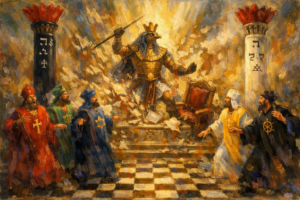
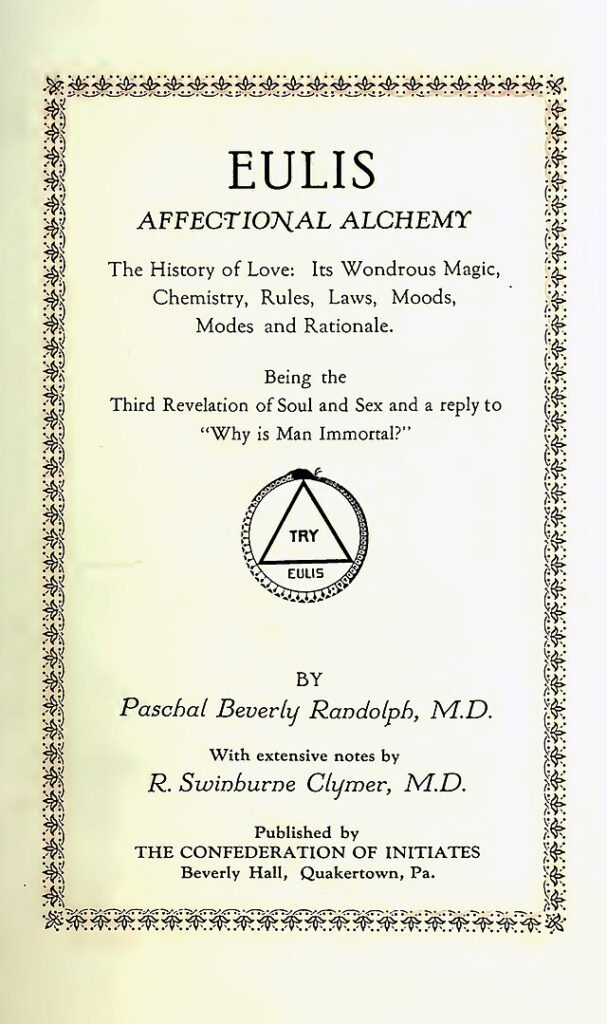
Paschal Beverly Randolph (1825–1875) was a Black American healer, mesmerist, and self-styled Rosicrucian whose 1874 book Eulis! is among the earliest modern texts to state, plainly and operationally, that the erotic act, performed under precise conditions, can be sacramental in effect. You don’t have to enjoy his stagey tone to see that he was an important figure in regards to the development of modern occult thinking: much later “sex-magic” replays the same instrument with different casing. Scholars like Joscelyn Godwin and John Patrick Deveney underline Randolph’s practical focus (Seership!, Eulis!) and his influence on the Hermetic Brotherhood of Luxor. Teresa Burns and Lana Finley add the crucial social context: a contested biography, contradictions in his racial politics, and a reception shaped by both racism and Randolph’s own pugnacious persona.
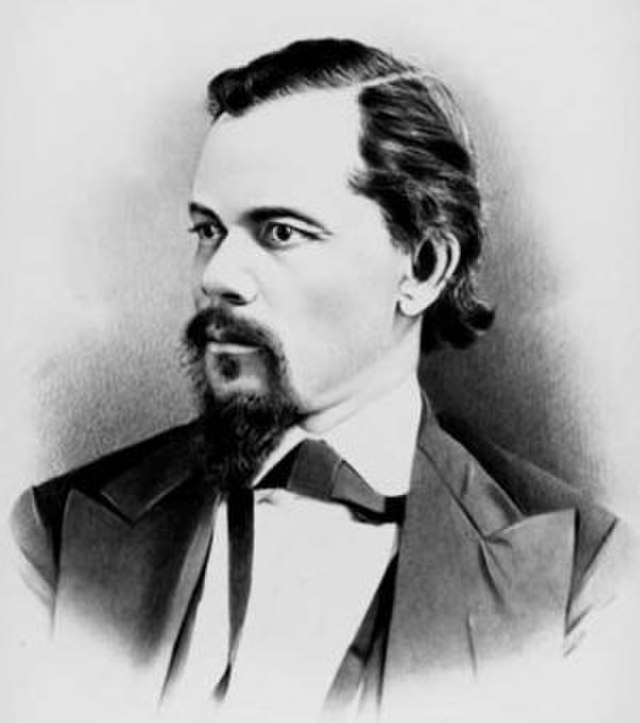
WHAT ARE A.A. AND YAE?
In Eulis, Randolph uses mysterious significators such as A.A. and YAE that he leaves unexplained. In one key line he writes of adepts who have “raised the veil of Isis … the—yae or the a.a.,” without glossing either term.
Possible motives (not mutually exclusive):
- Shibboleth for insiders: a wink to 19th-century occult readers.
- Doctrine of reserve: some meanings belong to oral instruction, not print.
- Sales mystique: purposeful opacity to suggest depth and invite initiation.
- Private vocabulary: especially for YAE, which does not appear as a common tag elsewhere.
Likely meanings (with caveats):
- A.A. most plausibly signals Arcanum Arcanorum (“secret of secrets”), a familiar capstone label in 18th–19th-century Egyptian/Memphis-Misraïm currents. This remains an inference; Randolph never spells it out.
- YAE reads like a house word, an affirming or numinous syllable left deliberately opaque. It resembles older vowel-names (see below), but Randolph never builds a numerological or Kabbalistic system around it.
THE KERNEL YOU CAME FOR
Beneath the velvet rhetoric sits a clear mechanism. For Randolph, the erotic act becomes operative when four conditions converge:
- Mutual love and consent (not mere appetite).
- Form (timing, breath, uninterrupted completion).
- Dedication (a stated inward aim—prayer, vow, petition).
- Record (attend to result and aftermath).
His axiom is crisp: Will is the vector; Love is the medium. Everything else—pedigrees, sermons, initials—is packaging.
HOW THIS RHYMES WITH OLDER CURRENTS (WITHOUT CLAIMING A LINEAGE)
- Tantra (especially Kaula/Śākta “left-hand” streams): ritual union (maithuna) framed by mantra, visualization, breath, vow.
- The Kāma Sūtra / kāmaśāstra literature: beyond positions—a householder’s discipline of timing, atmosphere, mutuality—form harnessed to higher aims.
- Taoist “bedchamber arts”: breath, timing, conservation/transmutation of vital force.
- Western hieros gamos and alchemical coniunctio: a sacred joining that does work.
When traditions aim to make sex sacramental and effective, they keep rediscovering the same scaffold: container (rules and form), attention (breath/imagery), intention (dedication), and ethics/safety (mutuality, timing). Randolph’s fourfold frame maps neatly onto that shared architecture.
RANDOLPH IN THE RECORD: PROMISE, CONTRADICTIONS, RECEPTION
Burns sketches the legendarium: shifting parentage stories, a childhood in New York poverty, a leap into Spiritualism, the sudden “M.D.,” and then “The Rosicrucian” who writes on magic mirrors, launches a “Brotherhood of Eulis,” and issues Eulis! with its long treatise on “Affectional Alchemy.” Godwin’s verdict is unusually practical: Seership! (for crystal vision) and Eulis/Ansairetic (for erotic-operative doctrine) became fundamental HBL documents. Deveney emphasizes that mythology has obscured a very real practical innovator. Finley reframes Randolph as a controversial African American celebrity and “race man”—a figure whose radical spirituality and self-fashioned identity limited memorialization within Black communities even as he shaped white occultists.
EULIS AND ELEUSIS; HBL AND THE “GRADE OF EULIS”
Randolph himself prompts the echo: “Many will suspect from our true name, Brotherhood of Eulis, that we really mean ‘Eleusis,’ and they are not far wrong. The Eleusinian Mysteries were mysteries of sex.” He uses the Eleusis aura to frame his sacramental erotic method in the key of “mysteries.”
On the receiving end, the Hermetic Brotherhood of Luxor made “Grade of Eulis” its entry point and circulated Randolph’s manuscripts, even while sometimes dismissing him as “half-initiated.” The family resemblance between HBL’s Near-Eastern-tinted practical occultism and Randolph’s is hard to miss.
HOW THE IDEA TRAVELED (EULIS → H.B. OF L. → H.B. OF LIGHT → O.T.O.)
This section spells out the transmission for readers who don’t know the acronyms.
Brotherhood of Eulis (USA, 1870s)
Randolph publishes Eulis! (1874) and circulates private teachings like the Mysteries of Eulis to selected students.
Hermetic Brotherhood of Luxor / H.B. of L. (Britain/USA, 1880s)
A practical occult study order that, early on, used Randolph’s manuscripts. Its first grade was literally called the “Grade of Eulis” (later retitled “Grade of Eros”). Internally, some members warned he was “half-initiated,” even as they kept his methods.
Hermetic Brotherhood of Light (USA, 1890s)
A related later body (appearing, for example, in Chicago in the mid-1890s) that carried forward H.B. of L. threads.
O.T.O. (Ordo Templi Orientis) and Karl Kellner (Austria/Germany, 1890s–1900s)
Industrialist Karl Kellner (1851–1905) co-founded the O.T.O., an initiatory order that emerged from the Hermetic Brotherhood of Light milieu. The O.T.O. systematized several streams, including sexual-magical work, into a new umbrella framework. In plain terms: techniques that first surfaced publicly in Randolph’s circle moved through lodge networks and were later formalized in different organizational settings.
HOW ESOTERIC TEACHINGS ACTUALLY TRAVEL
Esoteric wisdom doesn’t move through clean pipes; it passes through people. Transmission always mixes wisdom and error.
- Hand to hand, not hand to glass. Print preserves the blueprint; people preserve the feel. A teacher’s emphasis and a student’s notebook shape what survives.
- Networks, not monoliths. Methods cross Spiritualist parlors, Masonic side-rites, Rosicrucian salons, and occult lodges. Each retells the act in its own dialect.
- Editors and heirs. Custodians “improve” what they inherit—adding diagrams, trimming scruples, bolting on metaphysics. Some edits help; others create forgeries of tone the originator never wrote.
- Prestige as carrier wave. Undefined initials and grand titles make ideas legible to the next circle—and attract barnacles. A.A. reads as a familiar capstone; YAE advertises a private Word. Expect both signal and static.
- Recontextualization. A householder’s private rite may later be staged as public ritual or slotted into grades and oaths. The operation travels even as the ornaments change.
What tends to survive is the act itself, along with a few safety and timing rules, and a terse sentence of doctrine (“Will + Love”).
What spoils: tone (scold becomes shibboleth), motives (caution becomes control), proportions (method buried under spectacle), attributions (retrofit numerology where none existed).
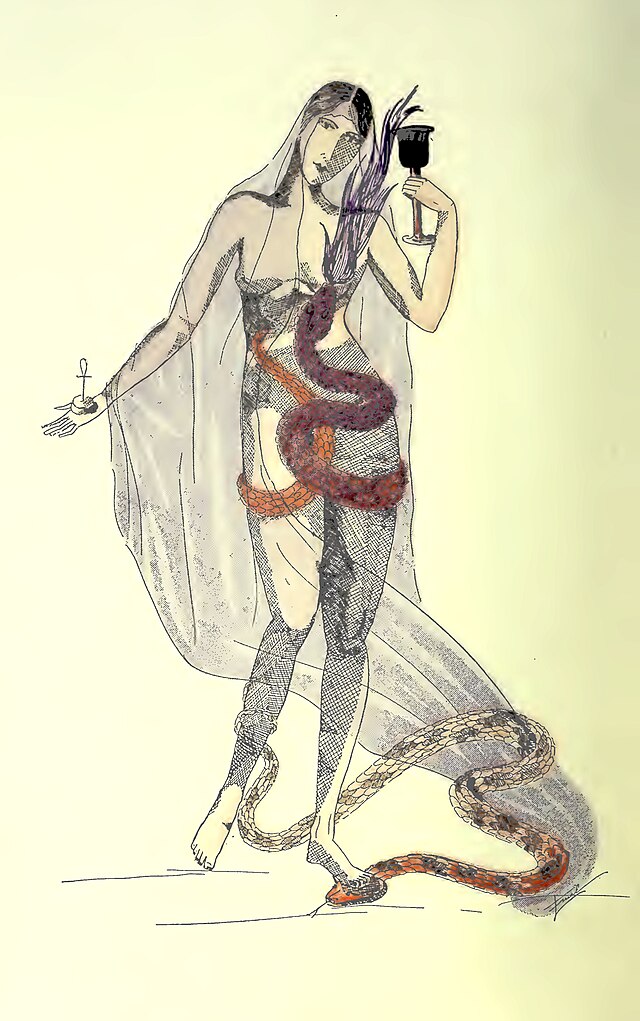
HOW TO READ EULIS! WITHOUT GETTING LOST
- Find the instrument. Skip pedigree paragraphs; go straight to numbered maxims and procedures.
- Translate the accent. The Victorian “medical-moral” voice (anti-masturbation jeremiads, “vital force” talk) is era, not essence. Ask what function a rule serves (attention, safety, fidelity). Keep the function; drop the scold.
- Handle the sigla up front. A.A. likely signals Arcanum Arcanorum; YAE is a house word. There’s no gematria scheme here. If decoding doesn’t change practice, let practice speak.
- Run the friction test. Can the consecrated act survive interruptions, ordinary work, and grief without turning precious or coercive? If not, the problem isn’t transmission; it’s design.
- Keep a ledger. If you experiment, note method, timing, conditions, effects. Prefer results that make you steadier, kinder, more capable to those that only make you feel “chosen.”
A FIELD GUIDE TO SILT AND GOLD (FOR ANY TRANSMISSION)
- Silt: undefined initials wielded as proofs; lineage gossip; purity theater; editors’ “improvements” that add certainties but subtract scruples.
- Gold: clear steps and boundaries; cautions that reduce harm; principles that scale to ordinary life; sentences you can live by.
The inevitability of drift isn’t a reason to quit; it’s a reason to pan. Keep the method. Test it under real conditions. Refuse what only inflates prestige.
Randolph’s lasting value isn’t that he solved a cipher; it’s that he named a possibility: ordinary energies—especially love—become extraordinary when consciously offered under will. Take that seriously and you inherit more than a pedigree. You inherit a practice.
QUICK GLOSSARY FOR GENERAL READERS
Hermetic Brotherhood of Luxor (H.B. of L.): A late-19th-century practical occult study order active in Britain and the U.S., known for hands-on techniques (clairvoyance, magnetism, ethics, and later sexual-magical cautions). It drew on Randolph’s manuscripts; its first grade was “Grade of Eulis.”
Hermetic Brotherhood of Light: A related later body (1890s), especially in the U.S., that carried forward H.B. of L. lines and served as a bridge into later lodge systems.
O.T.O. (Ordo Templi Orientis): An initiatory order formed in the early 1900s in the German-speaking world. It gathered several esoteric streams (including sexual-magical work) into a graded system. Karl Kellner, an Austrian industrialist, was a key early figure.
A.A. (in Randolph): Most plausibly a period shorthand for Arcanum Arcanorum (“secret of secrets”), a capstone label; not defined by Randolph on the page.
YAE (in Randolph): A house word—an affirming/numinous syllable he uses without defining, likely meant as a private shibboleth or “Word.”
IAO / IAE (Iaê): Ancient vowel-names of power found in the Greek Magical Papyri. Frequently appear with Hebrew titles (Sabaoth, Adonai). Scholars link IAO to Greek renderings of the Hebrew divine name.
Join the conversation in The Bohemian Star Salon, our private Facebook group for deep discussions, rare tracks, obscure lore, and unfiltered thoughts on music, culture, and the weird side of history.
Join The Bohemian Star Salon