

Reclaiming the Meaning of “Christos”
Anointing the Obvious
“Christ” wasn’t a surname. Nobody in Galilee said, “Mr. Christ, table for twelve.” It was a title, from the Greek Christos, meaning “anointed” or “salved with oil.” In antiquity, Christos could describe a priest, a king, or even a wrestler glistening before a match. To be Christos was, quite literally, to be oily.
The Sacred Recipe
The Hebrew word māšîaḥ—rendered Messiah in English—carried deeper significance. It meant one set apart through a sacred anointing oil. Exodus 30:22–25 lists the ingredients: olive oil mixed with myrrh, cinnamon, cassia, and kaneh-bosem. Many translations render the last term as “calamus,” though some scholars argue it referred to cannabis. The mixture was potent, reserved for ritual use, and forbidden for common wear. Anointing with it visibly and aromatically marked a person as chosen.
Borrowed Scents and Ancient Sources
Across Egypt, Mesopotamia, and Canaan, people used perfumed oils in burial, medicine, and worship. Egyptian priests coated statues and mummies with resins and myrrh. Oil masked decay, preserved bodies, and signaled sanctity. Anointing became a way of turning the ordinary into the sacred, a tactile theology of transformation.
By the first century, people had likely lost the original temple recipe. What survived was the expectation of a coming Anointed One, a liberator in David’s line who would restore Israel’s independence and divine favor.
The Meaning of Christos at Bethany
Textual Variations and Sources
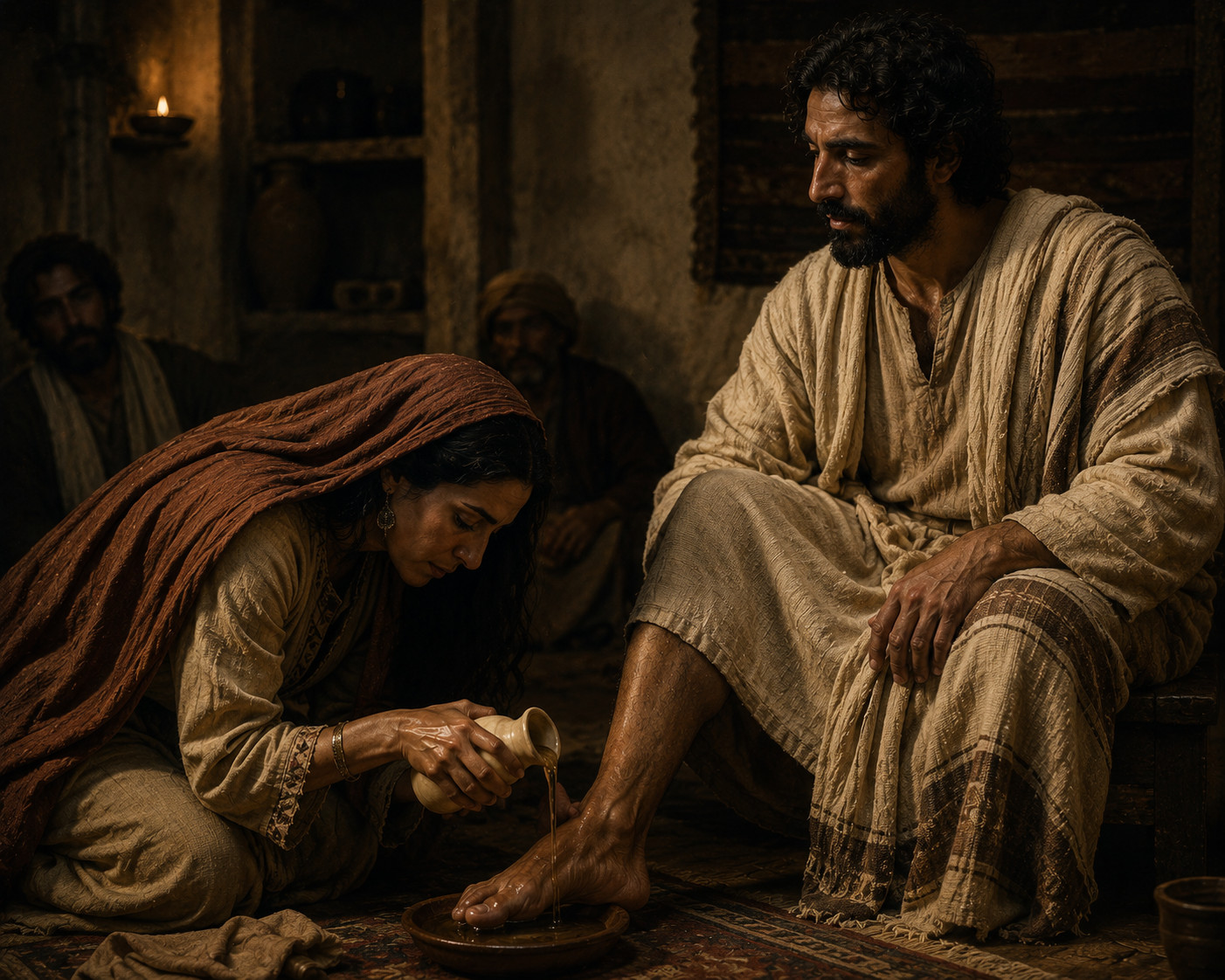
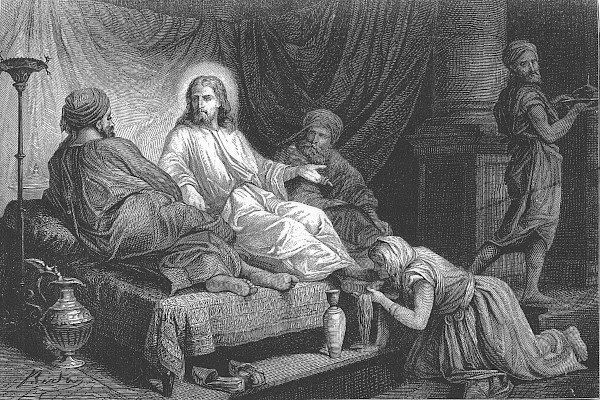
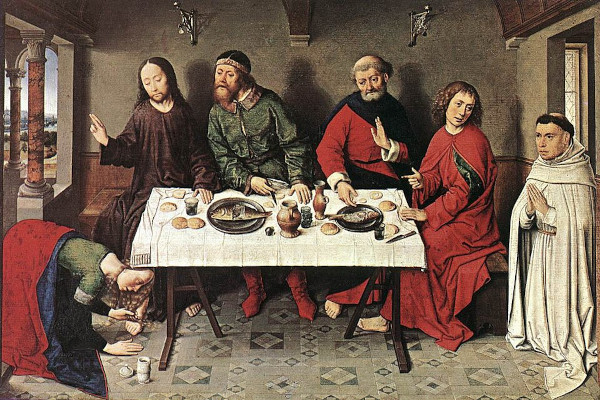
The story of Yeshua’s anointing appears in every Gospel, but changes shape with each telling. Luke locates the scene in the house of a Pharisee named Simon, where a woman known as a sinner washes Yeshua’s feet with her tears before consecrating them with oil. Mark (14:3–9 and Matthew (26:6–13) shift the story to Bethany, to the home of Simon the leper, where an unnamed woman breaks an alabaster jar. John (12:1–8) retells it once more, naming the woman as Mary of Bethany and focusing on the anointing of the feet.
Three tellings, possibly one event …or none.
The names shift, the hosts change, the body parts vary, and the moral emphasis wanders from forgiveness to consecration. Some scholars see three distinct traditions in the Gospels; others treat them as variations of a single remembered moment; still others read the story as a literary ritual that symbolizes Yeshua’s recognition as Christos.
The timing of the texts makes certainty impossible. Mark, the earliest Gospel, appeared around 70 CE. A decade or two later, Matthew and Luke circulated among developing Christian communities. John reached written form near the end of the first century. The disciples themselves didn’t write these accounts: Acts 4:13 describes them as “unlearned and ordinary men.” Educated followers wrote these stories decades later in Greek, shaping oral and written traditions for communities that already regarded Yeshua as divine. In historical terms, these writings function as theological reflections, not eyewitness memoirs.
Meaning and Allegory
This doesn’t diminish their value. It clarifies their purpose.
Each account uses the act of anointing as a vehicle for meaning. Whether in a Pharisee’s dining room, a leper’s home, or among friends in Bethany, the gesture is always transgressive: a woman crossing boundaries of purity to touch what is sacred. Oil, in the ancient world, marked kings, priests, and corpses. Here it marks an outsider. It is not a priest or ruler who declares Yeshua the Christos; it is a woman with a jar of oil and the instinct to honor what she perceives.
Taken together, the anointing stories read less as reportage than as ritual allegory, a meditation on recognition, compassion, and inversion. This act occurs in unclean spaces, performed by those marginalized from official religion. The Gospels differ in their details, yet they all stress the same idea: sanctity begins with those living beyond the sanctioned order.
Whether one event, two, or three, the story’s value lies in its symbolic continuity. The anointing scene marks the moment Yeshua becomes “the Oiled One,” the Christos. Whether the tradition reflects one event, two, or three, its value lies in symbolic continuity. The anointing scene marks the moment Yeshua becomes “the Oiled One,” the Christos. A human gesture recognizes him, outside the reach of temple or empire. The story endures because it turns a simple act into a statement about where holiness is found and who holds the authority to name it.
Names Through Empire
The man known as Yeshua became Iēsous in Greek, Iesus in Latin, and finally Jesus after the letter “J” entered English in the sixteenth century. Over time, “Jesus Christ” fused into a single phrase through translation, empire, and institution, a linguistic evolution that turned a tactile title into a theological trademark.
The Oiled One Remembered
Beneath centuries of doctrine, the original image still gleams: someone marked by oil, touched by another’s hands, set apart by an act of love and devotion outside the reach of hierarchy, an anointing that claimed holiness from below, not bestowed by priests but born in the hands of a commoner. The title began as a common Greek adjective, a word for being coated with oil. Only later did it enter the language of divinity. Later still, empire claimed that language for its own purposes. I take up that shift in Two Kingdoms: Yeshua’s Revolution and Christianity’s Empire, where the politics of anointing becomes the politics of rule.
Don’t let the conversation stop here. Join us at Blue Sky – @thebohemianstar.com. If you’re still lingering in the old spaces, you can also join our private inner circle over at The Bohemian Star Salon on Facebook to share thoughts on music, culture and the weird side of history.
Discover more from The Bohemian Star
Subscribe to get the latest posts sent to your email.


