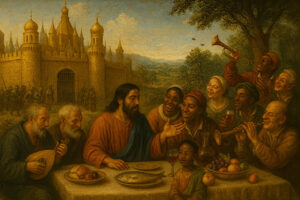
The Canaanite Gods Who Shape Today’s Theocratic Creep
There’s a world of difference between religion as a private sanctuary: conscience, ritual, and inner life, and religion as a lever of power. The first is deeply personal. The second weaponizes belief to claim authority, write laws, and impose conformity on everyone else. In America today, that line is being deliberately blurred, if not erased outright.
Legislators push the Ten Commandments as if they were civic law while political movements declare divine mandates. Leaders are cast as “chosen,” dissenters branded as enemies of God, and every election or court ruling hailed as divine judgment. An ancient machinery of hierarchy, obedience, and divine right has stirred from its sleep and is reaching for the levers of government.
The Canaanite Roots of Yahweh, El, and Divine Kingship
To understand this shift, we can look back to its foundations in the ancient Near East. The gods of Canaanite mythology and the emerging figure of Yahweh took shape within a world of storm deities and divine assemblies. The Ugaritic Baal Cycle, preserved on tablets from roughly 1400–1200 BCE, portrays the storm god Baal (Baʿal Hadad) as the “Rider on the Clouds.” He battles chaotic forces such as the sea god Yam and the death god Mot for kingship within the divine assembly. Baal embodied rain, fertility, and dynamic power.
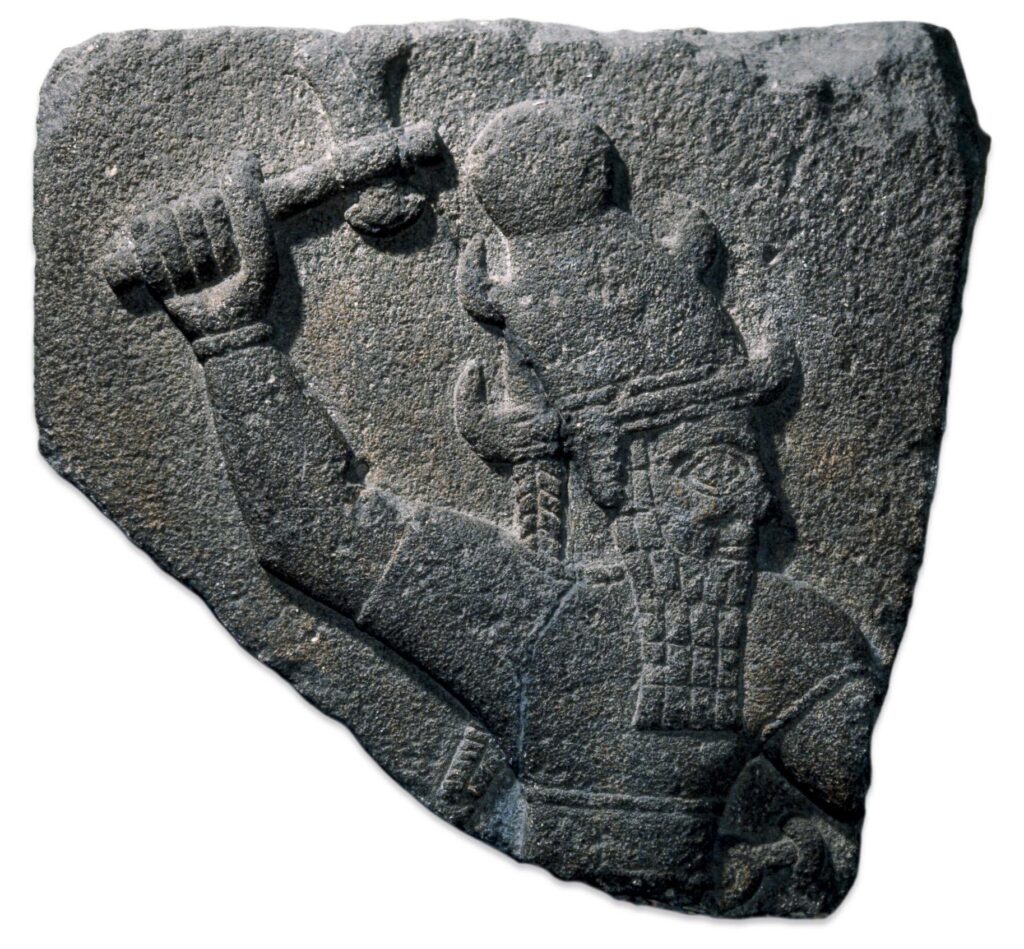
Yahweh, the god who would eventually take over Israelite religion, didn’t start as the universal, all-loving Father of later monotheism. The earliest extra-biblical reference to Yahweh appears in an Egyptian temple inscription at Soleb in Nubia, from the reign of Pharaoh Amenhotep III (c. 1390–1352 BCE). It mentions “the land of the Shasu of Yahweh.” This is thought to refer to pastoral nomads linked to southern regions such as Edom, Seir, or Midian. Yahweh likely began as a warrior-storm deity among these southern groups, later migrating northward.
In the Canaanite/Ugaritic pantheon, El stood as the chief god: a wise, elderly creator and father figure known as “El Elyon” (“Most High”) and “creator of heaven and earth,” often symbolized by bull imagery. The name “El” simply means “god” in Semitic languages, and “Israel” itself likely means “El strives” or “May El prevail.” Early on, Israelites integrated Yahweh into this pantheon as one of El’s “sons.”
Yahweh in the Divine Council
A key window into this stage survives in Deuteronomy 32:8–9. In the standard Masoretic Text, the Most High (Elyon) divides the nations “according to the number of the sons of Israel.” In this version, the Lord’s portion is Jacob. However, fragments from the Dead Sea Scrolls and the Septuagint refer instead to the “sons of God” (bene elohim). In that version, Elyon assigns the nations among divine beings while Yahweh receives Israel as his inheritance. This earlier rendering reflects a phase in which Yahweh operated within a larger divine council headed by El. It predates the later theological merger that identified Yahweh with El himself. The same transitional worldview appears in the First Commandment: “You shall have no other gods before me” (Exodus 20:3). The phrasing assumes the existence of other gods as real rivals or options; it demands exclusive loyalty to Yahweh rather than denying that other deities exist at all. Such language isn’t necessary in a strictly monotheistic system that asserts no other gods are real.
Yahweh’s Merger with El and the Absorption of Baal
Over time, likely beginning in the early Iron Age (c. 1200–1000 BCE) and accelerating under the monarchy, Yahweh gradually merged with and absorbed El.
This merging helped unify Israelite identity. Yahweh absorbed El’s attributes as supreme creator and patriarch. He took on titles such as El Shaddai (“God Almighty”) and El Elyon (“Most High”). Creator language was also applied to him. This is reflected in passages such as Genesis 14:19–22 and Exodus 6:2–3. The Priestly source notes that Yahweh appeared to the patriarchs as El Shaddai but later revealed his personal name. At the same time, Yahweh absorbed traits from Baal. As Yahweh-worshipping groups settled in or influenced the central highlands of Canaan in the late 13th and 12th centuries BCE, this process intensified. He took on the characteristics of a storm, fertility, and warrior god. Prophets and reformers such as Elijah and Hosea condemned Baal worship and portrayed Yahweh with Baal-like power. In doing so, they effectively co-opted Baal’s traits to assert Yahweh’s superiority. This absorption is clearest in early biblical poetry:
- Yahweh is called “rider of the clouds” (Psalm 68:4; Isaiah 19:1), a direct Baal epithet.
- Storm theophanies depict Yahweh thundering, sending lightning, and shaking the earth (Psalm 29, which scholars widely regard as drawing heavily from Canaanite hymns to Baal or as a near-direct adaptation of such a hymn; see also Psalm 18 and Habakkuk 3).
- Yahweh claims victory over sea and chaos monsters, paralleling Baal’s battles with Yam and Mot (Yahweh vs. Leviathan or Rahab in Psalms and Isaiah).
- The role of fertility and rain provider shifts to Yahweh, dramatized in the contest with Baal’s prophets in 1 Kings 18.
Yahweh eventually assumed El’s position as head of the divine council. Over time, he supplanted El entirely. Israelite religion evolved from worshiping one primary god among others toward exclusive monotheism. This shift became especially pronounced after the Babylonian exile.
The Cosmic Divorce: Yahweh, Asherah, and the Forging of Patriarchy
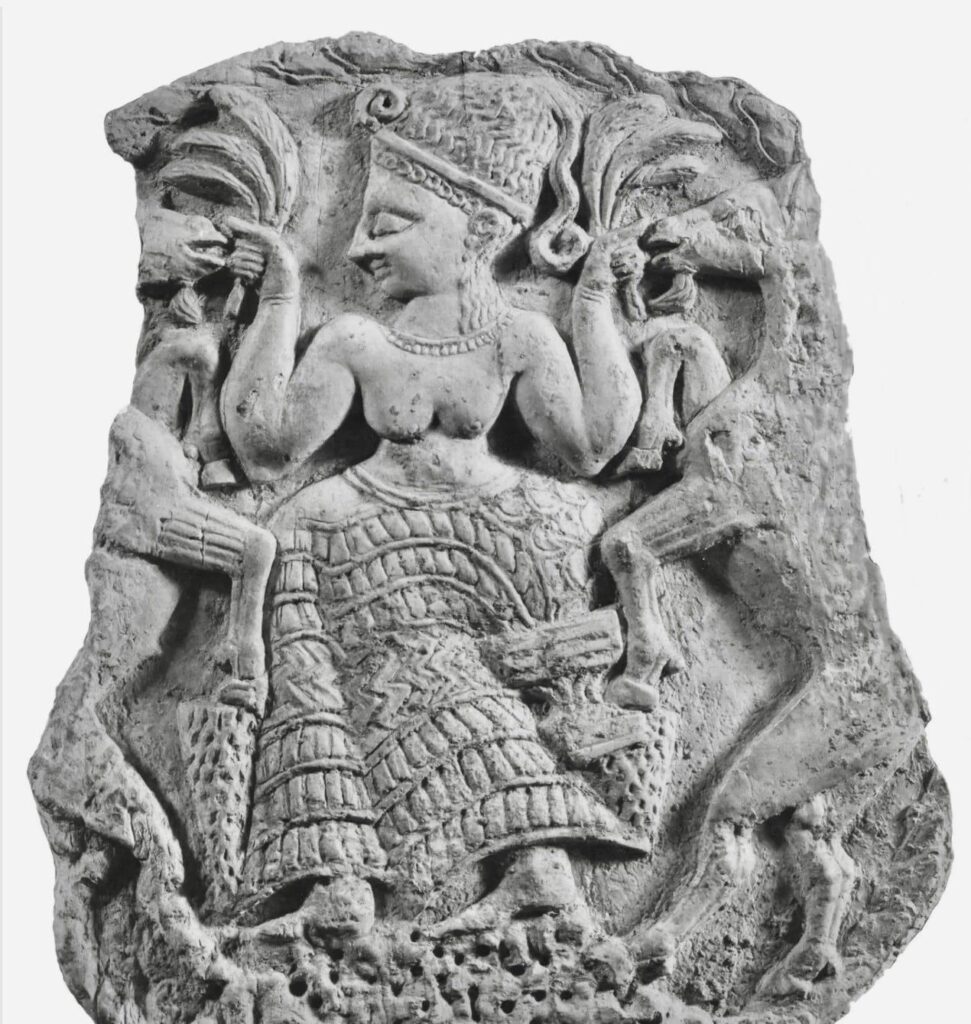
In the older Canaanite pantheon, El’s consort was the goddess Asherah, queen of heaven, mother of the gods, and embodiment of fertility and sacred groves. As Yahweh absorbed El’s identity, he effectively claimed Asherah as his own. Inscriptions at Kuntillet Ajrud and Khirbet el-Qom explicitly reference “Yahweh and his Asherah.” These findings show that the divine pair was once venerated together in popular Israelite religion. Over time, priestly editors in the exilic and post-exilic periods performed a thorough theological purge. They condemned Asherah’s sacred poles (asherim), destroyed her shrines, and erased her from the official cultus. What had been a royal divine partnership dissolved in a kind of cosmic no-fault divorce. The goddess disappeared from the scriptural record and in her place stood a solitary male sovereign enthroned above a now-subordinate creation.
This process of syncretism helped forge a strict patriarchy. Priestly editors subordinated the divine feminine and eventually eliminated it. The shift mirrored and reinforced earthly hierarchies of obedience, male authority, and conditional dignity.
Myth, Moses, and the Limits of Archaeology
Early Israelite religion, emerging in the Canaanite highlands around 1200 BCE, was culturally continuous with its neighbors. Material culture shows no sudden Egyptian imprint from any mass exodus. The grand biblical narrative of Egyptian captivity includes mass enslavement, plagues, a parted sea, forty years in the wilderness, and the full revelation of the Torah at Sinai. This narrative functions as a foundational myth that shapes collective identity. It doesn’t record verifiable events on a national scale. Egyptian records contain no mention of large-scale enslavement, plagues, or an exodus, despite the empire’s detailed bureaucracy. Early Iron Age Israelite material culture also remains overwhelmingly local and Canaanite in character. The Merneptah Stele (c. 1207 BCE) mentions “Israel” already present in Canaan. Scholars have proposed the existence of small historical kernels behind the tradition. These may include a proto-Israelite group or Levites with Egyptian connections. Some also point to the Midianite or Kenite hypothesis, which links Yahweh’s origins to southern nomadic groups. This detail echoes the biblical account of Moses encountering Yahweh in Midian.
The Exodus Myth and the Figure of Moses
At the center of this mythic tableau stands Moses, the archetypal liberator, lawgiver, and mediator. Moses is portrayed as the figure who confronts Pharaoh, parts the sea, receives the Torah from Yahweh at Sinai, and leads the people through forty years of wilderness wandering. He embodies divine authority in human form. Archaeology offers no contemporary Egyptian records of such a figure and has found no evidence of a mass exodus of hundreds of thousands. There are no remains of large wilderness encampments and no sudden shift in material culture. Like the Exodus story itself, Moses functions as a powerful symbolic anchor who shapes identity and legitimizes law while remaining unverifiable as a literal historical figure. The laws associated with him reflect a long regional tradition of ancient Near Eastern legal codes. Some elements resemble the Code of Hammurabi written centuries earlier.
The Gradual Birth of Judaism
Widespread, everyday observance of detailed Torah laws becomes evident only in the mid-to-late 2nd century BCE during the Hasmonean period. Judaism didn’t emerge fully formed, but developed gradually over time. Iron Age Yahwism, from roughly 1200 to 600 BCE, branched from Canaanite polytheism or henotheism. This earlier system included a divine council and, at times, a consort. Prophets later pushed for exclusive Yahweh worship, especially during crises such as the Assyrian conquest in 722 BCE. Full monotheism crystallized during and after the Babylonian exile between 587 and 539 BCE. This period prompted extensive editing of texts to emphasize covenant and purity. The Torah reached something close to its final form during the Persian and Hellenistic periods. The Babylonian exile, by contrast, rests on solid historical ground. This real cultural trauma accelerated a theological shift toward exclusive monotheism.
The Exodus story and the figure of Moses crystallized as a shared belief system framing identity around chosenness, covenant, and divine deliverance. By the time of Yeshuah (Jesus) in the 1st century CE, this cultural reality had become deeply embedded.
Monarchical Metaphors and the Psychology of Hierarchy
At the heart of this system lies its linguistic and metaphorical structure. The Abrahamic traditions of Judaism, Christianity, and Islam overflow with monarchical language: God as “Lord,” Heaven as “Kingdom,” the faithful as “servants” or “chosen people,” and ultimate hope vested in the return of the “King of Kings” and “Lord of Lords.” This vocabulary mirrored the dominant political reality of the ancient world. Ancients cast the divine in the image of empire: hierarchical, unquestionable, and demanding obedience.
The removal of the divine consort only intensified this interpretation, removing any feminine counterbalance and embedding a cosmic patriarchy at the root of religious imagination.
Wilhelm Reich, in The Mass Psychology of Fascism, observed how such systems internalize authority. They condition individuals to view hierarchy as natural and submission as moral virtue. Cognitive linguistics shows that repeated royal metaphors structure thought itself, making egalitarian democratic premises feel secondary or even unnatural.
From Civil Rights to Chosenness: The Double-Edged Sword

Consider the civil rights movement. Defenders of religion often cite it as proof of scripture’s moral power. Martin Luther King Jr. masterfully drew on biblical imagery: Exodus as a template of liberation, prophetic calls for justice rolling “down like waters,” and the “beloved community” as a realized kingdom. The actual moral force, though, arose from lived persecution: Jim Crow laws, lynching, systemic exclusion, and daily inequity. Religion supplied trusted networks of churches, shared symbolic vocabulary, organizational focus, and safe spaces for mobilization. Leaders selected and amplified the most liberatory strands of the Bible while navigating the tradition’s deeper monarchical and in-group currents.
The same pattern of drawing on familiar religious traditions for mobilization appears across cultures. Mahatma Gandhi was able to relate his concept of satyāgraha because the principle of ahimsa was already embedded in Indian culture. With both MLK and Ghandi, it was the real human suffering that provided the drive while familiar religious or cultural symbols supplied an accessible medium for collective action.
In the case of the American civil rights movement, this reliance on existing religious architecture also reinforced its underlying hierarchy. Even movements that successfully used biblical imagery to advance justice ended up strengthening the Abrahamic monarchical metaphors, chosenness theology, and divine-sovereignty structures that later enabled exclusionary politics. Today we see the cost: the neurological and cultural habit of viewing the world through covenant, chosenness, and divine favor has been repurposed to justify division instead of equality.
Central to this architecture is the concept of chosenness. To be “chosen” means to stand set apart as God’s “treasured possession” (Deuteronomy 7:6). Originally an ethno-cultural survival strategy for a small highland people navigating imperial pressures, chosenness creates a durable insider/outsider distinction. Those outside the covenant rank implicitly lesser: gentiles, goyim, nations to be blessed, converted, or judged. This ethno-cultural hierarchy has repeatedly served as a weapon across history. Christianity reframed it through the “new covenant” and the Church as spiritual Israel; Islam through the final ummah. When fused with political power, chosenness justifies exclusion, territorial claims, or differential rights.
The Translation into Public Policy and Environmental Risk
The danger crystallizes when these narratives translate from private belief into public policy. Mythic or theologically shaped stories elevate doctrine over evidence, make rights conditional on conformity to religious rules, and turn law into an instrument of belief rather than an impartial framework for justice.
This has concrete consequences far beyond social issues. Recent state-level efforts to mandate poster-sized displays of the Ten Commandments in every public school classroom, from Louisiana to Texas, Arkansas, and Alabama illustrate the push to embed biblical authority directly into civic education.
Consider the environment. If people view the world as fundamentally “fallen,” temporary, and destined for divine judgment, then long-term stewardship of the planet can appear pointless or even contrary to “God’s plan.” Why invest in protecting rainforests, curbing emissions, or preserving biodiversity if the “Kingdom of Heaven” is imminent and the current creation is slated for destruction and renewal? Genesis 1:28’s “dominion” language, when interpreted through a hierarchical, monarchical world view, easily slides from responsible care into exploitation. Secular governance treats the planet as a shared, finite home requiring collective, evidence-based responsibility across generations.
Christian Nationalism and Young Earth Creationism in America Today
Nowhere is this translation more overt today than in the rise of Christian nationalism. In its various strains, Americans recast their country as a latter-day covenant nation under explicit divine mandate. Political leaders appear as modern divinely “chosen” instruments.
Recent surveys show that roughly one-third of Americans qualify as Christian nationalism adherents (about 11%) or sympathizers (about 21%), with a majority of Republicans (56%) falling into these categories. Among white evangelical Protestants, support reaches 67%.
Closely allied with this political theology stands Young Earth Creationism, which insists the universe is roughly 6,000–10,000 years old and Genesis must be read as straightforward history.
Gallup polls show that 37% of Americans believe God created humans in their present form within the past 10,000 years. When fused with Christian nationalist politics, it subordinates empirical reality, including climate science, to a mythic timeline.
Democracy’s Alternative Premise
The promise of a democratic, pluralistic, secular society rests on a radically different premise: no one is above the law, no one is born beneath it, and authority derives from the consent of the governed rather than divine decree. This premise clashes with a worldview centered on an ultimate and eternal divine monarchy.
Addressing this doesn’t require prohibiting private faith. The bright line is clear: it is not acceptable for the State to adopt or enforce any single religion as official policy or preference. Public policy must remain anchored in secular, evidence-based standards that protect pluralistic institutions and cultivate an ethical model grounded in shared human dignity and opportunity.
We have inherited these ancient stories from Canaanite roots, nomadic origins, and centuries of editing by priests and scribes, along with the looming phantom of Moses as mythic lawgiver. In an era of theocratic creep and democratic strain, deprogramming the architecture of authority may be one of the most essential acts of cultural and political liberation available. Facta non verba — deeds, not words. The social commons is maintained by deeds, and those deeds must be rooted in our common needs and interests. Belief can remain private. Power, as well as the future of our shared environment, must remain accountable to all
In the next installment, Armed and Anointed, we will be taking a more detailed look at Christian Nationalism in the United States.

Join the conversation in The Bohemian Star Salon, our private Facebook group for deep discussions, rare tracks, obscure lore, and unfiltered thoughts on music, culture, and the weird side of history.
Join The Bohemian Star Salon
Bibliography:
- Aling, Charles F., and Clyde E. Billington. “The Name Yahweh in Egyptian Hieroglyphic Inscriptions.” Bible and Spade 22, no. 3 (2009): 79–84.
- Dever, William G. “Asherah, Consort of Yahweh? New Evidence from Kuntillet ʿAjrud.” Bulletin of the American Schools of Oriental Research 255 (1984): 21–37.Gallup. “Majority Still Credits God for Humankind, but Not Creationism.” Gallup News, July 22, 2024. https://news.gallup.com/poll/647594/majority-credits-god-humankind-not-creationism.aspx.
- Meshel, Ze’ev. Kuntillet ʿAjrud: A Religious Centre from the Time of the Judaean Monarchy. Jerusalem: Israel Museum, 1978.PRRI (Public Religion Research Institute). “Mapping Christian Nationalism Across the 50 States: Insights from PRRI’s 2025 American Values Atlas.” February 2026. https://prri.org/research/mapping-christian-nationalism-across-the-50-states-insights-from-prris-2025-american-values-atlas/.
- Smith, Mark S. The Ugaritic Baal Cycle. Vol. 1, Introduction with Text, Translation and Commentary of KTU 1.1–1.2. Supplements to Vetus Testamentum 55. Leiden: Brill, 1994.
- Smith, Mark S., and Wayne T. Pitard. The Ugaritic Baal Cycle. Vol. 2, Introduction with Text, Translation and Commentary of KTU/CAT 1.3–1.4. Supplements to Vetus Testamentum 114. Leiden: Brill, 2009.
- Tigay, Jeffrey H. Deuteronomy. JPS Torah Commentary. Philadelphia: Jewish Publication Society, 1996.
Image Sources:
- Basalt relief showing a storm-god, Neo-Hittite, 10th century B.C.E.
https://www.britishmuseum.org/collection/object/W_1926-0219-1 - Asherah, detail from an ivory box from Mīna al-Bayḍā near Ras Shamra
Medium Article: The Goddess Asherah: Queen of Heaven, Mother of Creation By Deanna Riddick, PhD - Martin Luther King Jr. in Washington D.C.: Wikimedia Commons (Public Domain)
Discover more from The Bohemian Star
Subscribe to get the latest posts sent to your email.