If you walked up to a wandering Jewish teacher in Roman-occupied Judea around the year 30 CE and called out, “Jesus!” …he wouldn’t have turned his head. Call him “Joshua!” and you’d be closer. Call him “Yeshua!” and you might have his attention.
The difference between Yeshua and Jesus is more than a quirk of translation. It’s a linguistic fault line that has reshaped theology, mysticism, and politics for two millennia. Beneath the sound of the syllables lies the distance between the story of a man and the story of a myth, between a teacher who walked dusty roads and a deity enthroned by empire.
The Historical Man and His Name
The figure the world has come to know as “Jesus” appears to rest on the memory of a real man, though the character built upon him may bear only the slightest passing resemblance to that source. Some details in the stories, such as village weddings, disputes with Pharisees, and the rhythm of local observance, belong unmistakably to first-century Judea rather than Hellenized myth. The story of his life sits within a tight, verifiable frame: Pontius Pilate ruled Judea, Herod Antipas governed Galilee, Caiaphas presided as high priest in Jerusalem. The stage is real, and so is much of the cast. The story of Yeshua /Jesus begins in that historical world.
His Hebrew-Aramaic name was Yeshua, short for Yehoshua — “Yahweh is salvation.” In English, the nearest equivalent is Joshua. But translation reshaped it: Hebrew → Greek (Iēsous) → Latin (Iesus) → English (Jesus). Through that chain the sound drifted into something he himself wouldn’t have recognized.
The difference sharpened with the invention of the letter J, which entered European alphabets only in the sixteenth century. Before then, Iesus sounded like Yay-soos. When J hardened into its modern form, Jesus became a different word altogether, one more suited to lavish European cathedrals than Galilean hillsides.
(See the companion piece “The Alabaster Jar” for how that ordinary adjective of anointing became a title of divinity.)
HaShem and the Power of the Name
In Jewish practice, the divine Name — YHVH — was too holy to pronounce. Instead, people said HaShem, “the Name.” Words carried essence; a name was a vessel of being.
Yeshua is a theophoric name: “Yahweh saves.” Early followers who baptized, healed, and prayed “in the Name” believed that power flowed through that invocation. To speak the Name was to join its meaning.
(For background, see the Jewish Encylopedia on the Tetragrammaton.)
YHShVH: The Hidden Formula
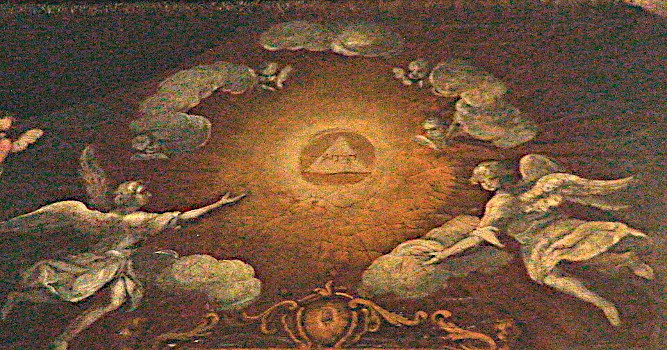
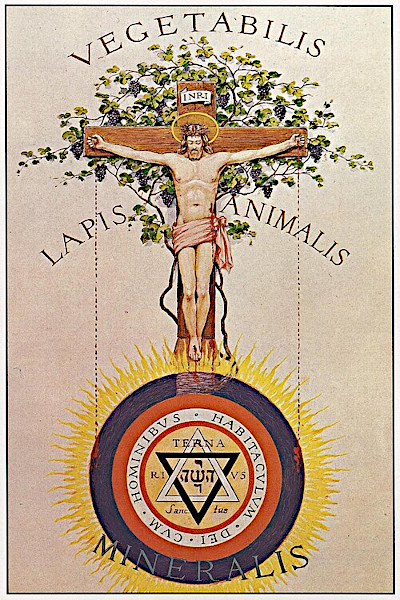
Kabbalistic readers later noticed something hidden in plain sight. Inserting the Hebrew letter Shin (ש) — the letter of fire and spirit — into YHVH creates YHShVH, a five-letter form sometimes called the Pentagrammaton.
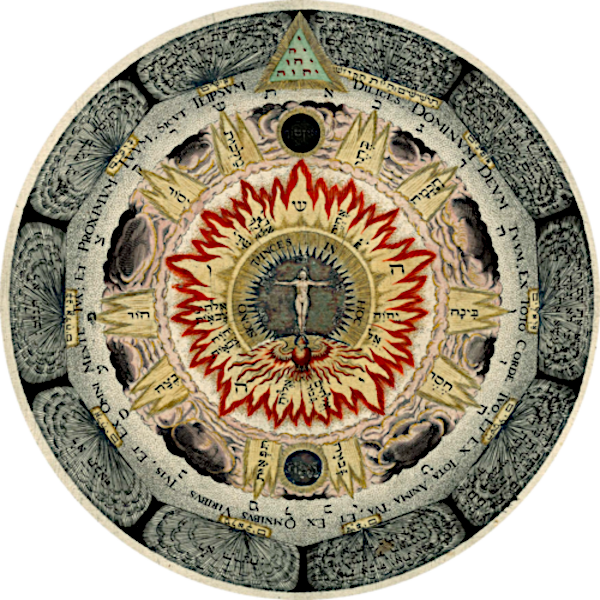
Renaissance Christian mystics such as Pico della Mirandola and Johannes Reuchlin saw in it a cipher of incarnation: the fiery Spirit placed within the divine Name to form the living Word. In gematria, the numbers tell the story — YHVH = 26, Shin = 300, together = 326 — a formula for spirit entering matter, God within humanity.
In this light, Yeshua is no longer merely a name. It is a mystical equation: fire in the clay, divinity breathing through dust.
(See Pentagrammaton on Wikipedia.)
Crucifixion and the Politics of Rome
Yeshua was executed by crucifixion, Rome’s punishment for rebels, seditionists, and runaway slaves. The placard above his head read INRI: Iesus Nazarenus Rex Iudaeorum — “Jesus of Nazareth, King of the Jews.” It was both a mockery and warning.
Rome viewed him less as a heretic than as a political threat. They viewed him as a man whose message stirred unrest among the poor and challenged the order of empire. His kingdom of mercy threatened the empire’s order of debt and domination. The same empire that nailed him to a cross, would one day crown his image in gold.
INRI: From Titulus to Alchemical Axiom
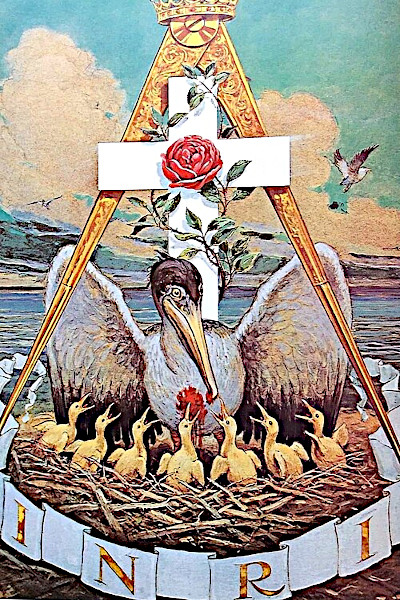
Centuries later, mystics re-read those letters. Alchemists saw in INRI new meanings: Igne Natura Renovatur Integra — “By fire, nature is renewed whole,” or In Nobis Regnat Iesus — “In us, Jesus reigns.”
What began as a death notice became a formula of inner transformation. The cross became a sign of intersection: the vertical and the horizontal, spirit and matter meeting in a single point. At its center arises the manifestation of the inner fire, the unseen living energy the ancients called Shin. The cross, then, speaks to incarnation itself. It marks the ground of being and the ever-present symbol of life.
Symbols: From Fish to Cross
The earliest believers never rallied around the cross. To them it was an instrument of state terror. Their chosen sign was the fish, traced quickly in dust: two interlocking arcs forming the vesica piscis, the womb of creation.
The Greek word ichthys doubled as an acrostic: Iēsous Christos Theou Yios Sōtēr — “Jesus Christ, Son of God, Savior.” Geometry and creed merged. The shape implied birth, union, and hidden belonging.
The cross would come later, when empire turned it into a brand.
Joshua, the First Yeshua
What often goes unnoticed is that the Old Testament’s Joshua ben Nun and the New Testament’s Yeshua of Nazareth share the same name.
Joshua succeeded Moses and led the people into the Promised Land. Moses represented Law; Joshua fulfilled it. Likewise, Yeshua declared, “I came not to abolish the Law but to fulfill it.” His promised land was not Canaan but the Kingdom of God.
Had translators kept the name intact, we would speak of Joshua the Messiah. The continuity would have been striking and perhaps the centuries of division less so.
Illiteracy, Memory, and the Gospels
After the crucifixion, stories of Yeshua survived by voice alone. His followers were peasants and tradesmen; Acts 4:13 calls Peter and John agrammatoi kai idiōtai — “unlettered and ordinary.” They preserved his story through memory and speech, not writing.
Decades of retelling reshaped those memories. Miracles expanded, parables adapted to local struggles, contradictions softened. By the time the Gospels took form some forty to seventy years later, the living voice had become community scripture.
Despite their titles, Matthew, Mark, Luke, and John were anonymous. Their texts are theological reflections, not eyewitness diaries. The written Jesus was already an interpretation.
Paul: Reinterpreting Yeshua and Jesus for Empire
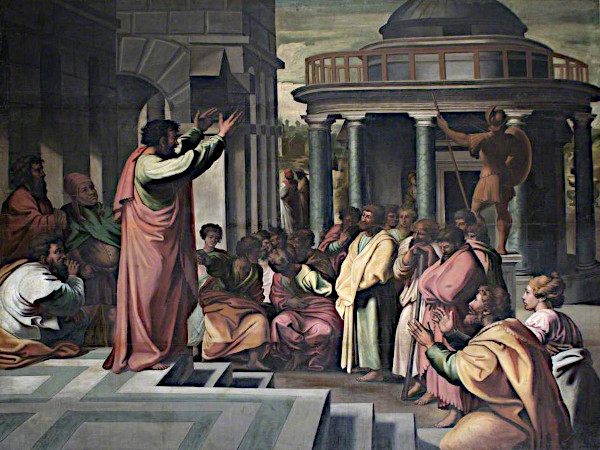
Then came Paul, a man who never met Yeshua. His letters, which our earliest Christian documents, reframed the message for a Greco-Roman audience already fluent in the mystery cults of Mithras, Isis, and Dionysus.
Paul wrote within a generation of Yeshua’s death, well before the fall of the Temple, and years before the Gospels themselves took shape. His writings stand closer to the living movement than to the later ruins, the first surviving traces of a faith still speaking in the accents of Judaism. Yet already, he was translating the message into the language of empire.
He universalized Yeshua. The Torah’s binding force fell away, replaced by faith in a cosmic savior. What began as a movement of the poor became a theology of empire. Through Paul, the revolutionary Yeshua became the theological Jesus, the first great divide between the names of Yeshua and Jesus.
Paul’s letters circulated between the 50s and early 60s CE. Within another decade, Rome itself would burn, and the empire would learn the name Christian.
The Empire Takes Notice
Rome first became aware of the movement through accusation and rumor. In 64 CE, a fire consumed much of the city, and whispers spread that Nero had ordered it. Half a century later, the historian Tacitus would write that Nero, to deflect blame, “fastened the guilt and inflicted the most exquisite tortures on a class hated for their abominations, called Christians by the populace.”
No other ancient writer confirms that detail. Tacitus alone links the Christians to the Great Fire. Suetonius described Nero’s punishment of “a class of men given to a new and mischievous superstition,” but without mention of the fire. Dio Cassius recounted the flames vividly, yet made no reference to the sect.
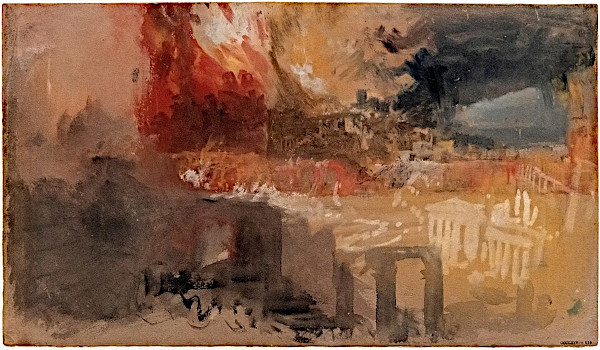
The story that Nero “fiddled while Rome burned” belongs to later rumor. Even Tacitus hedged his account, noting that some claimed Nero joined the firefighting efforts. The image of the emperor performing while his capital blazed hardened in later centuries, especially under Christian chroniclers who would recast him as the first persecutor of the saints and the pagan face of apocalypse.
To those early Christian writers, Nero’s humiliation became poetic justice: the tyrant who mocked the anointed and died a madman; the empire that crucified their messiah would one day bear his cross atop its monuments. In the retelling, “Nero fiddled while Rome burned” became a revenge myth and a moral reckoning for the empire that once mocked them.
When Yeshua and Jesus Reached the Emperors
By the early second century, the sect had grown too visible to ignore. Around 110 CE, Pliny the Younger, governor of Bithynia, wrote to Emperor Trajan, uncertain how to deal with these people who “sing hymns to Christ as to a god.” Trajan advised leniency: don’t hunt them, but punish them if accused and proven obstinate.
Even satire took note. A Roman graffito, the Alexamenos graffito, shows a man worshiping a crucified figure with a donkey’s head; scrawled beneath it, “Alexamenos worships his god.” To Romans of the early second century, the faith appeared absurd: devotion to a condemned criminal, a superstition of slaves and provincials.
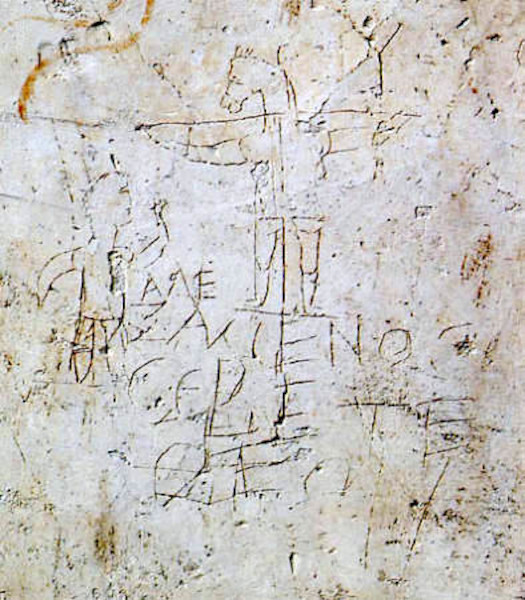
What began as a small reform movement among Jews under Roman rule had, within eighty years, become rumor, nuisance, and finally, a name known to emperors.
Josephus and the Silence of History
Josephus, the Jewish priest and historian who lived through those years, wrote in detail about the turmoil of Judea, its prophets, zealots, and would-be messiahs. Yet his authentic voice is silent about any Jesus or “Christ.” The two short passages that later generations point to, the so-called Testimonium Flavianum and a brief line about “the brother of Jesus who was called Christ,” bear the marks of later Christian editing, almost certainly added in the fourth century when the empire’s scribes were recopying and “harmonizing” ancient texts under imperial Christianity.
That silence is exactly what we should expect. Josephus was a Pharisaic priest who had survived the Jewish War by pledging loyalty to the Flavian emperors. He lived and wrote under their patronage in Rome, devoted to proving that Judaism was ancient, rational, and loyal to imperial order, the very opposite of the apocalyptic sects that had brought the Temple to ruin. To mention a crucified rebel worshiped as divine would have endangered his purpose and his position alike.
For Josephus, Christians were beneath notice: a small, troublesome offshoot of a defeated province. His silence reveals the political reality of a world where survival depended on deference to Rome and careful avoidance of anything that smelled of revolt. The “voice of Josephus” that praises Jesus, then, is not his at all; it is the ventriloquism of a later church eager to graft its story onto the authority of antiquity.
From Nazarenes to “Christians”
Yeshua’s earliest followers called themselves Nazarenes (Notzrim) or simply Followers of the Way (hodos). Their path was communal and ethical, not creedal. Only later, in Antioch, did outsiders coin the label Christianoi, a term of derision before it became a badge of faith.
Through Paul’s reimagining and Rome’s suspicion, the Way hardened into a religion of belief. The language of compassion and equality became a theology of divinity and obedience. The revolutionary Yeshua, who taught that the kingdom was within reach, became the imperial Christ, enthroned beyond it.
The transformation was already underway before the fall of the Temple, but the empire’s fires, in both Jerusalem and Rome, sealed it.
The Radical Meal
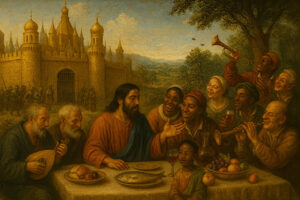
At Yeshua’s table, hierarchy dissolved. Rich and poor, master and slave, men and women ate together as equals. The act itself: simple communal eating, became revolutionary. In a society built on purity codes, class divisions, and patriarchal rank, sharing food across those boundaries broke every rule that held the social order together. Meals marked status; the guest list defined worth. To invite the unclean, the indebted, or the outcast was to declare that divine favor ignored the categories of empire and temple alike. Each meal re-enacted the kingdom he preached: a community without exclusion, a world remade through hospitality.
This pattern echoes through time: Masonic lodges where rank vanished, guild tables where owners and workers broke bread, civil-rights sit-ins, community kitchens. The meal was edible equity, a sacrament of shared life.
Paul’s letters already show the drift: the wealthy feasting while the poor went hungry. Over centuries the communal meal climbed the steps of the altar, fenced off by clergy. The bread of equality became the wafer of authority.
The Teacher Behind the Myth
Strip away dogma, and Yeshua re-emerges not as a flawless demigod but as a fierce, compassionate teacher:
- Preached forgiveness in a culture built on vengeance.
- Confronted priestly corruption and imperial violence alike.
- Spoke in riddles that disarmed the proud and uplifted the poor.
His “Kingdom of God” was not a post-mortem paradise but liberation from oppression, debt, and despair, a politics of mercy in the present tense.
“I Never Knew You.”
If Yeshua could see what has been built in his name: the cathedrals of power, the armies beneath the cross, the pulpits of fear, the institutions that serve empire before compassion, his words might echo through the centuries once more:
“I never knew you.”
Don’t let the conversation stop here. Join us at Blue Sky – @thebohemianstar.com. If you’re still lingering in the old spaces, you can also join our private inner circle over at The Bohemian Star Salon on Facebook to share thoughts on music, culture and the weird side of history.
Discover more from The Bohemian Star
Subscribe to get the latest posts sent to your email.