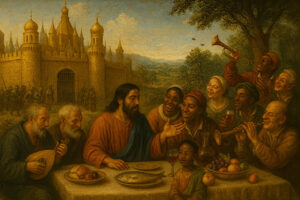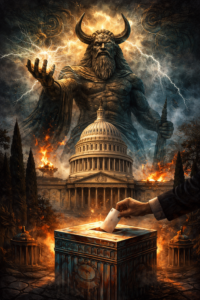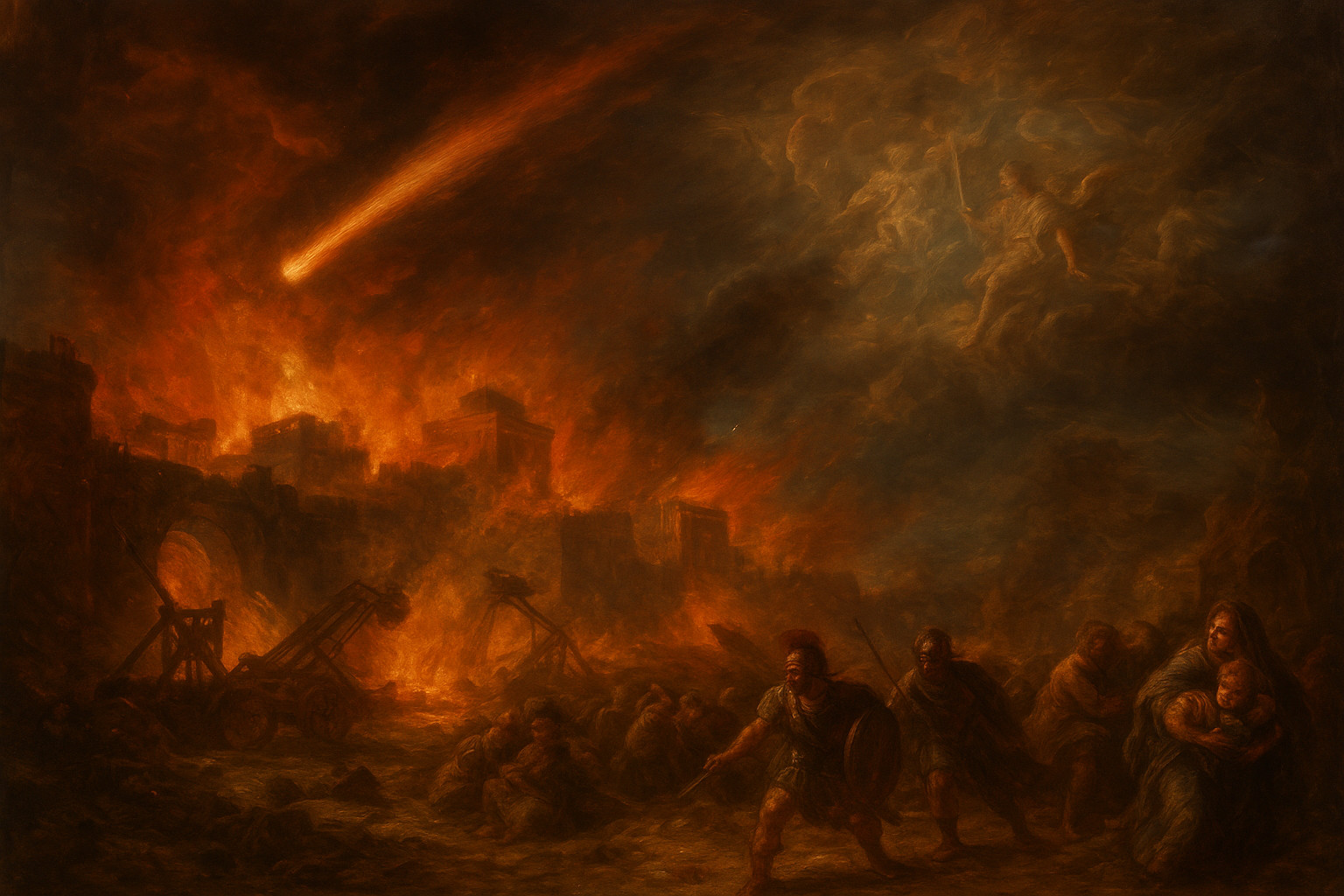
The Book of Revelation wasn’t written about the end of the world, but out of the end of a world—the Roman siege and destruction of Jerusalem in 70 CE. Stripped from this traumatic, historical context and repurposed by later readers, this chronicle of localized disaster became an engine of fear, a text that turned collective grief into cosmic threat.

When the World Ended in Jerusalem
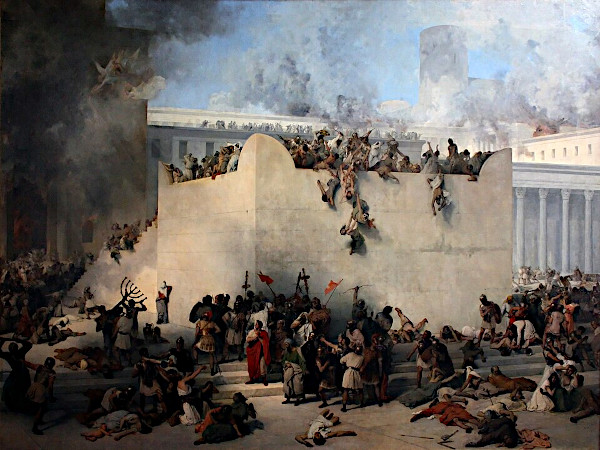
Jerusalem in the late 60s and early 70s CE was a city in upheaval. Contemporary accounts, given by Flavius Josephus, describe a brutal Roman assault. Months of internal violence and mass starvation preceded the attack. The city fell, and the Romans destroyed the Second Temple. This Temple had served as the center of Jewish religious and communal life. Its destruction shaped Jewish and Christian memory for generations.
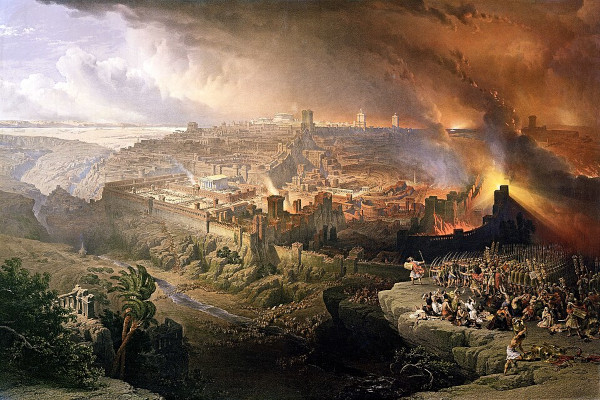
For those inside the walls, the world truly did end.
- Famine and fire devastated the city. Josephus reports mothers resorting to cannibalism. He also describes bodies piled high to reinforce failing barricades.
Josephus described the scene on the Temple Mount with horrifying clarity:
“One would have thought that the hill itself, on which the Temple stood, was seething hot, full of fire in every part; that the blood was larger in quantity than the fire; and those that were slain more in number than those that slew them, for the ground nowhere appeared visible for the dead bodies that lay on it; but the soldiers went over heaps of these bodies as they ran from such as fled from them.”
This historical report described blood rising like a river. The earth disappeared under bodies, and a hill seethed with fire. These scenes inspired Revelation’s exaggerated, terrifying visions of God’s final judgment.
- The Unforgettable Trauma: The experience: months of siege, fire, and plague, left an indelible mark. To understand its scale, one might compare it to September 11, 2001: an instant, collective wound whose images and cultural memory remain vivid, shaping behavior long after the event. Jerusalem’s destruction was similarly unforgettable for those who survived and for those who heard their fevered accounts.
Prophecy from Portent
Crucially, the city faced both war and hysteria. People interpreted every natural event as a sign. Walter Besant and Josephus record the popular obsession with portents:
The people knew full well, of course, that the Romans were coming. Fear was upon all, and expectation of things great and terrible… A star shaped like a sword, and a comet, stood over the city for a whole year… Chariots and troops of soldiers in armour were seen running about in the clouds, and surrounding cities.
The language of heavens opening, celestial battles, and terrifying lights shows a population preoccupied with signs. They ignored practical military and diplomatic preparation. Revelation inherited this language. It amplified the terror and failed faith that accompanied the siege. The visions transformed local trauma into apocalyptic imagery.
Reportage in Visionary Language
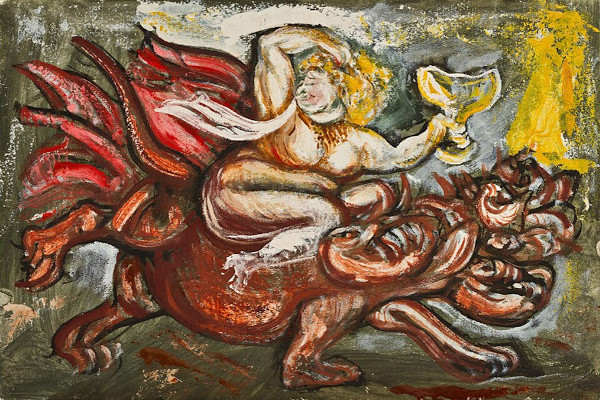
Read close to these events, Revelation’s symbols function less like a timetable for the end of history than like reportage transposed into visionary language.
| Revelation’s Symbol | The Historical Reality of the Siege | Connection to Roman Military |
| Beast rising out of the sea | The Roman Imperial Fleet appearing on the horizon to besiege coastal cities, representing Rome’s inexorable, monstrous military power. | The warships, appearing to “rise” over the distant waterline, symbolized Rome’s power arriving from the sea, where it was most dominant. |
| The Great Harlot/Scarlet Woman | The imperial power of Rome itself (often associated with the seven hills of Rome), whose vast wealth and military might were built on conquest and oppression. | This figure is Rome, arrayed in the luxury and color of its imperial power—a system that seduced nations only to rule them violently. |
| Horns, Trumpets, Vials | The sounds and actions of the approaching Roman legions. The “Horns” are literally the trumpets and horns being blown by the advancing forces as they marshal for battle and signal the stages of the siege. | The apocalyptic soundscape is comprised of the real, terrifying sound of the imperial army closing in, not abstract heavenly signals. |
| The “bottomless pit” opening | The collapse of John of Giscala’s subterranean mine under the Roman siege ramparts (filled with burning pitch and bitumen). | This literal collapse, described by Josephus, was a localized, fire-and-smoke-filled hell that swallowed Roman engineering, which Revelation transformed into a cosmic pit. |
Scholars following the preterist view argue that the book’s imagery reflects the immediate reality of the Jewish War and the destruction of the Temple. It is a plausible and historically illuminating decoding of a survivor’s nightmare.
Trauma and the Text
Trauma does strange things to narrative: it fragments temporality, enlarges metaphor, and turns the local into the cosmic. Revelation reads like a trauma dream or an attempt to fit the unspeakable into story.
Some historians speculate that extreme conditions: starvation, disease, and stress, were amplified by ergotism, a fungus in grain that causes convulsions & hallucinations. Trauma can shape memory and myth. In this light, Revelation’s surrealism reflects a mind overwhelmed. The apocalypse becomes a memory distorted by shock and PTSD.
What begins as a communal lament becomes, in literature, an apocalypse: a refiguring of who is guilty and who will be redeemed. This dramatic pivot: the oppressed imagining a reversal of fortunes upon their conquerors, explains much of Revelation’s intensity.
The Long Shadow and the Damage Done
Successive audiences detached Revelation from its immediate lament and repurposed its imagery in dangerous ways. As authorities reshaped Yeshua into the Christ of empire (see how this transformation occurred), they turned Revelation’s apocalyptic visions into tools for fear and obedience.
Christianity’s eventual alliance with the Roman state under Constantine transformed an earlier rebel’s lament into imperial scripture. Where Yeshua/Jesus taught presence, simplicity, and love of neighbor (explored in detail here), apocalyptic Christianity often taught preparation for catastrophe and identification with cosmic enemies.
- The Inversion of Faith: Where Yeshua said, “Take no thought for tomorrow,” later apocalyptic Christianity made tomorrow its obsession. Fear replaced the inward, ethical core with a cosmic monarchy, compelling obedience through dread of divine judgment.
- A Scaffolding for Paranoia: Revelation has provided a broad apocalyptic nomenclature that permeates modern media, political discourse, and everyday conversations. People readily understand terms like ‘armageddon,’ ‘the beast,’ and ‘the mark,’ which provide a scaffold for discussing social and political anxieties in the context of ultimate judgment.
- The Problem of the Habitat: Literalists believe God will annihilate the world suddenly, and this belief drives how they approach environmental ethics. Why invest in conservation or clean-up if God will soon judge the habitat, rendering all earthly efforts moot? This theology can lead to a profound lack of responsibility toward the Earth.
- The Dark Legacy: The literalist reading has fueled paranoia and legitimized mass violence. The pattern repeats in tragic modern episodes: charismatic leaders and enclosed communities have converted apocalyptic rhetoric into deadly policy. The 20th century furnishes ghastly exemplars: Charles Manson’s cult and the “Helter Skelter” murders, Jonestown, and the Branch Davidian siege outside Waco, where apocalyptic imagination, charisma, and isolation combined in annihilating ways. These are the predictable consequences of reading a text designed to process local catastrophe as if it were a world-ending program.
The Ethical Imperative
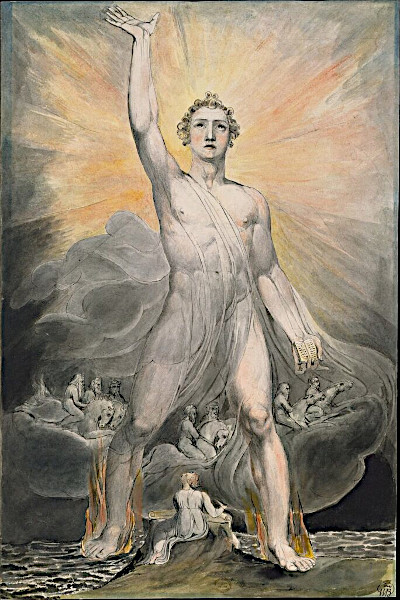
Revelation has done real damage. Read as a literal prophecy, it has fueled wars, persecution, and a fatalistic approach to social and ecological responsibility. The ethical imperative is to refuse the conversion of communal trauma into a program for terror by situating Revelation’s imagery in siege and famine rather than in abstract futurism. Those who practice Christianity should reorient themselves to recover Yeshua’s ethical center: presence, neighborly care, and resistance to political violence, from the sediment of later apocalyptic theology.
Doing this makes Revelation a record of human grief and anger that can be studied. If Revelation is to remain in the canon, let it serve as a cautionary memorial and as a recognition that prophecy is often just the projection of the anxieties of a traumatic past onto the future.
Don’t let the conversation stop here. Join us at Blue Sky – @thebohemianstar.com. If you’re still lingering in the old spaces, you can also join our private inner circle over at The Bohemian Star Salon on Facebook to share thoughts on music, culture and the weird side of history.
Discover more from The Bohemian Star
Subscribe to get the latest posts sent to your email.