Thelemia and the Three Gates
Hypnerotomachia Poliphili (aka Love’s Strife in a Dream) appeared in Venice in 1499, printed by Aldus Manutius and attributed to Francesco Colonna. Its publication brought forth one of the Renaissance’s most enigmatic creations. Written in a dense blend of Italian, Latin, and invented Greekisms, and adorned with intricate woodcuts of ruins and temples, it presents the dream journey of Poliphilo in pursuit of his beloved Polia.
Beneath its ornate surface lies a sustained meditation on a single human power: will. That meditation comes into focus in the episode of the Three Gates, where a figure named Thelemia guides Poliphilo at a decisive crossroads.
Thelemia
Thelemia’s name comes from the Greek thelēma (θέλημα), meaning “will,” “desire,” or “intention.” The verb behind it, thelō, carries the sense of willing toward something; it speaks to an inward movement shaped by inclination.
Colonna transforms this word into a living presence. Renaissance writers often personified virtues and faculties; Thelemia belongs to that tradition, yet she carries unusual weight in the narrative. She stands beside Poliphilo at the moment when his direction becomes fixed.
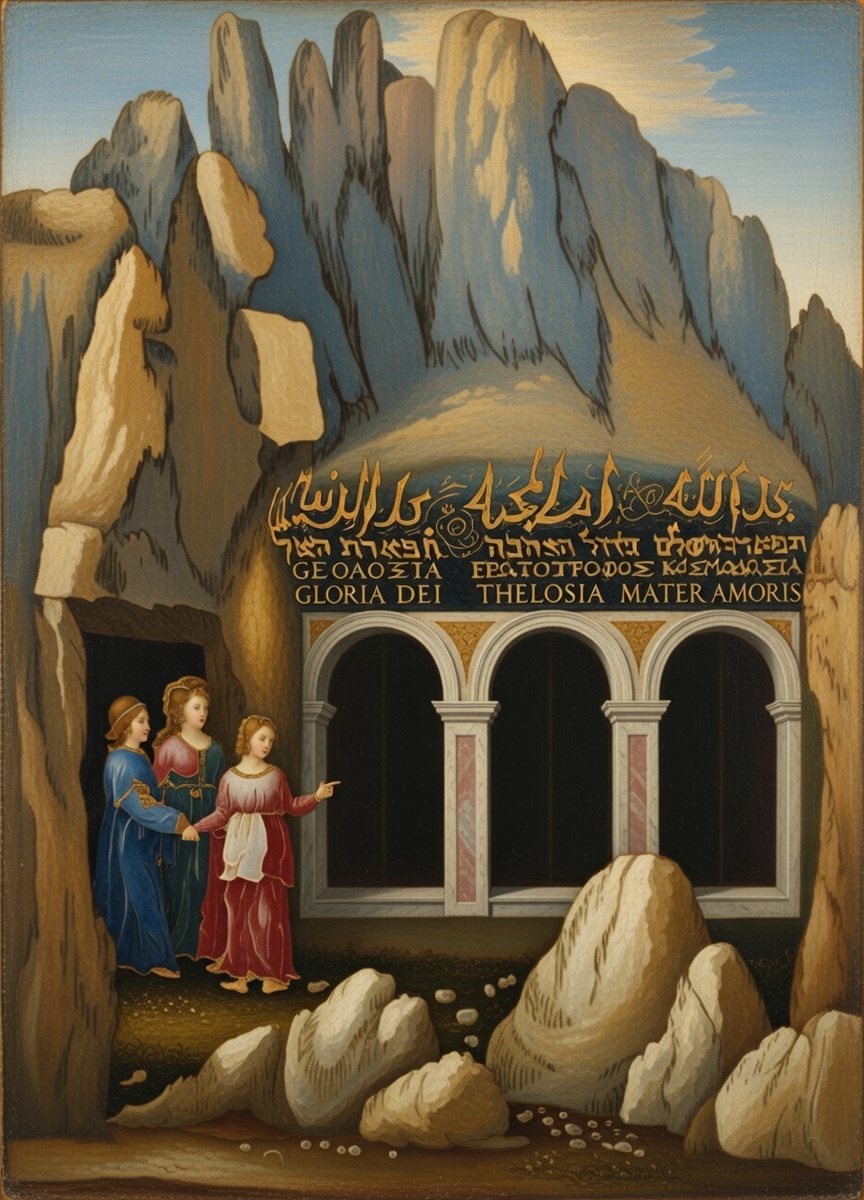
The gate she urges him to enter bears the inscription Thelosia / Mater Amoris—“Mother of Love.” The term “Thelosia” appears closely related to the Greek telos (τέλος), meaning “end,” “goal,” or “fulfillment.” The pairing of thelēma and telos suggests a subtle linguistic harmony: will oriented toward completion.
Colonna’s multilingual inscriptions: Greek, Latin, Hebrew, Arabic, surround the gates. The carved letters appear as part of the architecture itself. Language becomes structure. Choice becomes inscription.
Through this philological play, the dream links inward intention with outward form.
The Three Gates
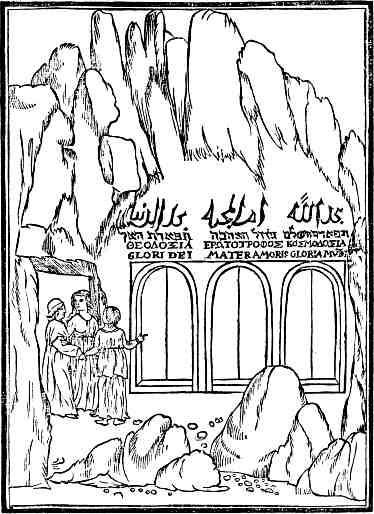
The woodcut of the gates (folio h8r) captures the drama in a single tableau. Three portals are carved into a rocky escarpment:
- Gloria Dei – Glory of God
- Gloria Mundi – Glory of the World
- Thelosia / Mater Amoris – Fulfillment through Love
Poliphilo stands between two figures: Logistica (Reason) and Thelemia (Will). Their gestures create a quiet tension. Logistica’s posture suggests measured reflection. Thelemia’s stance carries a forward impulse. Poliphilo inclines toward her.
The rock face evokes antiquity and permanence. The gates emerge from stone that appears older than memory. Their inscriptions are crisp and deliberate, merging text and threshold.
The composition condenses psychology into architecture. Human faculties appear as companions. Paths appear as carved openings. The act of choosing becomes visible.
When Poliphilo steps toward Thelosia, the dream enters a new phase shaped by eros, ceremony, and sacred geometry.
Desire as Direction
Throughout the Hypnerotomachia, beauty organizes experience. Poliphilo moves through ruined cities, elaborate temples, ritual processions, and mythic landscapes. Each scene refines perception. Each encounter deepens awareness.
Within this aesthetic world, Thelemia represents directed desire. Her presence suggests that longing carries structure. The narrative unfolds through stages that resemble alchemical transformation: confusion and wandering give way to order, procession, and union. By the time Poliphilo reaches the Temple of Venus Physizoe, his desire has acquired clarity and depth.
At the visionary climax, Polia vanishes. The beloved recedes into absence, and the dream closes in a mood of awakened solitude. The journey leaves Poliphilo changed. What began as pursuit becomes interior formation. The will that chose love has shaped the one who chose.
Renaissance Context
Renaissance humanism placed renewed emphasis on human agency and self-direction. Classical sources recovered by scholars offered language for speaking about intention, purpose, and fulfillment. Within that atmosphere, Colonna’s Thelemia embodies a distinctly human power: the capacity to orient oneself.
The linguistic pairing of thelēma and telos reinforces this orientation. Will moves toward an end. Desire seeks form. The gates episode presents this dynamic in vivid symbolic terms.
The influence of the Greek root extended into later Renaissance literature. François Rabelais drew upon the same word in his Abbey of Thélème in Gargantua and Pantagruel, linking the idea of will with cultivated freedom. The shared etymology reflects a broader cultural interest in inclination as a shaping force in human life.
A Dream Carved in Stone
The enduring power of Hypnerotomachia Poliphili lies in its ability to make abstract ideas tangible. Words become architecture. Architecture becomes allegory. Allegory becomes lived experience within the dream.
In the scene of the Three Gates, Colonna offers an image that continues to resonate: a human figure poised before inscribed thresholds, accompanied by reason and will, compelled to choose.
Thelemia stands at that moment as the embodiment of directed longing. Through her, the dream affirms that the shaping of a life begins in the movements of intention.
References
Colonna, Francesco. Hypnerotomachia Poliphili: The Strife of Love in a Dream. Translated by Joscelyn Godwin. London: Thames & Hudson, 1999. (Originally published 1499.)
Godwin, Joscelyn. Introduction to Hypnerotomachia Poliphili: The Strife of Love in a Dream, by Francesco Colonna. London: Thames & Hudson, 1999.
Faivre, Antoine. Access to Western Esotericism. Albany: State University of New York Press, 1994.
Rabelais, François. Gargantua and Pantagruel. Translated by Donald M. Frame. Berkeley: University of California Press, 1991. (Originally published 1534.)
Wind, Edgar. Pagan Mysteries in the Renaissance. New Haven: Yale University Press, 1958.