In the sprawling garden of Renaissance literature, two figures stand as great, luminaries: François Rabelais and William Shakespeare. Though separated by language, time & geography, the spirits in their writing seem to recognize each other on the path of human folly and wisdom. Their works teem with fools and kings, grotesque bodies and lofty ideals, learned buffoonery and existential doubt. But was Shakespeare directly influenced by Rabelais? Or is their kinship more a matter of shared spirit: the exuberant, irreverent genius of Renaissance humanism let loose in the theater of the world?
Let’s examine Rabelaisian undercurrents that bubble through Shakespeare’s work. Beyond parallel themes, there is also tangible evidence that Shakespeare had access to Rabelais’ writings, and that he drew from it, at times, quite directly.
Rabelais in English: A Timeline of Possibility
There has long been confusion about when Rabelais first entered the English literary imagination. While the first English translation by Sir Thomas Urquhart of Cromarty did not appear until 1653, decades after Shakespeare’s death in 1616, Rabelais’ works were available in French throughout the 16th century, and references to his themes and characters began surfacing in English cultural contexts from the 1580s onward.
Though Shakespeare himself likely did not read French (and no direct evidence confirms he did), several of his contemporaries did. If the popular theory that Shakespeare collaborated with or served as a front for other writers bears any truth, it’s plausible that at least one of those individuals had read Rabelais in French. Figures in the Shakespearean orbit, such as Ben Jonson, John Florio, or even George Chapman—were well-read in continental literature and fluent in French and Italian. It’s also worth noting that Florio’s 1603 translation of Montaigne’s Essays, steeped in Rabelaisian wit and digression, was known to Shakespeare and may have served as an indirect conduit.
Thus, while there’s no definitive proof that Rabelais was on Shakespeare’s shelf, the thematic, linguistic, and philosophical resonances suggest that the spirit of Rabelais, if not his words, found its way into the Elizabethan imagination.
Direct Echoes: Rabelaisian Traces in Shakespeare’s Plays
Several textual parallels strongly suggest that Shakespeare was not just spiritually aligned with Rabelais, but familiar with the French writer’s work:
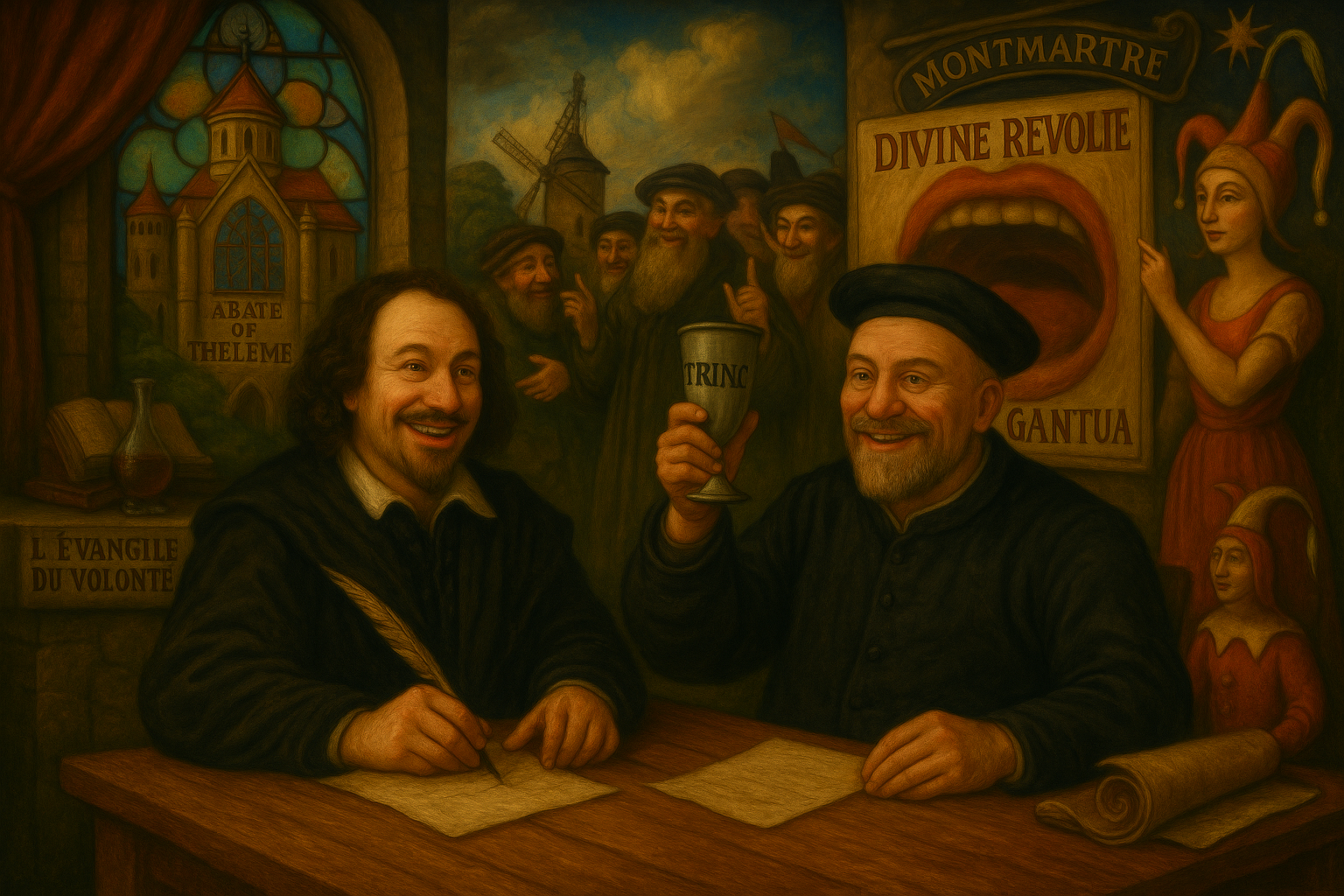
- In As You Like It, Celia quips: “You must borrow me Gargantua’s mouth first: ’tis a word too great for any mouth of this age’s size.” This is a direct allusion to the giant Gargantua, and a rare moment where Rabelais is explicitly named in Elizabethan drama.
- In Love’s Labour’s Lost, the pedant character is named Holofernes—the same as Gargantua’s learned tutor in Gargantua and Pantagruel. The satire of pompous, verbose academics in both works strengthens the connection.
- In Othello (I.i.116–117), Iago says of Desdemona and Othello: “Your daughter and the Moor are now making the beast with two backs.” This image of “the beast with two backs” is originally found Rabelais’ Gargantua (Book I, Chapter 3), where we read of Gargantua’s conception by his parents:
“En son aage virile espousa Gargamelle fille du Roy des Parpaillons, belle gouge, & de bonne trongne. Et faisoient eux deux souvent ensemble la beste a deux dos.”
Not only is the phrase rare and distinctly Rabelaisian, but its original context, describing the union of Gargantua’s father and Gargamelle, suggests that Shakespeare may have drawn it from this passage, strengthening the case for his familiarity with Rabelais’ work.
1. The Carnival King: Falstaff as a Rabelaisian Hero
Rabelais gave new life to the folkloric giant Gargantua and created the cunning Panurge, giant figures of appetite, wit, and bawdy subversion. Shakespeare, in turn, gave us Falstaff, who was a walking tavern of a man, full of sack and jests, cowardice and cunning. Both Panurge and Falstaff represent what Mikhail Bakhtin calls the “carnivalesque”: they revel in the body, turn hierarchies upside down, and speak truth through jests and mockery.
Falstaff, like a character torn from the Abbey of Thélème, refuses to live by anyone’s moral code but his own. He mocks honor, makes a theology of appetite, and turns cowardice into wit. When he declares, “Give me life,” in Henry IV Part 1, he echoes the Rabelaisian cry for the pleasures of the body over the abstractions of duty. He is, in a word, Gargantuan.
2. The Satire of Authority and Pedantry
Rabelais never missed a chance to lampoon the pompous. His characters bloviate in mangled Latin, pursue absurd lawsuits, and confuse learning with wisdom. His masterstroke is Master Janotus, who attempts to retrieve church bells by speaking gibberish cloaked in academic pretense.
Shakespeare takes up the same sword in his portraits of pedants. Holofernes in Love’s Labour’s Lost is a scholastic fool, more in love with his own words than with knowledge. Polonius in Hamlet drowns in his own advice. Even the well-meaning Gonzalo in The Tempest is gently mocked for his utopian ramblings. Like Rabelais, Shakespeare sees the danger in words divorced from life, and uses fools to expose the wise.
3. Utopia and the Free Life: The Abbey of Thélème and the Forest of Arden
The Abbey of Thélème in Rabelais’ Gargantua is a fictional utopia of mutual respect, coeducation, beauty, and natural virtue. It is a radical inversion of the monastery.
In As You Like It, Shakespeare creates a similar space in the Forest of Arden. There, exiles reinvent themselves, social hierarchies dissolve, and love flourishes freely. Duke Senior calls it a “desert forest,” but it becomes a zone of transformation, a kind of pastoral Thélème. Even The Tempest’s enchanted island, ruled by Prospero, hints at such a world, structured by magic, but open to redemption, renewal, and love.
4. Language as Alchemy: Puns, Paradox, and the Grotesque
Both Rabelais and Shakespeare are linguistic sorcerers. Rabelais coined hundreds of new words, juggled Greek, Latin, French, and bawdy slang. His language is lush, overripe, obscene, and wise. Shakespeare’s own love of punning, double entendre, and rhetorical excess often mirrors this Rabelaisian style.
Take Mercutio’s “Queen Mab” speech in Romeo and Juliet or the Fool’s riddles in King Lear; they perform the same function as Rabelais’ digressive parables. They stretch language until it breaks apart in laughter. In the mouth of Shakespeare’s jesters and madmen, language becomes a living thing; it is paradoxical, excessive, and divine.
5. The Philosophical Fool: Doubt and the Divine Belly
Panurge spends an entire book asking whether he should marry, consulting oracles, theologians, philosophers, and fools but is never satisfied with the answers. Rabelais, under his comedy, explores the limits of reason and the absurdity of fate.
Shakespeare does the same. Hamlet dithers as Panurge does. Lear wanders the heath asking what justice means. The gravediggers joke about mortality. The Porter in Macbeth imagines hell as a drunken knock at the door. In each case, comedy and tragedy meet, not in opposition, but in the belly of the same beast. Shakespeare, like Rabelais, puts his deepest thoughts in the mouths of clowns.
6. A Shared Humanism: Body and Soul in Balance
Above all, Rabelais and Shakespeare are united by their Renaissance humanism. They believe in the grandeur and absurdity of human beings as whole creatures: bodies, desires, fears, dreams. They celebrate love and learning, freedom and folly, appetite and art.
Both men write in a world cracking under religious strife and political transformation. They replace escapism with transformation: to laugh at the world is to survive it, to reshape it, to love it more.