Rabelais’ Humanist Ideal vs. Crowley’s Occult Religion
A Renaissance Satire Becomes a Modern ‘Revelation’
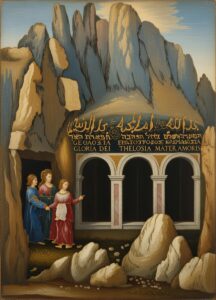
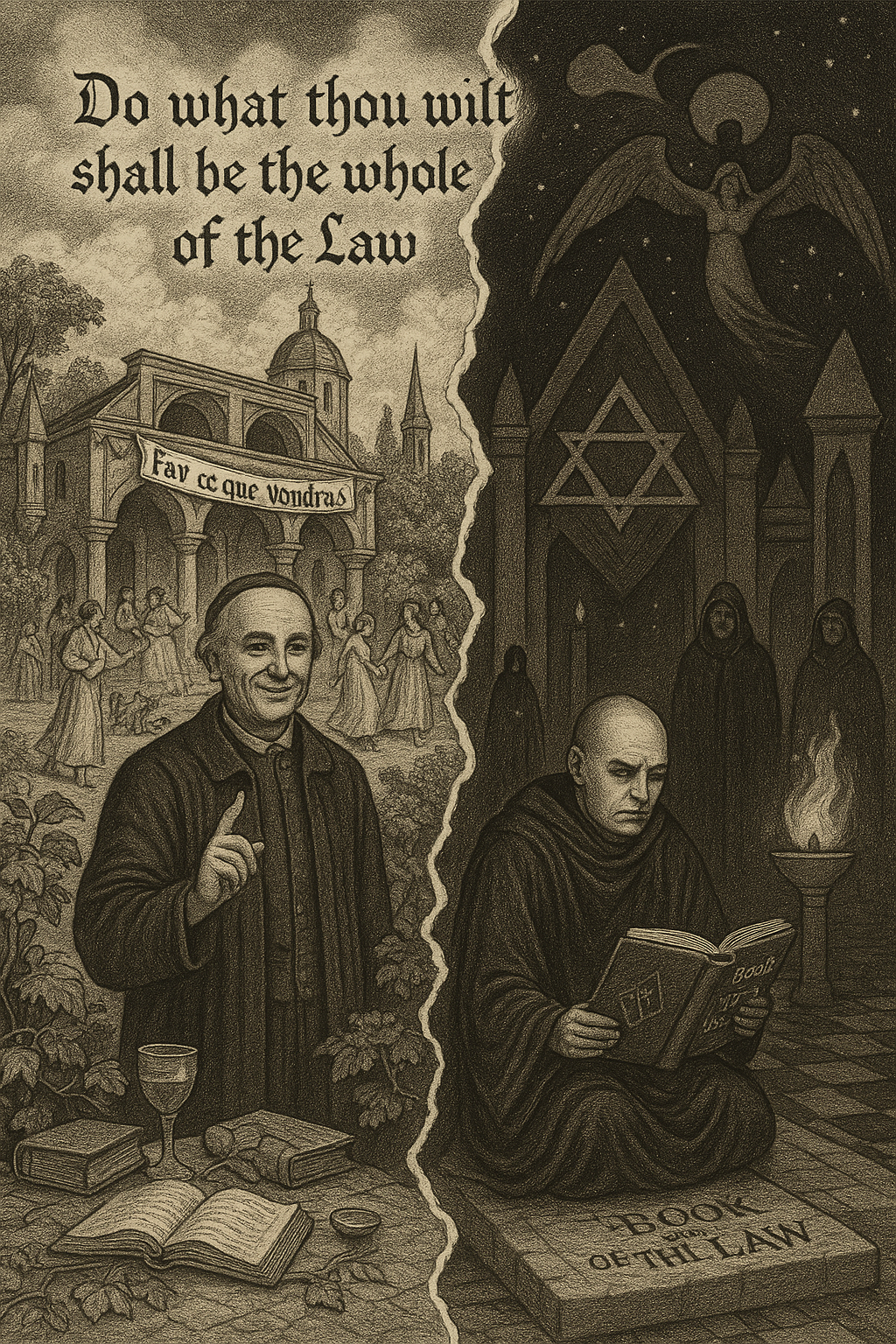
When François Rabelais introduced the enigmatic law “Fay ce que vouldras”—“Do what thou wilt”—in his 1534 novel Gargantua, it was not a commandment from the heavens, but a gleeful jab at the rigidity of religious institutions. The Abbey of Thélème, Rabelais’ fictional utopia, was a mirror turned against the monastic life: a space of joy, freedom, sensuality, and reason, with no need for rigid rules because its inhabitants were already noble in character.
Almost 400 years later, Aleister Crowley would seize this phrase, extract it from its satirical humanist soil, and make it the foundational maxim of a new religious movement: Thelema. Yet while both Rabelais and Crowley invoked the same word, the spirit behind their Thelemas could hardly be more different. Where Rabelais ridiculed religion, Crowley built one. This profound shift—from literary humanism to occult law—deserves careful examination.
Rabelais’ Thelema: A Utopia of Reason and Play
Rabelais, a former monk turned physician, scholar, and satirist, emerged as a central voice of French Renaissance humanism. Deeply influenced by classical philosophy and the rediscovery of ancient texts, his writing celebrates education, bodily pleasure, and intellectual freedom. The Abbey of Thélème appears in Gargantua as a fantastical community where men and women live freely, united only by their own good nature. The sole rule is simple:
“Do what thou wilt.”
But this wasn’t an invitation to licentiousness. Rabelais believed that a truly free human being who was well-educated, self-aware, and ethical would not abuse liberty. In his words:
“Because people who are free, well-bred, and well-educated have a natural instinct and impulse which always prompts them to virtuous actions…”
(Gargantua, ch. 57)
This idea, rooted in Renaissance optimism about human nature, was a clear rebuke to both ecclesiastical authority and the assumption that virtue requires external control.
Sidebar: From Rabelais to the Enlightenment
Rabelais’ impact didn’t stop with satire. His embrace of liberty, skepticism, and secular education laid groundwork for the Enlightenment. Voltaire admired Rabelais’ irreverence; Diderot and the Encyclopédistes drew upon his celebration of curiosity and reason. In fact, Diderot’s Rameau’s Nephew channels Rabelaisian dialogue, irony, and philosophical ambiguity.
Moreover, the Abbey of Thélème foreshadows Enlightenment utopias like Charles Fourier’s phalanstères or even Rousseau’s concept of the “noble savage.” In each, we find the belief that human beings, left to their natural inclinations, may achieve harmony without the need for oppressive structures.
Thus, Rabelais’ Thelema is not merely a literary curiosity—it is a milestone in the evolution of secular humanist thought.
Crowley’s Thelema: Law from Above
In April 1904, Aleister Crowley claimed to have received The Book of the Law through a form of dictated revelation from a non-human intelligence named Aiwass. The text does not open with ethical instruction, but with a cryptic declaration: “Had! The manifestation of Nuit.” It begins in mythic cadence, unveiling a cosmology centered on divine polarities—Nuit, the infinite expanse, and Hadit, the point of motion and awareness.
The book’s most famous command appears later, in Chapter I, verse 40:
“Do what thou wilt shall be the whole of the Law.”
Unlike Rabelais’ playful injunction, this is no satirical motto but a sacred imperative. Crowley presents it not as a utopian fantasy but as a metaphysical law: a divine injunction to discover and carry out one’s True Will—the unique, inborn purpose that aligns the individual with cosmic order. In Crowley’s telling, Thelema is not philosophy, nor literary conceit, but the foundation of a new Æon: an era in which all external moralities are to be judged and, if need be, discarded in the face of the individual’s divine mandate.
This Thelema is steeped in esotericism, drawing from Hermeticism, Qabalah, Eastern mysticism, and ceremonial magic. The concept of the True Will becomes central—not as libertine desire, but as sacred vocation. If Rabelais imagined the noble subject as already virtuous and free, Crowley reimagines that subject as the initiated magician, tested by ordeal and guided by secret knowledge.
As scholar Marco Pasi observes:
“Crowley took the Rabelaisian motto and reinterpreted it in a religious context, turning a Renaissance utopian idea into a rule of life backed by supernatural authority.”
(Aleister Crowley and the Temptation of Politics, 2014)
Convergences and Contradictions
Despite their differences, a few threads of continuity can be found:
1. Celebration of the Individual
Both Rabelais and Crowley center the individual as sacred—whether through education and virtue (Rabelais) or divine destiny (Crowley). The emphasis on personal freedom and self-realization is a shared axis.
2. Erotic and Physical Joy
The Abbey of Thélème was no cloistered convent. Rabelais wrote frankly about bodily desires and pleasures—echoed in Crowley’s later inclusion of sexual magic and celebration of desire as a path to transcendence.
3. Anti-authoritarianism
Rabelais mocked religious orthodoxy; Crowley rejected Christian morality altogether. Both saw the prevailing religious order as an impediment to human flourishing.
Yet, these similarities are largely cosmetic. The deepest contradiction lies in structure. Rabelais’ Thelema is intentionally non-binding—a principle of freedom, unencumbered by creed. Crowley’s Thelema, despite its libertine language, installs a new law, new rituals, new clergy, and even apocalypse myths (see: Liber AL vel Legis, Chapter III).
The Irony of Institutionalizing Freedom
Crowley’s decision to institutionalize Thelema as a religion is, in a sense, a betrayal of Rabelais’ vision. Rabelais offered Thelema as a gleeful parody of religious control; Crowley turned it into the backbone of a new religious order.
This irony has not gone unnoticed. Peter Lamborn Wilson (Hakim Bey), in his essay The Temporary Autonomous Zone, observed:
“Crowley takes Rabelais’ humanist joke and inflates it into a metaphysical system—he fails to see the humor that made it radical.”
(TAZ: The Temporary Autonomous Zone, 1991)
Crowley, for all his rebellion, ends up constructing the very kind of esoteric hierarchy that Renaissance humanism sought to dismantle.
Thelema’s Forked Path
The story of Thelema is a tale of divergence. Rabelais’ path leads toward Enlightenment, secular liberty, and laughter. Crowley’s path leads toward mysticism, revelation, and sacred law. One liberates through satire; the other sanctifies through secrecy. One trusts human virtue; the other invokes cosmic command.
Yet, in both, we sense a yearning—for freedom, for meaning, for a life unshackled from tyranny. That shared longing makes Thelema, in both its forms, a symbol of the human desire to be more than what religion, society, or convention allow.
But let us not forget: the Abbey of Thélème had no walls. The Temple of Thelema, for all its stars, still has a door that must be passed.
Citations:
Crowley, Aleister.
The Book of the Law (Liber AL vel Legis). York Beach, ME: Samuel Weiser, 1976.
———. The Confessions of Aleister Crowley: An Autohagiography. Edited by John Symonds and Kenneth Grant. London: Arkana, 1989.
———. Magick: Liber ABA, Book Four. Edited by Hymenaeus Beta. York Beach, ME: Weiser Books, 1997.
Pasi, Marco.
Aleister Crowley and the Temptation of Politics. Durham, UK: Acumen Publishing, 2014.
Rabelais, François.
Gargantua and Pantagruel. Translated and edited by M.A. Screech. London: Penguin Classics, 2006.
Wilson, Peter Lamborn (as Hakim Bey).
TAZ: The Temporary Autonomous Zone, Ontological Anarchy, Poetic Terrorism. Brooklyn, NY: Autonomedia, 1991.
Cohn, Norman.
The Pursuit of the Millennium: Revolutionary Millenarians and Mystical Anarchists of the Middle Ages. Oxford: Oxford University Press, 1970.
(Optional, if you reference millenarian threads or apocalyptic tendencies in Crowley’s system)Hanegraaff, Wouter J.
Esotericism and the Academy: Rejected Knowledge in Western Culture. Cambridge: Cambridge University Press, 2012.