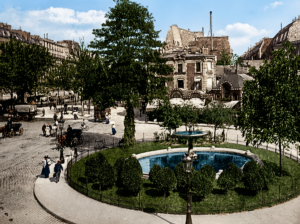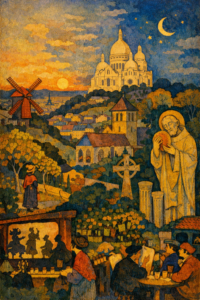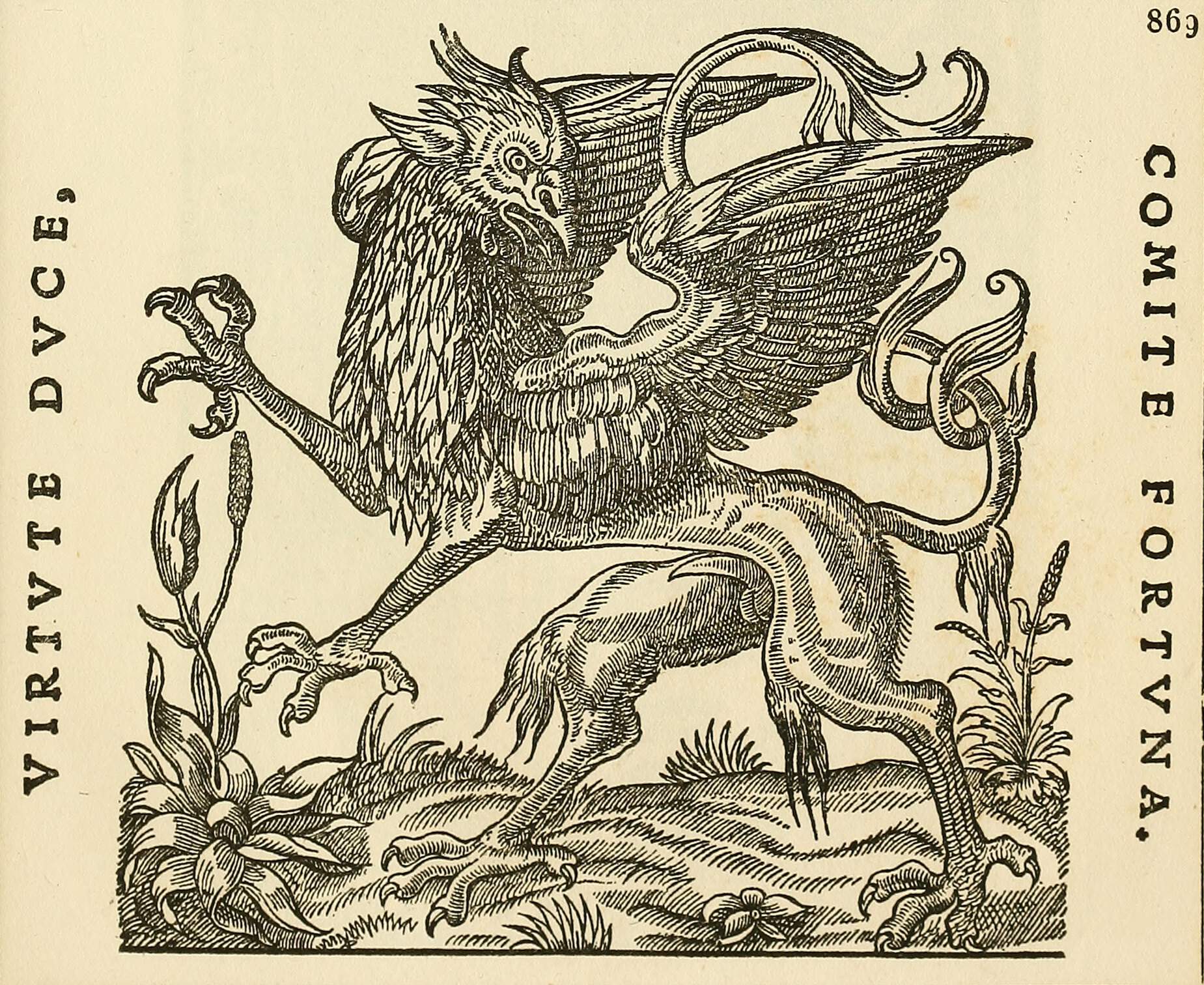
“The literary coterie called the Angelic Society was founded by the Lyonnaise printer Gryphe during the sixteenth century. Grasset Orcet tells us that this group was placed under the ultra-Masonic protection of Saint-Giles. Its adepts took as their crest an angel head: ‘chef Angel’ translated into Goliard language by St. Giles.” In reality, the printer Gryphe, named Sebastian Greif, was a native of Reitlingen in Würtemburg. He had settled in Lyon in 1522 and taken the gryphon as his emblem. … In any case, the angel appears as the messenger of this fog, and the Angelic Society sometimes changed its name to simply the Fog. According to Grasset d’Orcet, this name also reveals “a very important branch of Freemasonry worshipping the sepulchre of a Neapolitan scholar known as Pierre Barlieri.” p.231 The Secret Message of Jules Verne: Decoding His Masonic, Rosicrucian and Occult Writings by Michel Lamy
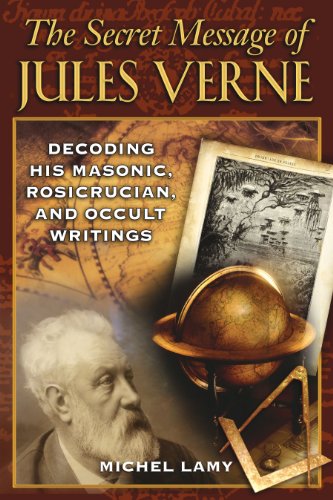
In the 2007 work, The Secret Message of Jules Verne: Decoding His Masonic, Rosicrucian and Occult Writings, esoteric author Michel Lamy asserted that a vast, multi-generational cabal called the Société Angélique (Angelic Society) operated in the shadows of Renaissance Lyon. Lamy claimed this group was organized by master printer Sébastien Gryphius as a secret network embedding complex cryptographic codes into 16th-century books. He sought to tie this local circle to a grand conspiracy, stating that Jules Verne used his writings to pass down the sacred symbolism of this order. Lamy connected the group to the mystery of Rennes-le-Château, the Rosicrucians, and the Bavarian Illuminati. It’s a fabulous story. As we will see, it’s also a work of complete fiction.
Lamy’s premise relies primarily upon the fantasies of the eccentric late-19th-century French occultist Claude-Sosthène Grasset d’Orcet. By treating d’Orcet’s speculative essays on French folklore and language as a reliable historical narrative, Lamy committed a chronological error that undermines his own thesis. Sébastien Gryphius died in 1556. While Nicolas de Langes began acquiring pieces of his Fourvière hill estate in 1552, the actual designation L’Angélique didn’t exist during Gryphius’s lifetime, but emerged much later as a personal tribute to de Langes. Walter Besant and other historic commentators may have inadvertently seeded this confusion, by misidentifying the open literary gatherings of the 1530s as a structured, continuous organization founded by Gryphius.

Richard Copley Christie v. Walter Besant
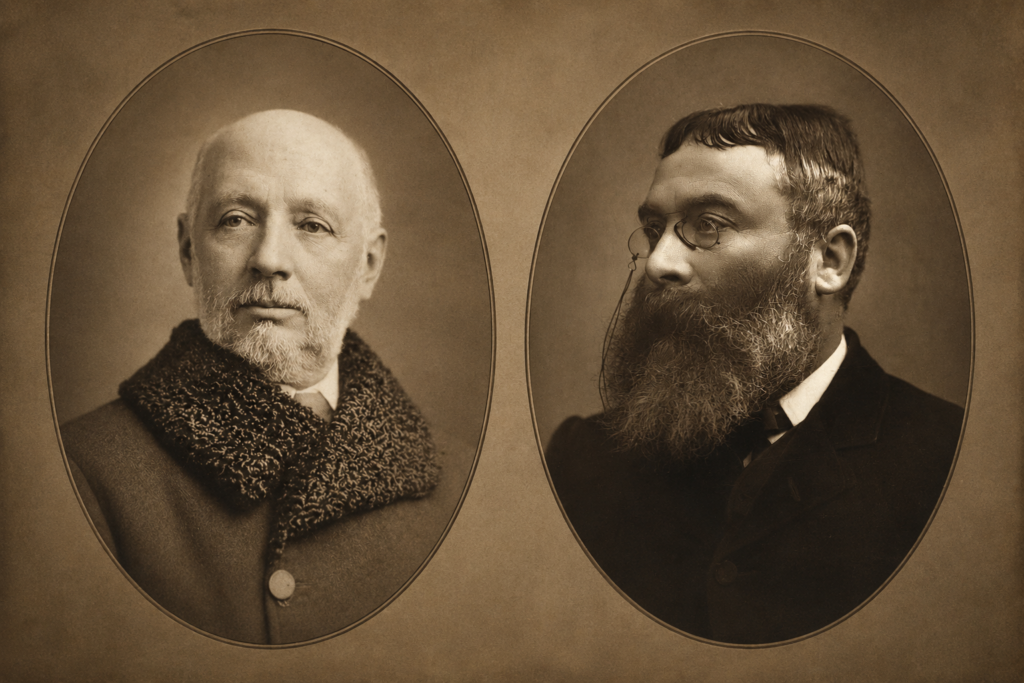
In his 1880 study on Étienne Dolet, Richard Copley Christie openly refuted the romanticized claims popularized by his contemporary, Walter Besant, who had bought into the myth of the Société Angélique. Besant had misidentified the casual literary gatherings of the 1530s as a structured, permanent organization under Gryphius’s leadership. Christie dismantled this interpretation by demonstrating that the intellectual associations of that era were entirely informal. Gryphius was a participant in a broader, public community of humanists, instead of the founder of an exclusive, secret apparatus like the rumored Société Angélique.
“If we are to believe the Père de Colonia-and his statement has often been repeated-it is to Lyons that the honour belongs of the establishment of the earliest of those literary societies or academies for which France was afterwards to become so famous. The Academy of Fourviere (so called from the venerable mansion on the slopes of the hill of that name, the remains of the palace of the Roman emperors, in which the meetings took place) was founded, as we are told, very early in the sixteenth century by Humbert de Villeneuve and Hugues Fournier, afterwards successively First Presidents of the Parliament of Burgundy, Humbert Fournier, a brother of the last-named, Symphorien Champier, Benoit Court, Gonsalvo of Toledo, a learned Spanish physician then resident at Lyons, and others.
It is on a letter from Humbert Fournier to Symphorien Champier in 1507, and on a letter and certain odes of Voulté written in 1536, that Père de Colonia has based his account of this Academy. But the letter of Fournier, which is printed at the end of Champier’s treatise De Quadrupla Vita 2, though full of interest and proving the abundance of intellectual vigour at Lyons at this time, seems only to be an account of the mode in which Fournier and four friends passed their time in a summer visit to the country-house of Fournier, situate on the slopes of Fourviere; while the letter and odes of Jean Voulté, thirty years afterwards, certainly refer to nothing more than the casual meetings of his literary friends.
I am surprised to see that Mr. Walter Besant, who always writes on the renaissance of letters in France with an appreciative intelligence rare among Englishmen, in his recent interesting monograph on Rabelais has fallen into the error of treating as real this pretended Academy, the Société Angelique as it has sometimes been called.” p. 164-165 Étienne Dolet: The Martyr of the Renaissance, by Richard Copley Christie
The true history of the humanists of Fourvière hill differs significantly from the imaginative underground network first perpetrated by d’Orcet. The Société Angélique was a mythic mirage that emerged from separate timelines, disparate locations, and different social objectives. Lyon’s geographic history as an ancient Roman capital, its commercial printing secrets, and exposure to continental intellectual currents made the city a prime canvas for later occultists & conspiracy theorists to project a number of lurid historical fantasies.
The real story finds its beginnings in the summer of 1506, inside a walled garden, as a private sanctuary for a tight-knit circle of men who sought to protect the specific nature of their passions from the outside world.
The Academy of Fourvière (1506)
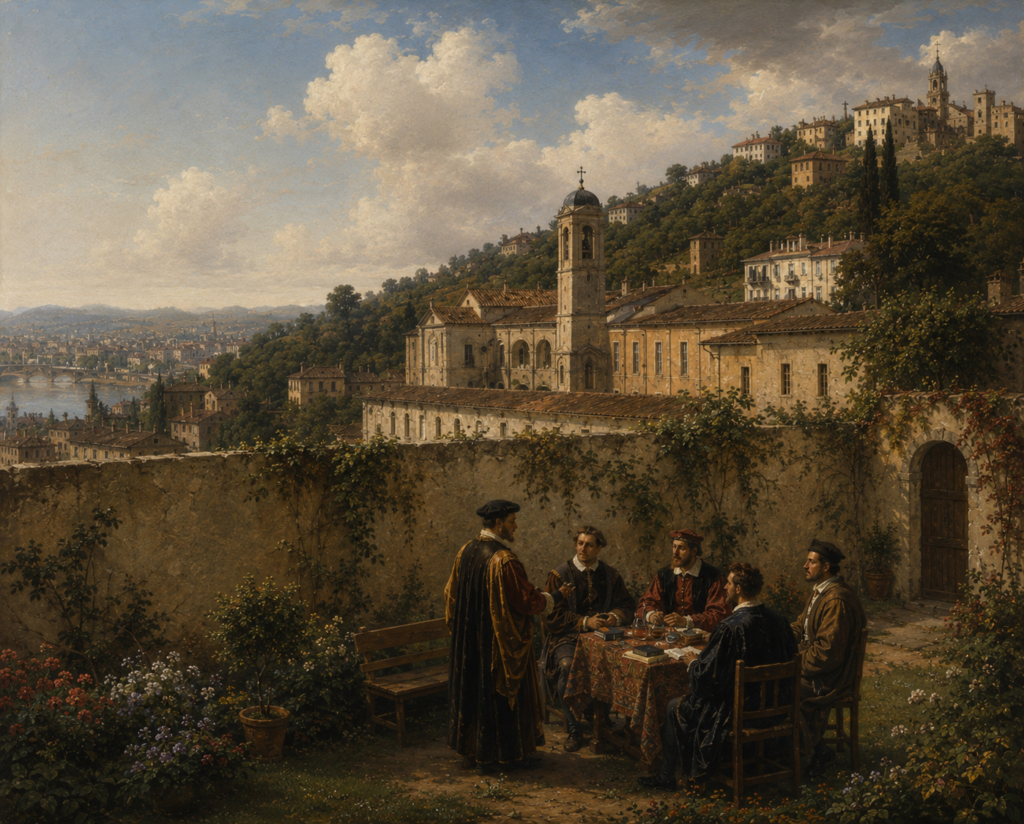
The location for this gathering was the private, walled garden of Hugues de Talaru, a wealthy cleric and Canon of the Cathedral of Saint-Jean. Talaru’s property sat on the lower slopes of the Fourvière hillside, elevated above the noise and dust of the crowded streets along the riverbank.
The Florentine Homage: Naming the Cénacle
The title “Academy of Fourvière” was likely an informal name and an inspired homage to the Florentine Academy, where Marsilio Ficino had introduced Neoplatonism. Ficino’s Latin translations of Plato had become a vanguard of European thought. By referring to their retreat as an “academy”, these free-thinkers saw themselves as a revival of the Careggi villa gatherings who sought to establish an outpost of Florentine free-thought in Lyon.
A letter written that year by the young humanist jurist Humbert Fournier records the identities of the five men who gathered together for that summer retreat:
- Humbert Fournier: The young legal scholar and poet who recorded the retreat.
- Symphorien Champier: The prominent Lyonnais physician, philosopher, and historian.
- Hugues de Talaru: The cathedral canon who provided the private sanctuary.
- Jean Perréal: The royal court painter and architect fascinated by classical structure.
- Pierre de Villeneuve: A humanist scholar and close literary associate of the group.
Fournier’s letter details that this gathering functioned as an exclusive social circle dedicated to leisure and camaraderie as opposed to a rigid, formal institution. They spent their summer days hosting dinner parties, staging amateur plays, singing Petrarchan sonnets, and sharing poetry.
An Intellectual Shield
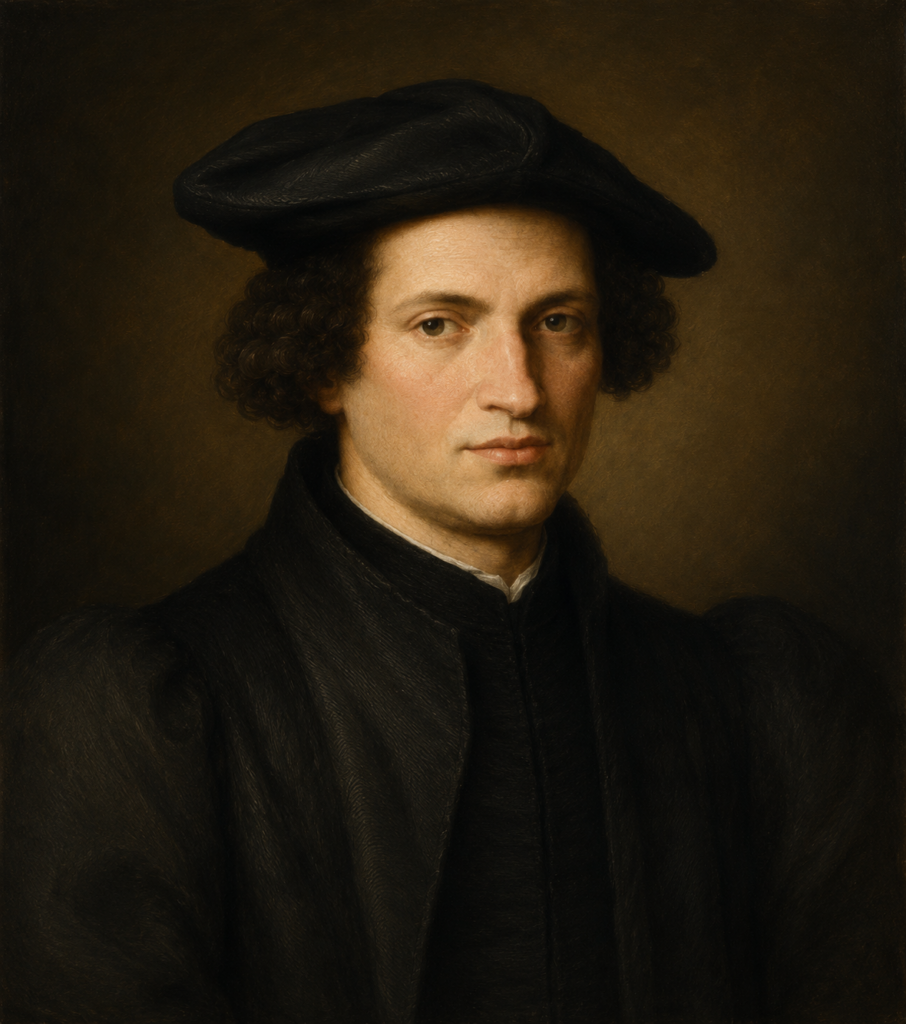
The “Academy of Fourvière” was a private gathering where these men could freely express themselves without inhibition. To justify their physical and emotional intimacy, Symphorien Champier deployed Ficino’s concept of Amor Platonicus, a philosophical doctrine built on the idealization of same-sex desire and male bonding.
By expressing their intimate friendships, shared poetry, and classical study as a Neoplatonic endeavor, they constructed an intellectual shield. It was a clever way to outsmart the bigotry of their era, protecting themselves from a society that might have otherwise accused them of heresy or sodomy. This gathering only lasted for one summer season.
The Proto-Salon: Marie-Catherine de Pierrevive (1520s–1530s)
The Villa du Perron
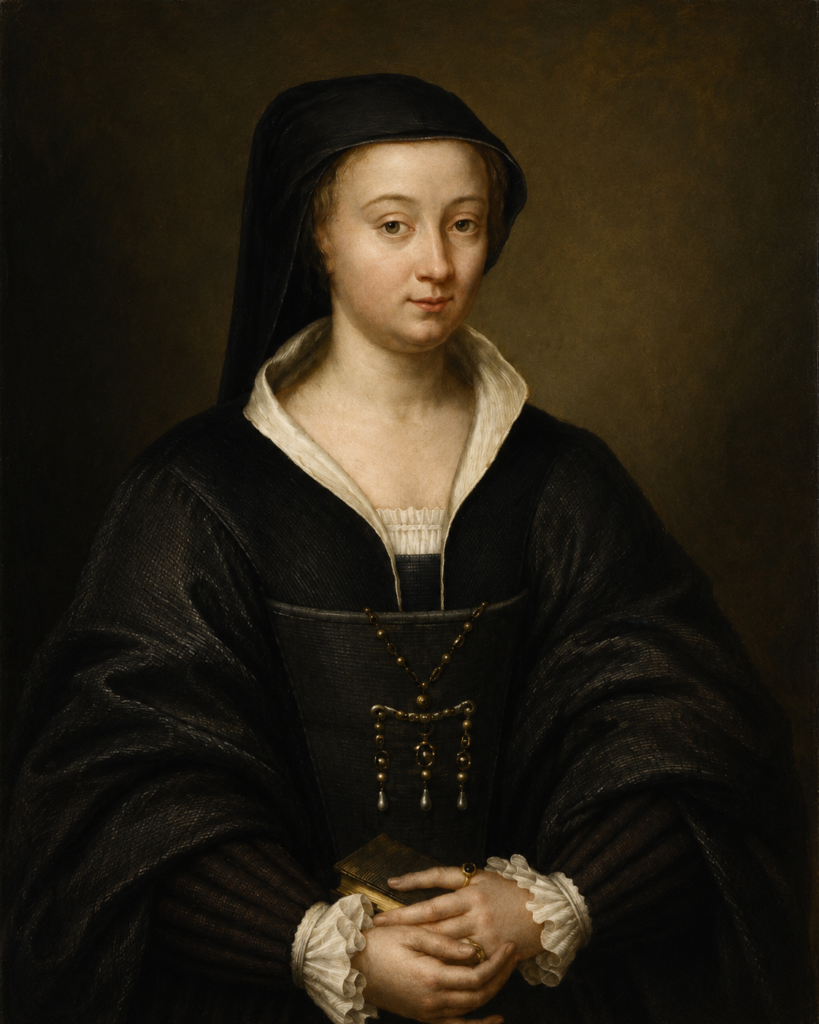
As the intellectual landscape shifted into the 1520s and 1530s, the center of Lyon’s free-thinking culture moved just beyond the city walls to the Villa du Perron in Oullins. This estate was bought in 1521 by a wealthy Florentine banker named Antonio Gondi and his prominent Lyonnese wife, Marie-Catherine de Pierrevive. Funded by Italian banking fortunes and hidden away from the city authorities, the villa became a hotspot of intellectual and social recreation.
Smashing the Printing-Press Conspiracy
Some fringe writers like to claim that these gatherings were an underground network of printing-press conspirators operating a shadow courier guild under the cover of secret ciphers and mysterious ceremonies. The reality is far more pragmatic. The famous local printers of the era, like Sébastien Gryphe, were hard-nosed, merchants focused on profit margins and paper costs. Gryphe’s griffin logo was a visual business brand based on a pun on his German birth name, Greyff. The printing shops were coarse and grueling commercial endeavors, entirely separate from the aristocratic, courtly leisure of the Gondi estate.
The Salon: Structured Wit and Courtly Play
These lively parties transformed parlor games into sharp intellectual discourse directed by educated women. The guests engaged in a sophisticated form of imaginative roleplay:
- The Questions of Love (Questions d’amour): Guests staged competitive, witty debates over the morals and psychological paradoxes of desire.
- Intellectual Personas: Participants routinely assumed classical or allegorical pseudonyms, interacting with each other under hidden literary identities.
- Improvisational Contests: Guests were challenged to craft impromptu, highly structured speeches or epigrams on random objects or abstract virtues.
- Poetry Duels: The circle collectively composed verses, taking turns building upon a single poetic line, directly fueling the competitive output of the burgeoning Lyonnese school of poetry.
The Inner Circle
Because these gatherings occurred before anyone recorded their guest lists, the social network had to be reconstructed through printing dedications and contemporary testimonies. Chief among these was the poet and musician Eustorg de Beaulieu, whose praise of Pierrevive’s generosity celebrated her home as a “temple of science and wit.” The known regulars who frequented this sanctuary formed the cutting edge of the French Renaissance:
- Marie-Catherine de Pierrevive (Gondi): The central patron and host who would later become a powerful confidante to Queen Catherine de’ Medici.
- Maurice Scève: The leader of the Lyon school of poetry and author of Délie, who was a permanent fixture of the household.
- Clément Marot & Bonaventure Des Périers: Celebrated court poets, storytellers, and prominent skeptics who found intellectual sanctuary on the estate.
- Eustorg de Beaulieu: The poet-musician and regular guest who documented the household’s intellectual brilliance and immortalized the salon in his verses.
- François Rabelais: The legendary satirist and physician who lived in Lyon from 1532 to 1535. Rabelais was close with Scève and Marot, and he explicitly dedicated his 1532 medical translation of Giovanni Manardi to the master of the house, Antonio Gondi.
- Étienne Dolet: The radical scholar and translator who championed vernacular literature within the circle before his eventual execution for heresy.
The Need for Protection
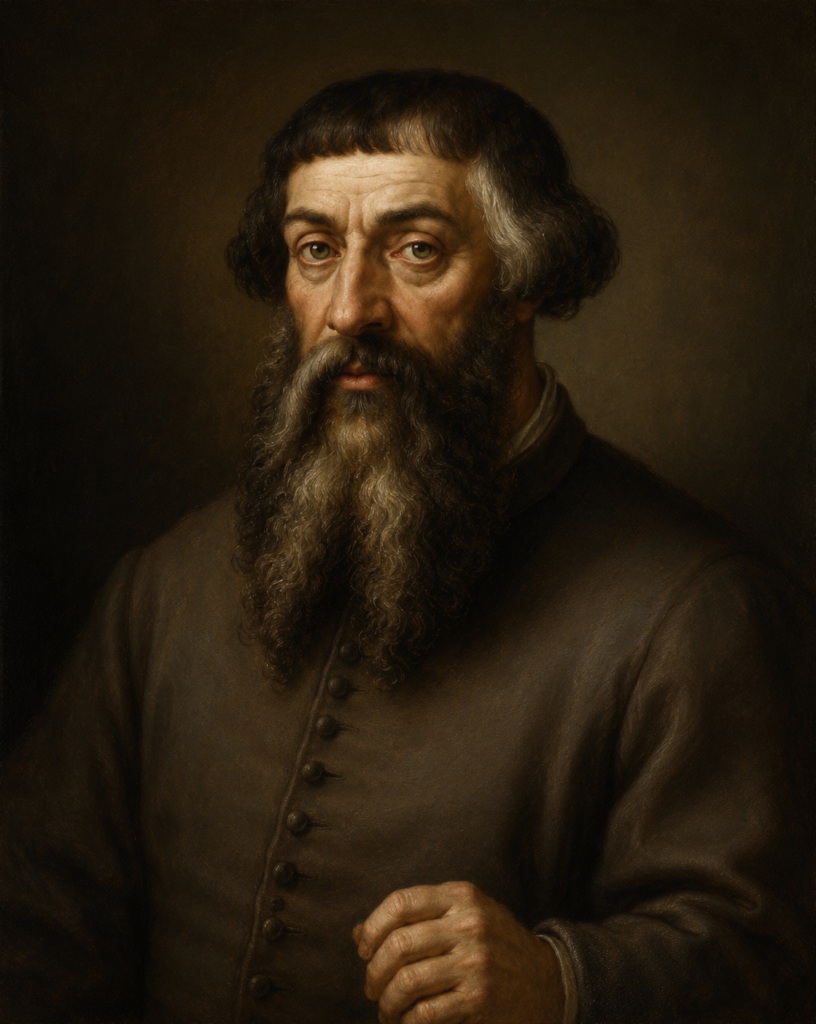
This informal network existed as a critical mechanism for safety and survival. Free-thinkers like Étienne Dolet and François Rabelais worked under the permanent glare of Church inquisitors. Dolet would ultimately be burned at the stake in Paris for his theological transgressions, while Rabelais had to repeatedly flee his medical posts and publish under pseudonyms to avoid a similar fate to his late friend.
The Villa du Perron functioned as a sanctuary of aristocratic protection. By participating in the stylized, playful games of the Gondi estate, writers and artists secured the political cover of powerful patrons. They used the courtly aesthetic of Italian humanism as armor, shielding dissent behind a veneer of sharp wit.
The Print House as an Intelligence Network (1530s)
To understand the role of a master printer like Sébastien Gryphius, we must look past the books and look at the real socio-economic power of his print shop. By the 1530s, the master printers held a certain kind of monopoly on information.
A Renaissance printing house was a complex, self-contained cultural institution. Operating a press required a massive aggregation of specialized capital and human labor. This included all manner of scribes and translators fluent in Greek, Latin, and Hebrew who prepared the copy, alongside illustrators, woodprint masters, font-makers, and punch-cutters who engineered the physical layouts.
Because printing a full edition was a laborious and expensive economic gamble, the master printer held considerable power within the intellectual marketplace. Gryphius and his peers were often the ones who made the decisions as to which manuscripts were worth submitting for royal approval, being printed covertly or never seeing print at all.
Since these printing houses sat at the crossroads of European trade, their translators were often the very first to intercept newly discovered manuscripts arriving from Italy, the Levant, or the German states. The master printers frequently possessed certain types of information before the royal houses of Europe, the Catholic Church, and the Sorbonne. They were a functioning network of intellectual illumination, often moving faster and knowing more than the powers who claimed to rule them.
The Worker Class: The Clandestine Union of the “Griffarins”
The Underground Reality of the Shops
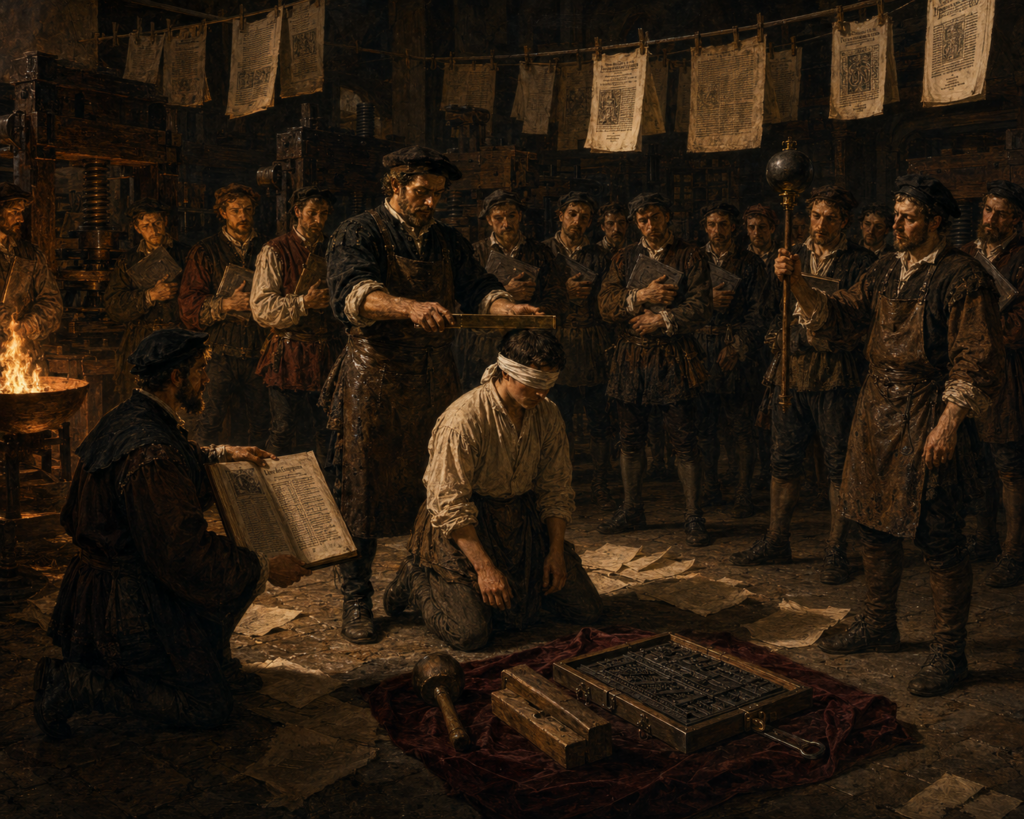
A genuine, highly disciplined secret society actually DID operate directly inside Sébastien Gryphe’s shop and across the printing houses of Lyon and Paris. This underground network belonged to the print-shop journeymen. As historian Natalie Zemon Davis documents in her studies on early modern labor, organized worker assemblies and mutual-aid brotherhoods were strictly illegal under the French crown. To survive and bypass royal prohibitions, the printing laborers formed a fierce, surreptitious union known as the Griffarins.
The Apprenticeship Pipeline and Union Power
The craft of printing was passed down exclusively through a brutal, multi-year apprenticeship system. Because the specialized technical knowledge of the presses couldn’t be acquired in any other way, the master printers and journeymen held a monopoly on the labor supply. The Griffarins leveraged this monopoly by controlling who entered the shops and who learned the trade. They maintained their secrecy as well as a stranglehold on the production capacity of Lyon’s entire mercantile print industry.
The Real Secret Society
The Griffarins functioned as a mutual-support network designed solely for the economic security of its members. They guarded their trade secrets and enforced solidarity through traditional clandestine practices:
- Initiation Rituals: New journeymen underwent initiation rites to swear allegiance to the brotherhood.
- Secret Grips and Passwords: Members used specific handshakes and passwords to identify fellow union brothers across the numerous workshops.
- Verification of Rank: Possession of these secret signs allowed a transient worker to instantly prove his skill rank and union status to a shop foreman, managing wage expectations and preventing the hiring of uninitiated, low-wage scabs.
Well before the invention of modern fraternal orders like Freemasonry or the Rosicrucians, these 16th-century workers ran a highly effective, real-world underground. They used rituals and secrets to protect their livelihoods, control their wages, and strike against their employers.
The Grand Tric of 1539
The Tipping Point: Class Warfare at the Table
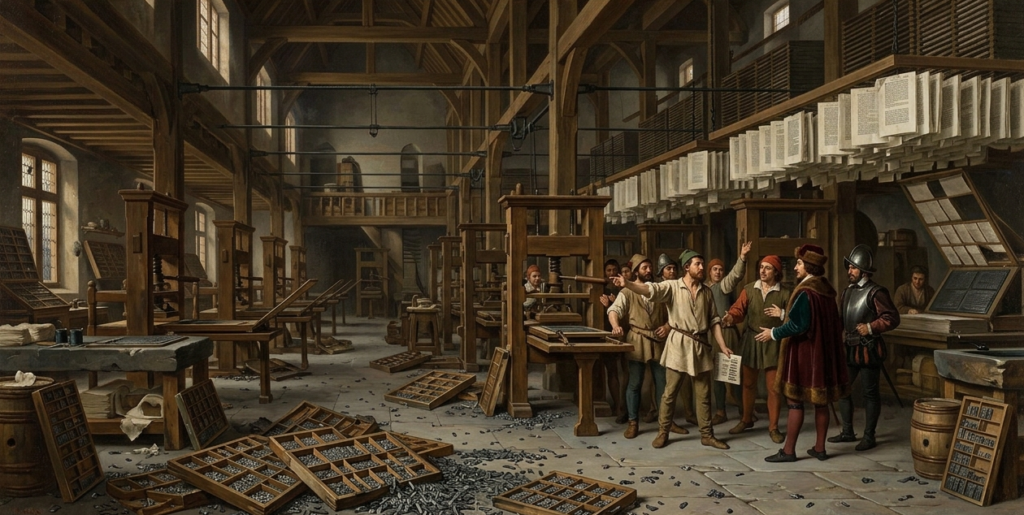
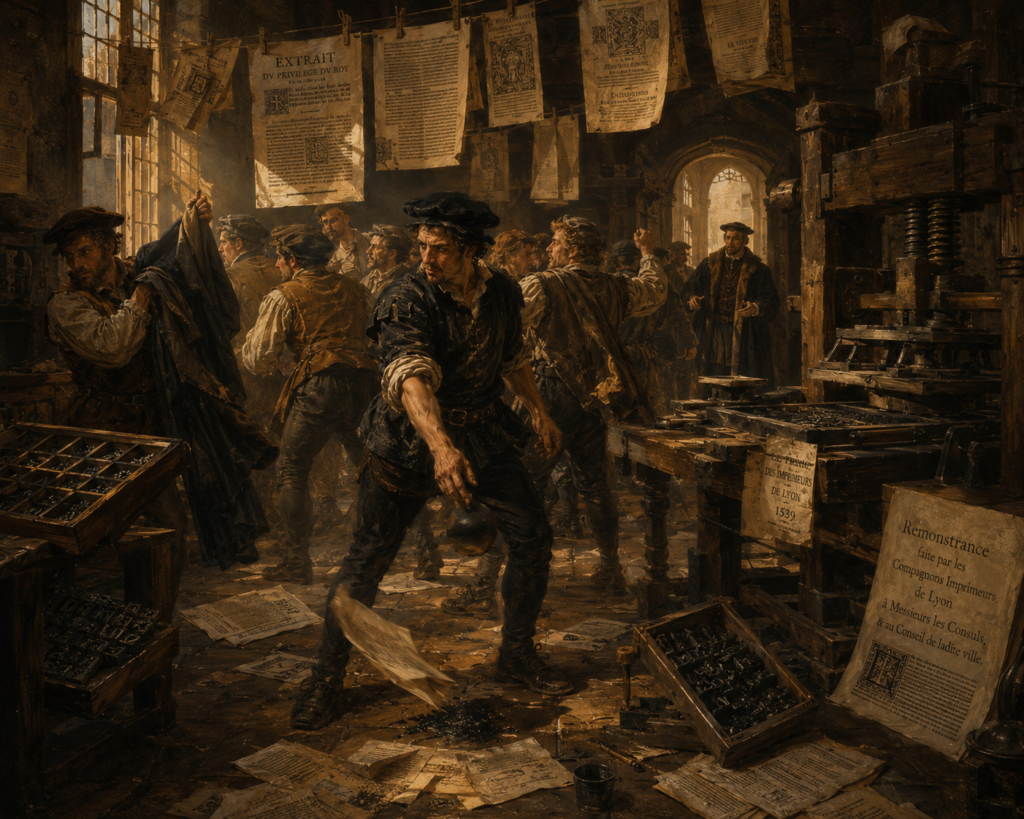
In the spring of 1539, the Griffarins launched the Grand Tric, one of the earliest major organized labor strikes in European printing history. While the masters’ abrupt decision to end communal meals provided the immediate spark, the revolt grew out of a deeper accumulation of grievances that had been building for years.
Traditionally, masters and journeymen had eaten together at the same table—“pain, vin et pitance.” Over these shared meals, the journeymen could look their employers in the eye, discuss daily workshop issues, push for better working conditions, and defend their worth during a time of economic inflation. When the masters unilaterally abolished the practice to reduce costs and harden class distinctions, the journeymen saw it as a direct attack on both their dignity and their established customs.
The Griffarins also opposed the masters’ efforts to flood the shops with undertrained apprentices who undercut journeymen wages, the lengthening of working hours, and stagnant pay despite the workers’ high skill and the industry’s profitability. Having already built a disciplined underground network capable of rapid coordination across Lyon’s printing houses, the journeymen responded with a mass walkout on April 25, 1539.
The Four-Month Paralysis and the Two-Year War
The Griffarins paralyzed Lyon’s printing houses for four straight months. Presses fell silent, book production halted, and the international trade in printed works was disrupted.
This initial shutdown was just the opening salvo. Sporadic actions and renewed tensions continued over the next two years as the masters resisted concessions. Using their tight organization, the journeymen coordinated walkouts, intimidated strikebreakers, and disrupted operations in the merchant quarters.
The Letters Patent of Fontainebleau: Breaking the Back of Labor
The prolonged conflict forced royal intervention. On December 28, 1541, King Francis I issued stricter Letters Patent from Fontainebleau. The decree outlawed the Griffarins’ assemblies and associations, imposed severe penalties for striking, and reinforced the masters’ authority. Some immediate concessions on food provisions were granted under pressure, but the crown’s ruling ultimately favored the masters and dealt a serious blow to organized labor.
The Bottom Line
There were plenty of secrets in the printing houses of Lyon, but they had absolutely nothing to do with occult orders or hidden lineages. The masters kept secrets to protect their profits, and the workers kept secrets to avoid the gallows. Fringe writers who wrap this history in a mystical cloak dismiss a real struggle for decent wages and dignity inside a gritty and cutthroat industry. A secret handshake in a 1530s print shop was simply a gesture intended to stop a scab from stealing a journeyman’s wages.
The Hypnerotomachia Poliphili: Intellectual Status Symbol or Occult Gospel?
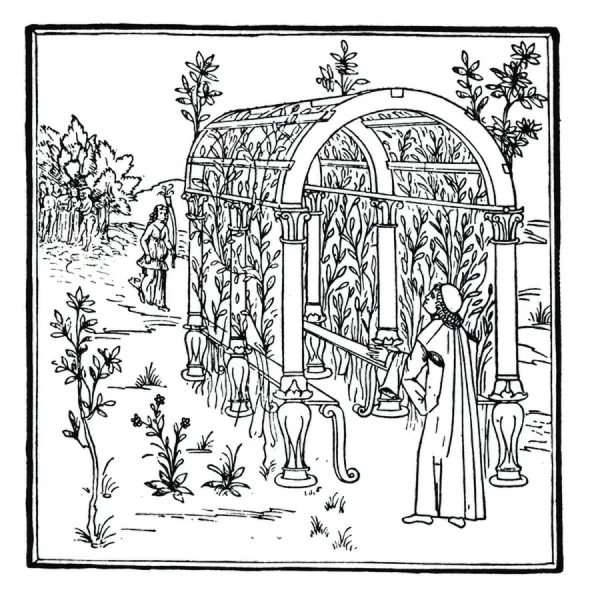
In the attempt to construct a formal philosophical foundation for his imaginary secret society, Michel Lamy devotes several pages of The Secret Message of Jules Verne to canonizing Francesco Colonna’s enigmatic 1499 Venetian book, the Hypnerotomachia Poliphili (The Strife of Love in a Dream). To Lamy, this dense, woodcut-laden romance was the literal breviary of his Société Angélique, a sacred text protected and decrypted only by an initiated printing elite.
Lamy’s error is a common one found in alternative history: he mistakes a widespread, high-society cultural trend for a specific, localized conspiracy. The Hypnerotomachia was indeed a prominent topic of discussion among Lyon’s literati for decades, but it was a public literary phenomenon. It was the Renaissance equivalent of an expensive, highly fashionable coffee-table book, an intellectual status symbol for the affluent.
When we track the book’s documented footprint in Lyon, we see a natural, decades-long evolution of humanist appreciation, entirely independent of a fictional secret society. Furthermore, we see how easily alternative historians read deep, conspiratorial intent into casual literary choices.
An Architectural Curiosity
The local fascination with the Hypnerotomachia might have well begun with the informal summer retreat on the Fourvière hillside. Symphorien Champier is thought to have already been deeply immersed in the text’s Neoplatonic allegories. As early as 1503, Champier had published La Nef des dames vertueuses, adapting the Italian masterpiece’s allegorical structures and themes of divine love to his own work.
For the five men sharing the Summer of 1506: a group that included the royal painter and architect Jean Perréal, the original 1499 Venetian edition would have been seen as an exotic visual masterpiece. They would have treated the book as an aesthetic meditation, contemplating its famous woodcuts and debating its classical architecture.
Rabelais, Satire, and the Trap of Over-Reading
By the 1530s, the text had found its way into the urban printing hub, where it was read, mined, and satirized. François Rabelais explicitly named the book in his 1534 edition of Gargantua, printed in Lyon by François Juste.
Lamy claims the book’s codes were tightly guarded secrets, but Rabelais treats them with casual familiarity. In Chapter 9 of Gargantua, he openly references Polyphilus, in his Dream of Love during a discussion about Egyptian hieroglyphics and color symbolism.
Typographic Codes vs. Professional Practice
Esoteric writers often interpret early modern printing anomalies as evidence of a hidden, coded language. 16th-century printers did use specialized marks, printer emblems, as well as the occasional cryptographic cipher, but these usually served practical, commercial functions. They protected intellectual property against rampant piracy, authenticated official editions, and managed complex pagination systems. Errata sheets and unusual typesetting were outcomes of rapid manual production and the limitations of physical lead type, rather than an intentional, hidden language imagined by Grasset d’Orcet.
The Shift to Mainstream Print
The definitive proof that the book was a public literary phenomenon as opposed to a secret text came in the 1540s. An anonymous, rough French translation of the original 1499 edition began circulating in manuscript form. The celebrated translator Jean Martin took this raw draft, revised it, and smoothed out the language for the press. The humanist Jacques Gohory collaborated on the project, composing intricate prefaces and commentaries for the text.
This collaboration culminated in the beautifully illustrated 1546 public French edition, Discours du songe de Poliphile, published in Paris by the printer Jacques Kerver.
This wide-scale commercial release undermines the conspiracy narrative. If the text were a closely guarded secret manual for an elite, typographic cabal run by Sébastien Gryphe in Lyon, translating it into the common vernacular, adding public commentary, and selling it on the open Parisian market would have been a fundamental failure of their raison d’etre.
Using 16th-century books to pass codes would be incredibly laborious, slow, and inefficient. They would have just written letters.
The Société Angélique: The Antiquarian Elite (Post-1570s)
To find the true origin of the phrase Société Angélique, our narrative must return to the Fourvière hillside, skipping forward several decades into the late 16th century. By this era, the free-thinkers of 1506 and the proto-salon of the 1530s existed only as memories. Lyon had moved on, and a new circle took to the hill with a completely different agenda.
The Crest of Lugdunum
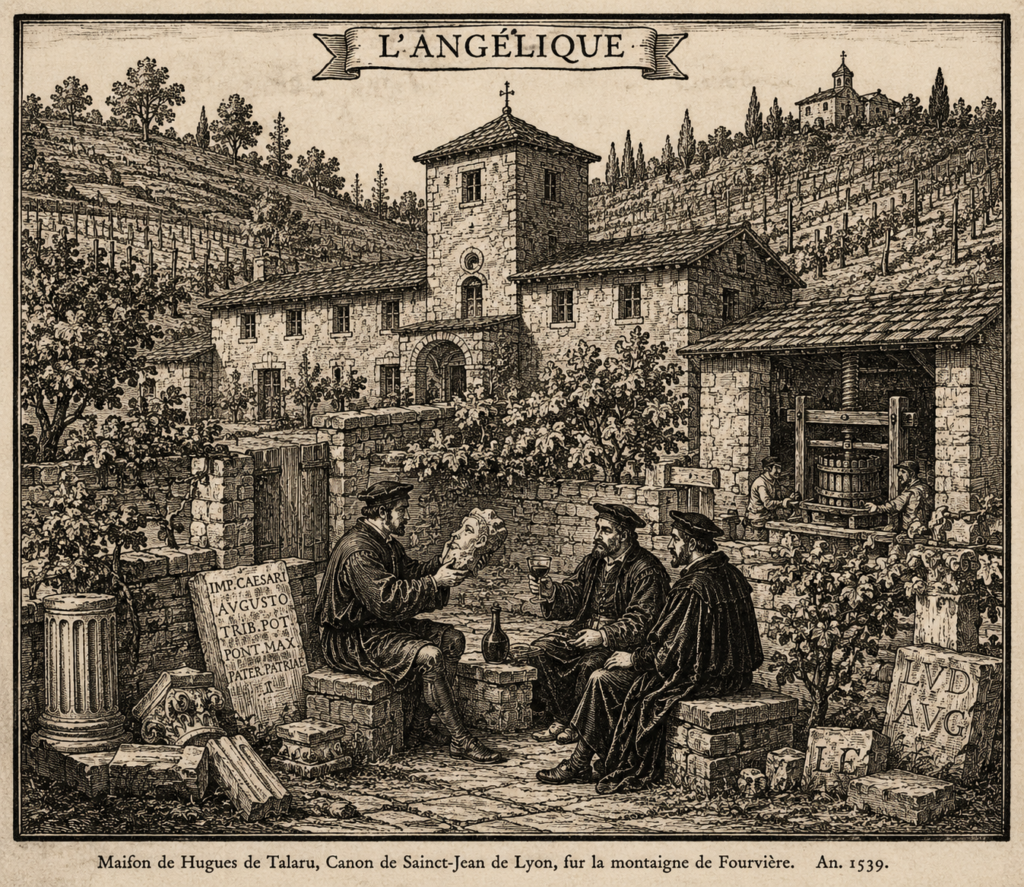
Nicolas de Lange, a wealthy royal magistrate, established his hilltop estate through a series of land acquisitions between 1552 and 1558. He compiled the property by buying up a rugged hillside vineyard, a small house from a local feather merchant, and an attached plot from a royal armor-maker.
This estate sat further up the hill than Hugues de Talaru’s 1506 walled garden. De Lange had purchased land directly on the crest of the ancient Roman forum, Forum Vetus, which local vernacular had corrupted over time into the name Fourvière. Because the property sat on the buried heart of ancient imperial Lugdunum, clearing the vineyard meant digging straight into major, monumental Roman ruins. At the time of purchase, the official municipal deeds recorded the site by its true previous name: La Crocte Ronde (The Round Crypt).
The Roman Foundations of their Judicial Power
Unlike the rogue poets or radical printers of the past, the group that gathered at de Lange’s estate appears to have been composed entirely of the late-Renaissance legal, judicial, and diplomatic elite:
- Nicolas de Langes: Premier president of the Parliament of Dombes and King’s counselor.
- Pomponne de Bellièvre: De Lange’s maternal uncle, a towering diplomatic figure and future Chancellor of France.
- High-Status Jurisconsults: Royal judges and magistrates who held immense legal power in the region.
Antiquarian Focus and Decline
The aim of these men was antiquarian research and collection. De Lange and his peers excavated Roman tablets, altars, and medals directly from his land. They invited international scholars, such as Jean-Jacques Boissard, to study these classical inscriptions. This informal antiquarian association was tied directly to the lifetime of Nicolas de Lange. Following his death in 1606, the systematic excavations ceased, the gathering of magistrates dissolved, and the property transitioned through various private owners. The group left behind a legacy of early archaeological documentation, but the project was discontinued after his death.
Dismantling the Mythic Palace
The designation L’Angélique emerged later as a local double pun referencing Nicolas de Lange’s surname, his scholarly reputation, and the highly prized botanical collection of Angelica (Angelica archangelica) that he cultivated in his hilltop garden.
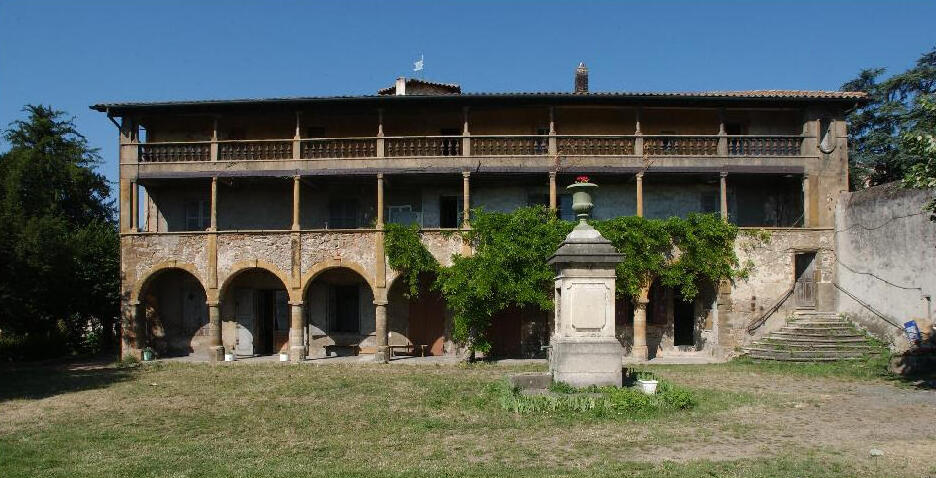
The grand, palatial structures imagined by alternative historians vanishes when confronted with the actual archives. In a definitive study, historian E. Vial analyzed the legal 1669 inventory compiled when the estate was sold to the Mascrany family. The property deeds officially recorded that the house was a rustic, four-room farmhouse containing worn, cheap furniture (un pauvre mobilier “my uze”).
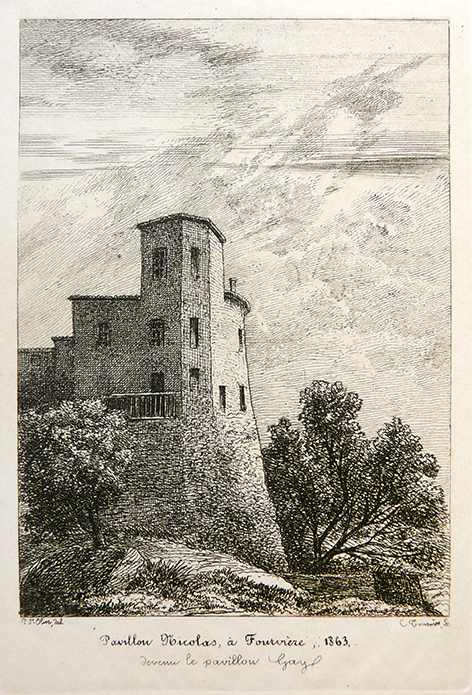
The building was meant to shelter a tenant winemaker (vigneron) and his tools, containing a standard wine cellar and an agricultural grape press. It was an unlikely candidate to be the heart of some sweeping intellectual or esoteric, global cabal. The massive, barrel-vaulted Roman rooms beneath the dirt were structurally identified by archaeologists as heavy foundation vaults (voûtes de soutènement) built to hold up the weight of the public Roman offices that once stood above them.
A 19th-Century Amusement Park
The ultimate fate of the site exposes the absurdity of the occult myths that have grown up around it. In 1861, the property was purchased by a tulle merchant named Pierre Gay who turned the lower gardens into a pay-to-enter public amusement park called the Passage Gay.
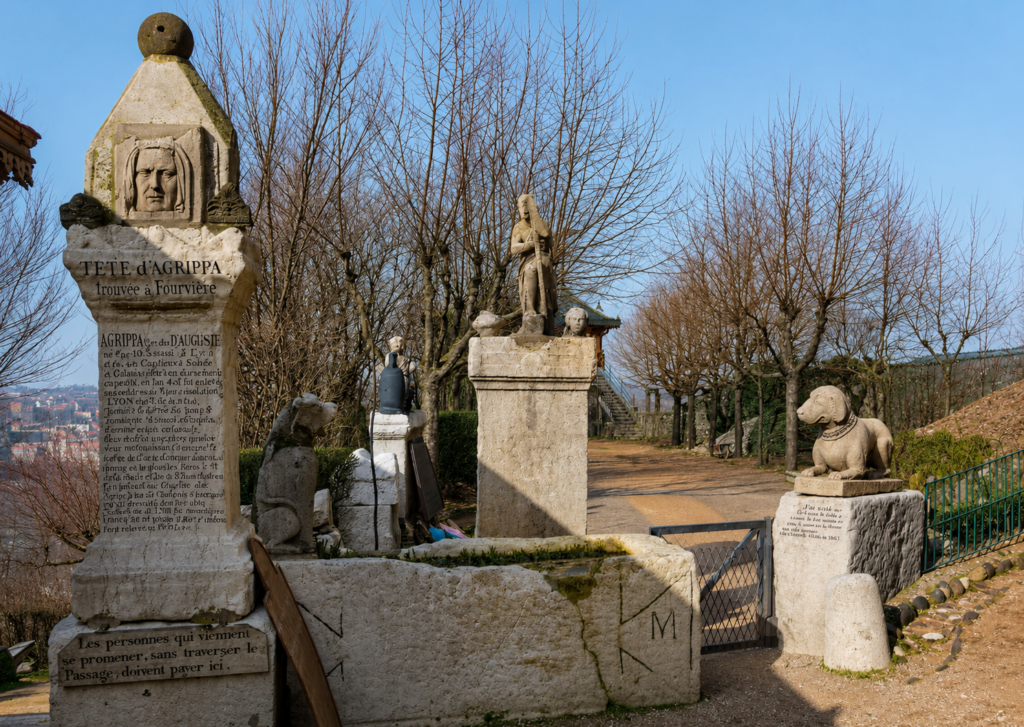
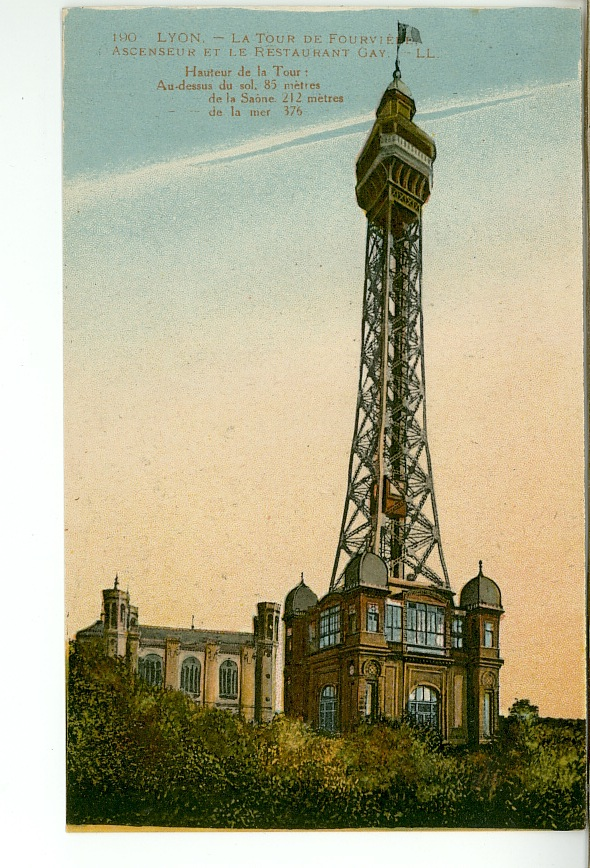
He leased de Lange’s old four-room winemaker’s house to a chef named Moret, who transformed it into an inn and tourist restaurant catering to the pilgrims visiting the nearby Fourvière church. To draw in crowds during the 1872 Lyon Universal Exposition, a whimsical Chinese-style bell tower was added to the terrace. By 1894, Gay’s son constructed a massive metallic tower as a miniature replica of the Eiffel Tower, directly next to the old house to maximize tourist revenue.
Nicolas de Lange’s modest vineyard home underwent a complete retrospective inflation. Occult writers like Lamy looked at a site that transitioned from a simple four-room winemaker’s shed to a 19th-century tourist trap with a French restaurant and a Chinese bell tower, and somehow mistook that for a sacred, unbroken tradition of esoteric illumination.
How the Myth Was Born: The Mechanics of Conflation
The invention of this esoteric mirage occurred in three distinct stages over three centuries:
Stage 1: The Jesuit Blunder (1728)
The patient zero of the myth was the Jesuit historian Father Dominique de Colonia. Writing his local history of Lyon in 1728, Colonia panicked at the lack of formalized, continuous academic institutions in early Renaissance Lyon. To manufacture civic prestige, he committed a major historiographical blunder: he took Humbert Fournier’s 1506 Latin letter describing the brief, lower-slope fraternal respite and haphazardly mapped it onto Nicolas de Lange’s 1570s archaeological estate further up the hill. Colonia claimed that a single, formal, and continuous institution, the “Société Angélique or Academy of Fourvière,” had existed uninterrupted since the turn of the 16th century.
Stage 2: The French Occult Leap (1880s)
A century later, Colonia’s unified timeline fell into the hands of the eccentric 19th-century French writer and cryptologist Claude-Sosthène Grasset d’Orcet. Noticing the library footnotes citing the Jesuit historian, d’Orcet executed a bizarre display of phonetic wordplay. Instead of viewing the two names as a coincidence, he used his custom method of phonetic puns, what he termed the ‘langue verte,’ to actively conflate Dominique de Colonia’s name with Francesco Colonna. d’Orcet argued that these shared linguistic roots were deeply woven, intentional esoteric calling cards, linking the 16th-century Lyonnais humanist cénacles back to the hidden typographical codes of the 1499 Venetian romance.
From this linguistic slip, d’Orcet claimed the hill was home to a prehistoric secret network that used typographic book ciphers called la langue des oiseaux (language of the birds) to pass down secret messages. This formed part of d’Orcet’s broader project on French folklore, where he attempted to read hidden political alignments into classical typography and regional architecture.
The enduring power of this historical confusion remains embedded in modern institutional curation. The historical data sheets published by Lyon’s own Musée d’Histoire de Lyon (Musée Gadagne) assert that the early 16th-century Academy of Fourvière met at the ‘Maison de l’Angélique’ alongside poets like Louise Labé and Pernette du Guillet.
This official narrative collapses under basic chronological scrutiny. Nicolas de Lange consolidated the Angélique estate in the mid-1550s, and Labé was born nearly two decades after the initial 1506 retreat. The modern museum has uncritically inherited Colonia’s compressed timeline, conflating distinct generations of fraternal circles, urban literary salons, and late-century legal antiquarians into a single monolithic entity.
Stage 3: The Unified Grand Conspiracy (1984)
This trajectory culminated with Michel Lamy. In The Secret Message of Jules Verne, Lamy treated Grasset d’Orcet’s phonetic fantasies as historical gospel. Lamy took Colonia’s smashed timeline and d’Orcet’s cryptographic codes and supercharged them into a very modern & very flawed alternative-history.
He claimed that the master printer Sébastien Gryphe created this formal cryptographic lodge, a narrative that breaks down against real-world timelines since Gryphe died before the L’Angélique estate was named or organized. Lamy forced this manufactured Lyon network into the modern alternative-history mythos, linking the Société Angélique to the mystery of Rennes-le-Château, the Rosicrucians, and so on. This synthesis helped to cultivate the groundwork for modern, Da Vinci Code-style thrillers that map monumental conspiracies onto ordinary municipal records.
Conclusion
When we strip away Lamy’s grand conspiracy, the illusion vanishes. The multi-century typographic conspiracy network is an absolute fiction.
The true history is human and grounded. By decoupling the timelines, we find a brief, protective haven for five friends in a 1506 walled garden, a vibrant 1530s urban salon serving to sharpen the wit of the local elite, and a late-century circle of legal magistrates digging up Roman ruins around a rustic, four-room farmhouse. The modern Société Angélique is an esoteric ghost birthed by 18th-century historians who misread dates, and supercharged by 19th-century occultists who mistook different groups of free-thinkers for a unified global conspiracy.
Sources and Further Reading:
- Besant, Walter. Rabelais. Edinburgh and London: William Blackwood and Sons, 1879. (The foundational English-language biographical study that popularized the literary footprint of the Lyonnese humanists.)
- Campbell, Julie. Women, Entertainment, and Precursors of the French Salon, 1532–1615. Electronic edition, 2024. (A critical modern study mapping the authentic social activities, parlor games, and courtly etiquette of early French precursors to the salon.)
- Christie, Richard Copley. Étienne Dolet: The Martyr of the Renaissance. London: Macmillan and Co., 1880. Christie’s rigorous biographical study serves as the primary foundational anchor for dismantling early academic myths. He systematically traces how casual summer letters between 16th-century humanists were misread by later historians.
- Colonia, Dominique de. Histoire littéraire de la Ville de Lyon, avec une Bibliothèque des Auteurs Lyonnois, sacrés et profanes, distribués par siècles. 2 vols. Lyon: François Rigollet, 1728–1730.
This original 18th-century compendium is the definitive starting point for the compressed timeline criticized in the article. Father Colonia, a Jesuit historian, was the first to explicitly weave disparate Renaissance figures like Sébastien Gryphius, Louise Labé, and the 1506 Fourvière companions into an interconnected, continuous timeline, laying the foundation for later occult interpretations. - Colonna, Francesco. Hypnerotomachia Poliphili: Ubi humana omnia non nisi somnium esse docet. Venice: Aldus Manutius, 1499. The primary Renaissance text central to late 19th- and 20th-century cryptographic fabrications. This rare, woodcut-heavy allegorical romance became an expensive collector’s item among the intellectual elite of Lyon, leading alternative historians to misidentify a widespread cultural trend as a coded manual for an unrecorded printer’s cabal.
- Crawford, Katherine. The Sexual Culture of the French Renaissance. Cambridge: Cambridge University Press, 2010. (An essential gender-history framework documenting the utilization of Neoplatonic models and same-sex intimacy among Renaissance intellectuals.)
- Davis, Natalie Zemon. Society and Culture in Early Modern France. Stanford: Stanford University Press, 1975. Davis’s groundbreaking social history provides crucial material realities regarding Lyon’s printing workshops. Her documentation of the clandestine journeymen printing brotherhoods separates real labor unions from alternative occult conspiracies.
- Fournier, Humbert. Humberti Fornerii Montorientis iurisconsulti et poetae Epistolarum et Carminum. Lyon, 1506. The primary historical text documenting the actual baseline reality of the “Academy of Fourvière.” Fournier’s literal summer letter records a casual, unstructured holiday retreat shared by five close companions (including Symphorien Champier and Jean Perréal), providing explicit proof that the gathering functioned as an informal social cénacle focused on poetry and leisure rather than a secret institution.
- Grasset d’Orcet, Claude-Sosthène. “Souvenirs de la Société Angélique.” La Revue Britannique, 1880. (The eccentric journalistic essays that birthed “Le Brouillard” and the typographic cipher theories.)
- Lamy, Michel. The Secret Message of Jules Verne: Decoding His Masonic, Rosicrucian and Occult Writings. Rochester: Destiny Books, 2007.
This modern esoteric text functions as the primary catalyst for the multi-generational Société Angélique mythos. It demonstrates how late-19th-century phonetic cryptology is adopted into contemporary alternative histories. - “L’édifice antique de l’Angélique à Lyon.” Revue archéologique de l’Est. Last modified April 15, 2024.
A comprehensive architectural and geographic profile detailing the physical evolution of the Fourvière hillside site. This resource utilizes archaeological excavation data and the 1669 property inventories of Nicolas de Langes’s villa to definitively chart how the property transitioned from a simple four-room vineyard farm into the 19th-century commercial Passage Gay. - “Marie Catherine de Pierrevive.” Vincentian Encyclopedia. Last modified July 11, 2023. https://wiki.famvin.org/en/Marie_Catherine_de_Pierrevive.
This specialized digital entry chronicles the biographical footprint and cultural impact of Marie-Catherine de Pierrevive. It contextualizes her 1530s estate at Oullins as an open, public crossroads for Parisian and Italian humanists, tracking her transition from an influential salonnière to a prominent court figure under the House of Savoy.